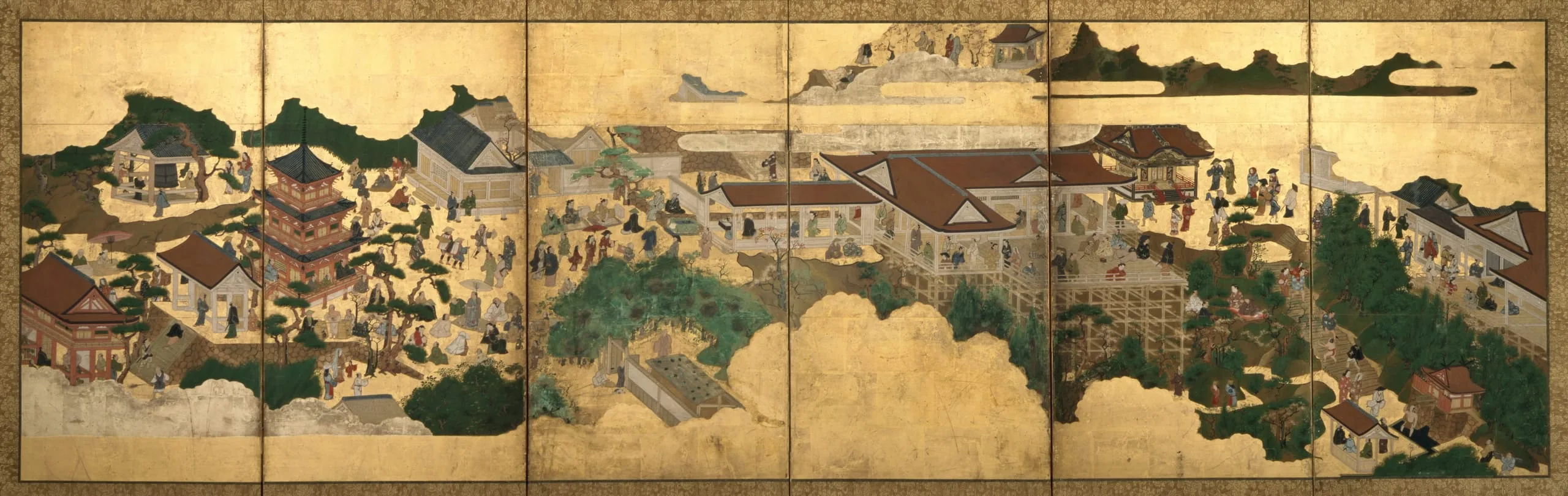
An important category of Japanese genre painting emerged in the sixteenth century called rakuchū rakugaizu (scenes in and around the capital), depicting locations in the imperial city of Kyoto. Arrayed from right to left across two large six-panel screens, these bird’s-eye panoramic views typically feature, on the right screen, scenes of spring and summer in the eastern hills and southern Kyoto, and, on the left screen, autumn and winter in the western hills and northern Kyoto. In the seventeenth century, a subset of rakuchū rakugaizu focused on specific renowned sites, in this case the Kiyomizudera (Temple of Clear Water), situated on a hill in eastern Kyoto. Founded in 778, the temple complex encompasses a gate with protective deity sculptures, a bell tower, a pagoda, a sacred waterfall (the Otowa), numerous subtemples, and, most distinctively, a main hall, one end of which is cantilevered out over a cliff supported by a massive structure of wood posts and crossbeams. The hall’s spacious veranda affords stunning views of the city. Here, every significant building is illustrated in an accurate topological sequence, interspersed with scenes of pilgrims and sellers of tea and refreshments. With their images of townspeople at work and leisure, rakuchū rakugaizu, which remained popular through the eighteenth century, provide vital documentation of everyday life in Kyoto.