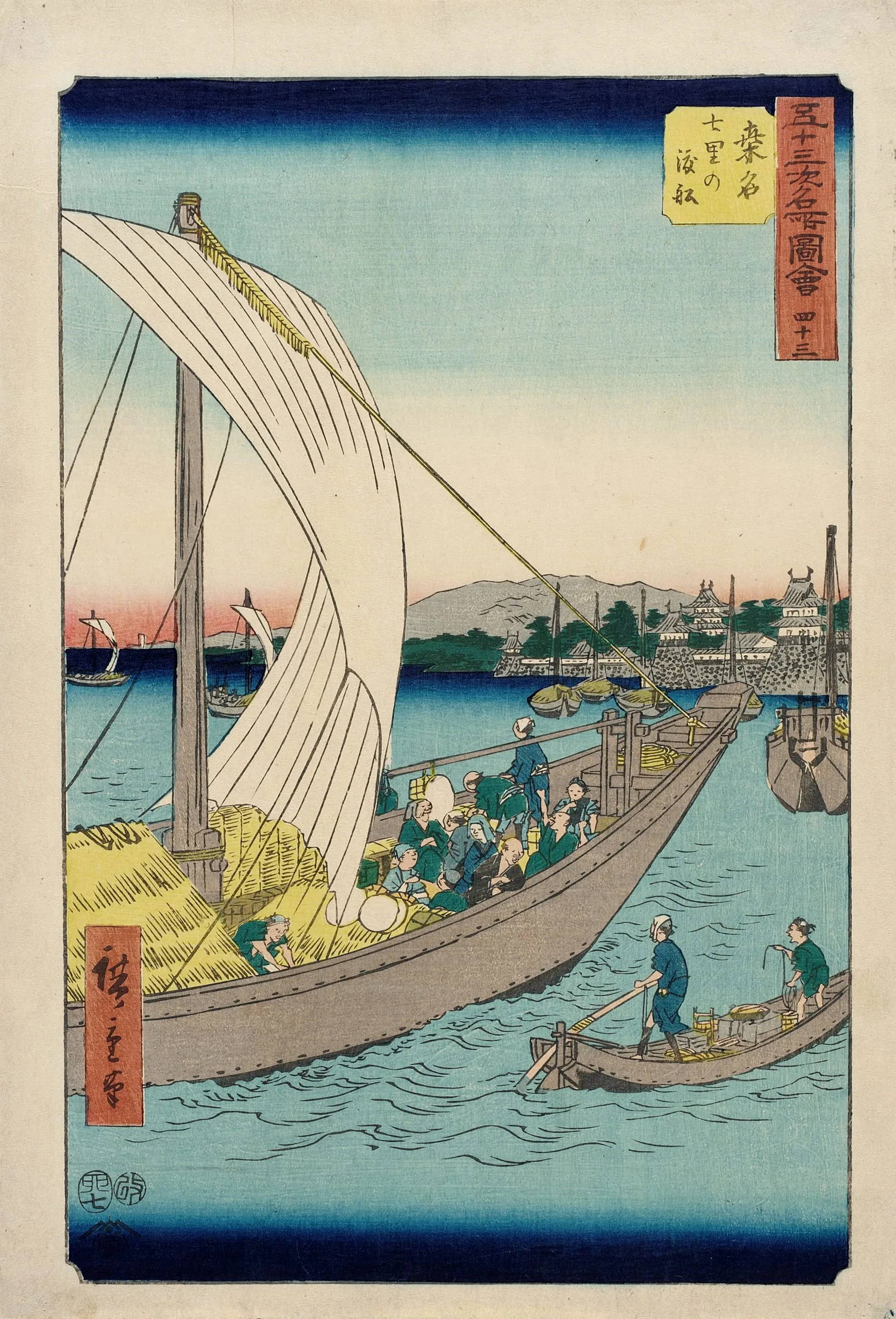
The bustling port town of Kuwana was a station on the Tōkaidō, or Eastern Sea Road. One of five major roads radiating from Edo (present-day Tokyo), it was the main route connecting the shogun’s capital with Kyoto, the imperial capital. Over 300 miles long, it roughly followed the eastern coast of Honshu and was traveled by commoners, samurai, daimyō and their retainers, itinerant entertainers and laborers, and many porters. The sometimes narrow passage and steep terrain made it difficult for wheeled vehicles (see M.73.37.594), so most traffic was on foot or on horseback. Along the Tōkaidō were fifty-three towns where travelers could find food, lodging, and souvenirs (omiyage). Between Kuwana and Miya (the 42nd and 41st stations), the road crossed a number of rivers that converged at Ise Bay. None of the rivers had bridges so, as shown here, travelers would board ferries to sail the approximately 16.5 miles to the far side of the bay. The large stone buildings in the background are the towers of Kuwana Castle, which was built in the early seventeenth century.
Hiroshige’s first designs of the Tōkaidō were published between 1833 and 1834 in a series of fifty-five prints titled Tōkaidō gojūsantsuge no uchi (Fifty-three Stations of the Tōkaidō). The prints depict each station plus the road’s starting point in Edo (Nihonbashi) and terminus in Kyoto (Sanjō Ōhashi). The artist is said to have traveled the road’s length in 1832, and it is presumed that the prints are based on both his own sketches and images from printed travel guides (meisho zue). Following his first exploration of the theme in the 1830s, Hiroshige continued to design more sets and individual prints of views along the Tōkaidō. The last set, produced in 1855, is titled Gojūsan tsugi meisho zue (Famous Sights of the Fifty-three Stations). LACMA’s print is from this set, which is commonly known as the Vertical Tōkaidō.
2024