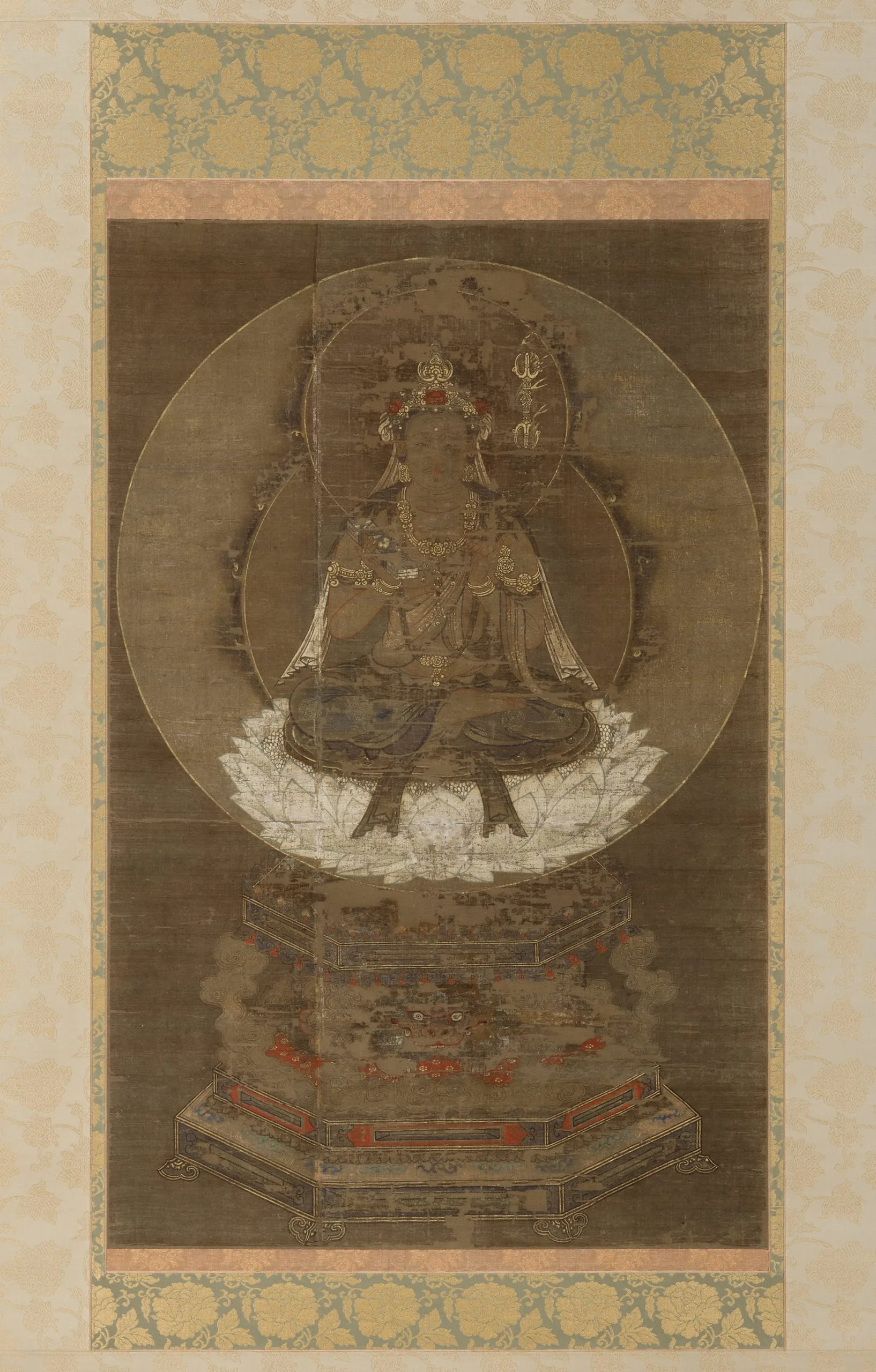
The Bodhisattva Monju is a manifestation of Buddhist wisdom and the power of mind whose role is eradicating ignorance and disseminating transcendental knowledge, creating a focus for meditation and esoteric ritual. He attends Buddha Shakyamuni, the historical Buddha. From the thirteenth century onward, Monju was often depicted as a youth; in this instance, however, he maintains the traditional appearance of maturity. He is customarily shown seated on a lion and carrying a book and a sword as his attributes. Here, he holds a Buddhist scripture in his right hand and a lotus-vajra in his left. The scripture represents the transcendental wisdom promulgated by the Buddhist school (Mahayana) that produced this image, while the vajra (thunderbolt) destroys the so-called incomplete knowledge characteristic of an opposing Buddhist school (Hinayana). Monju is seated on a white lotus throne engulfed in halos and painted in a range of rich mineral colors. The octagonal pedestal is meticulously drawn with black and gold outlines and embellished with abstract rinceau, cloud fungus, and wave patterns. Between the pedestal’s tiers are lion’s faces and paws, a contrast to the usual portrayal of Monju astride the animal. The practice of incorporating the lion within the pedestal may be traced to at least as early as the twelfth century.
Contacts with China during the Song and Yuan dynasties through traveling monks and merchant trade brought Chinese paintings and sculptures to Japan, particularly in the late twelfth and thirteenth centuries. Chinese features are seen here in the austere expression of Monju’s face and in the calligraphic contour lines of the drapery. The detached, passive calm of the figure, the patterned details, the definition of inner contours, and the swelling movement of the curving drapery lines all prefigure the style of the succeeding Muromachi period.