LACMA

ShopMembershipMyLACMATickets
LACMA
Los Angeles County Museum of Art
5905 Wilshire Blvd.
Los Angeles, CA 90036
info@lacma.org
(323) 857-6000
Sign up to receive emails
Subscribe
© Museum Associates 2025

Museum Hours

Monday

11 am–6 pm

Tuesday

11 am–6 pm

Wednesday

Closed

Thursday

11 am–6 pm

Friday

11 am–8 pm

Saturday

10 am–7 pm

Sunday

10 am–7 pm


  • About LACMA
  • Jobs
  • Building LACMA
  • Host An Event
  • Unframed
  • Press
  • FAQs
  • Log in to MyLACMA
  • Privacy Policy
© Museum Associates 2025
Collections

Unknown
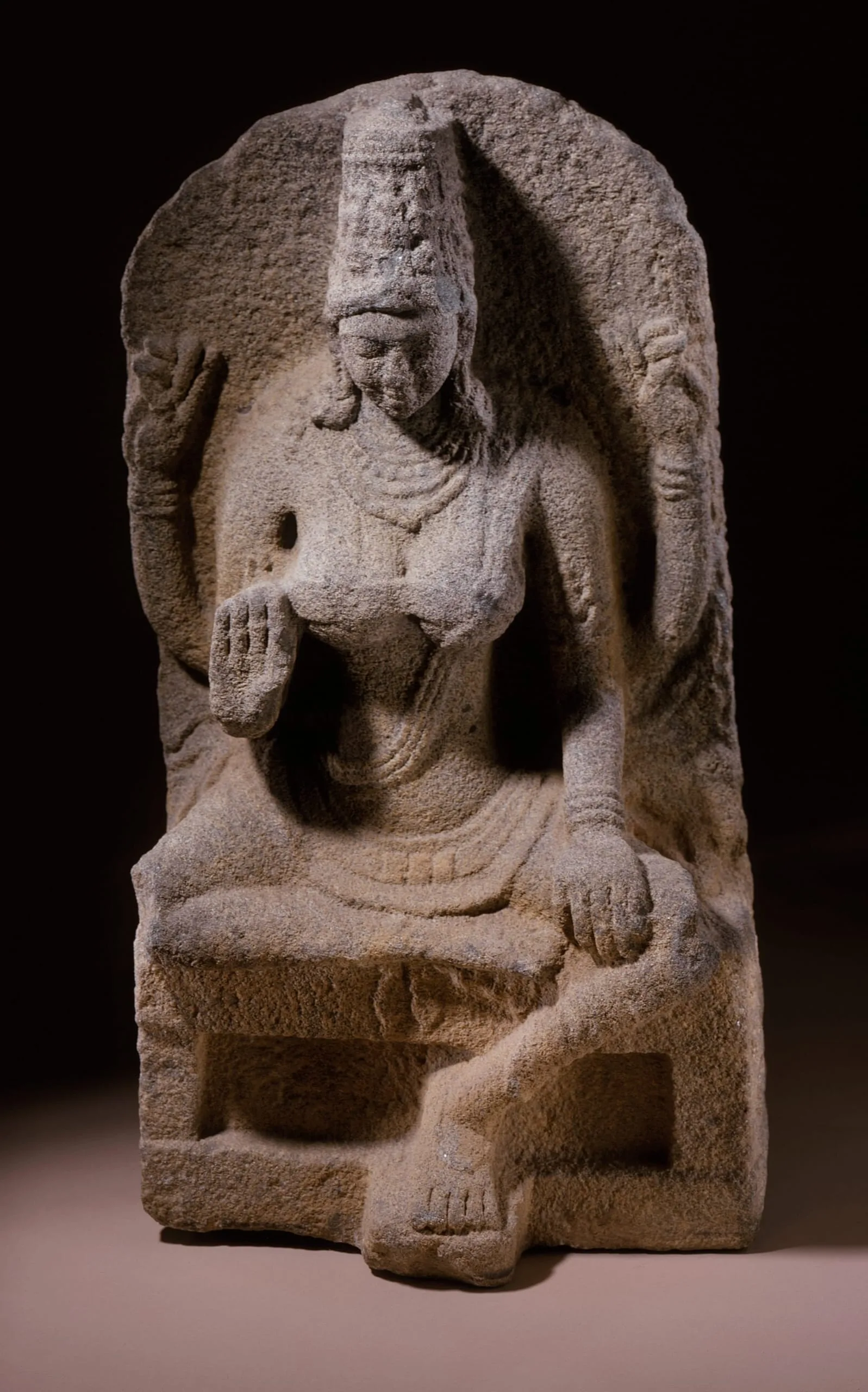
The Hindu Goddess Shri Lakshmi9th century, with circa 12th century recutting

Not on view
Gray granite sculpture of a seated four-armed female deity with tall crown, jewelry, and crossed legs on a block plinth, backed by an arched stone slab
Artist or Maker
Unknown
Title
The Hindu Goddess Shri Lakshmi
Place Made
India, Tamil Nadu, Kaveri region
Date Made
9th century, with circa 12th century recutting
Medium
Granite
Dimensions
35 1/2 x 18 1/2 x 14 in. (90.17 x 46.99 x 35.56 cm)
Credit Line
Gift of Drs. Peter and Caroline Koblenzer
Accession Number
AC1998.256.3
Classification
Sculpture
Collecting Area
South and Southeast Asian Art
Curatorial Notes
This granite sculpture is an intriguing illustration of how art in ancient South Asia was sometimes recast in the service of a new religious orientation. It was originally carved in the 9th century during the Chola Dynasty (848–1279) as an image of the goddess Durga, an important deity primarily affiliated with the god Shiva. Around the 12th century, during the rise of Vaishnavism (the worship of Vishnu) in southern India, it was recarved as the goddess Lakshmi, the wife of the god Vishnu. This was accomplished iconographically by shearing off the plane of the upper throneback in order to remove the identifying attributes of the four-armed Durga (presumably the discus and conch), which resulted in the Lakshmi’s upper arms having these unusual hand gestures devoid of attributes. Her lower right hand is held in the position of reassurance and her lower left hand rests on her inner thigh. To bring the image up to the then current stylistic fashion, the figure was also altered by recarving the face and narrowing the abdomen (as evidenced by the lines of demarcation and change in surface textures).