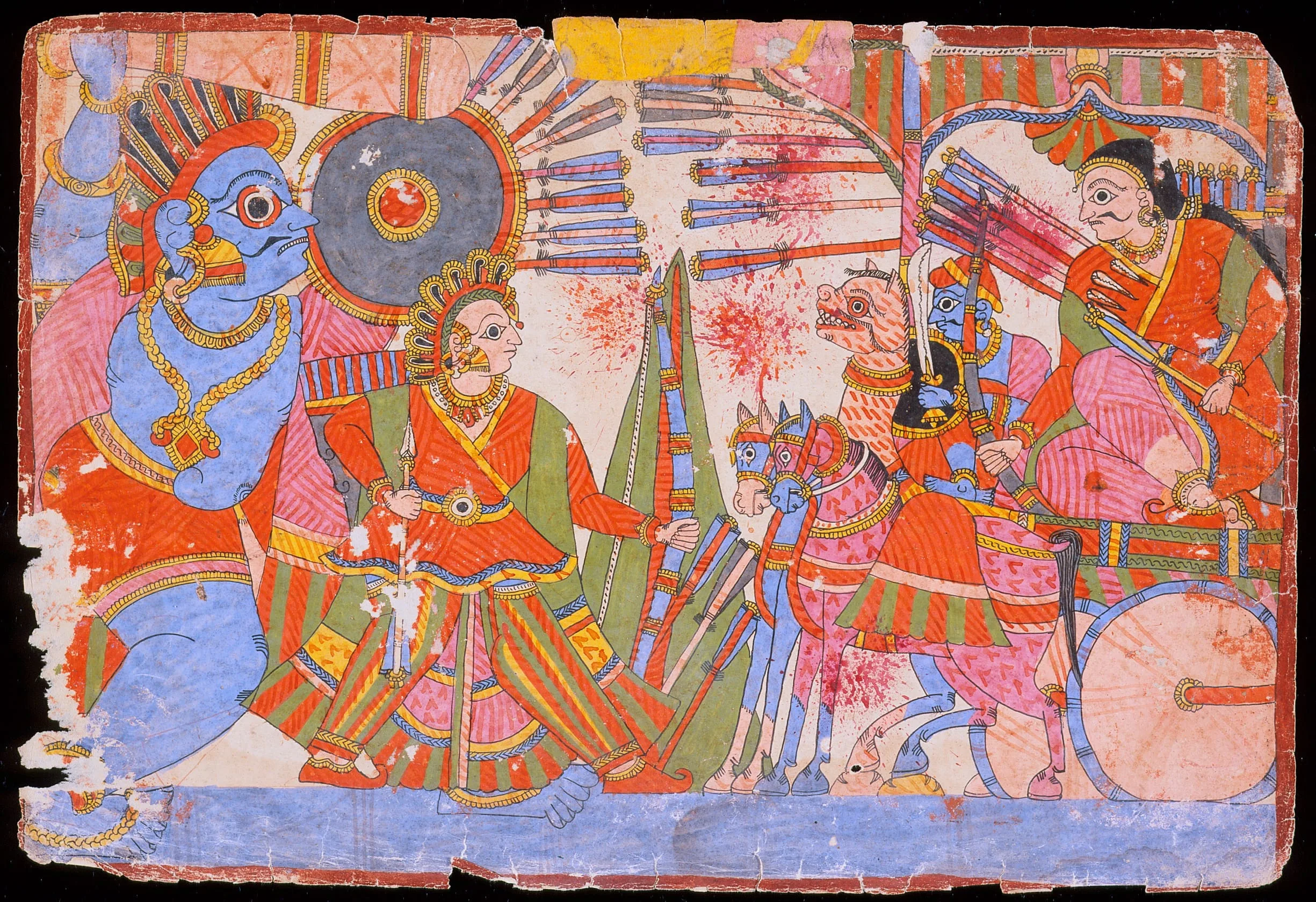
This painting’s bold forms and dynamic composition epitomize the narrative representations used as storyboards by itinerant storytellers (chitrakathis) in the Deccan. Traditionally attributed to Paithan in Maharashtra because of their discovery there in the 1960s, their range of production included Maharashtra, northern Karnataka, Andhra Pradesh, and Telangana.
The Mahabharata recounts the struggle between two powerful branches of a ruling family, the Pandavas and the Kauravas, for the control of the kingdom of Kurukshetra near New Delhi. When the eldest Pandava brother, Yudhishtira, conducted an Ashvamedha (horse sacrifice) ceremony, in which a horse accompanied by a king's soldiers would be released to wander for a year and the king would then acquire those lands if the horse had not been captured or killed, Arjuna was tasked to guard the horse. When the wandering horse arrived in Manipur, Babhruvahana (or Babruvahana), the king of Manipur, captured the horse and killed Arjuna and his fellow warrior Vrishaketu with magical arrows. Babhruvahana later relented and revived Arjuna and Vrishaketu with the help of a magical jewel and Krishna. Here, Vrishaketu and Bhima, another Pandava brother, battle Yavanatha, an ally of Babhruvahana.
Additional folios from this series are in the Asian Art Museum, San Francisco (2005.97 and 2010.464), Brooklyn Museum (2004.113.1-.2), Cleveland Museum of Art (2005.68), and the University of Michigan Museum of Art (1970/2.166 and 1975/.2.150-.151).