- Title
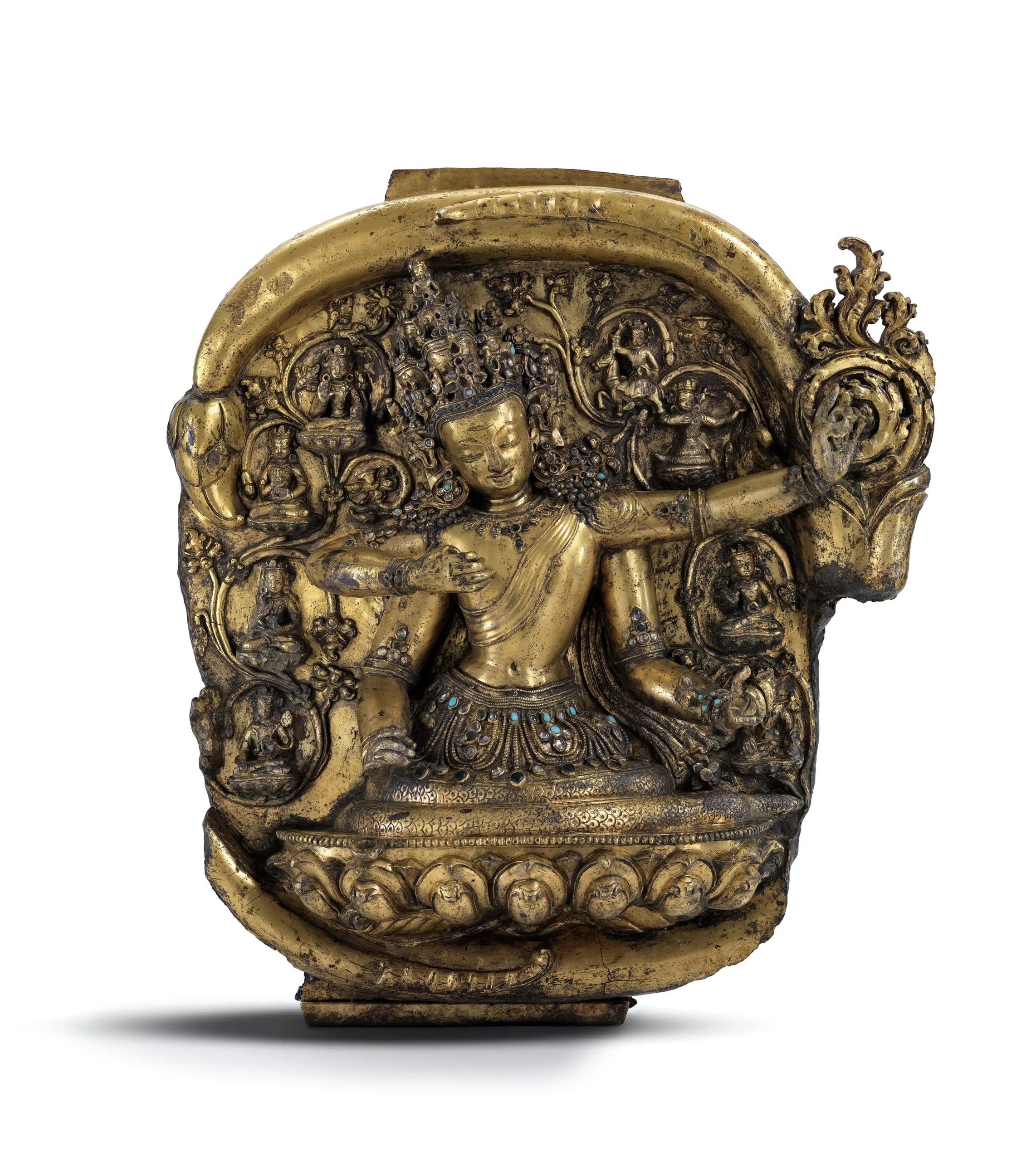
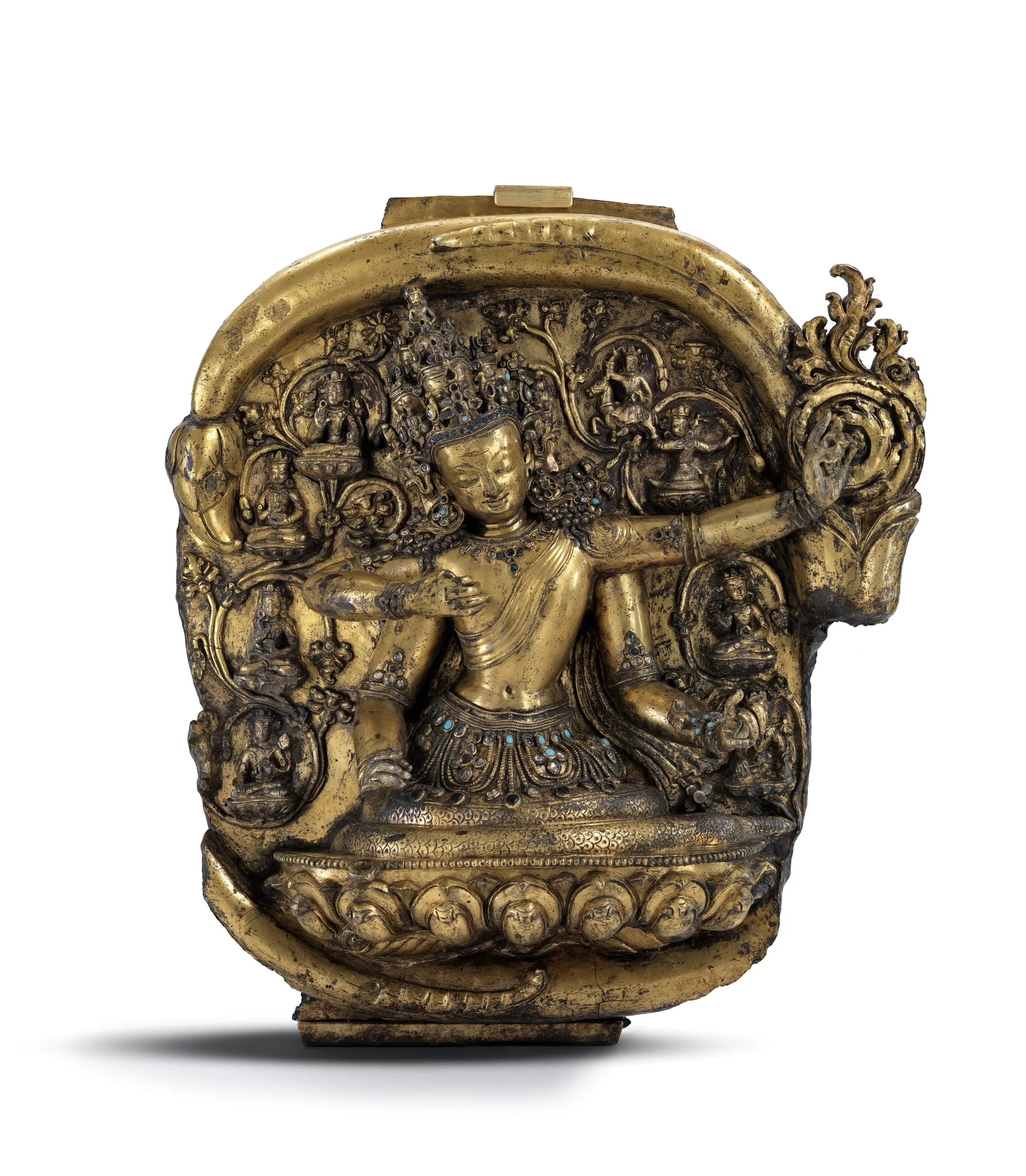
- Rahu, Lord of the Planets
- Date Made
- circa 1370
- Medium
- Gilt copper alloy inlaid with colored glass ornaments
- Dimensions
- 21 1/2 x 19 1/4 x 7 in. (54.61 x 48.9 x 17.78 cm)
- Accession Number
- AC1999.58.1
- Curatorial Notes
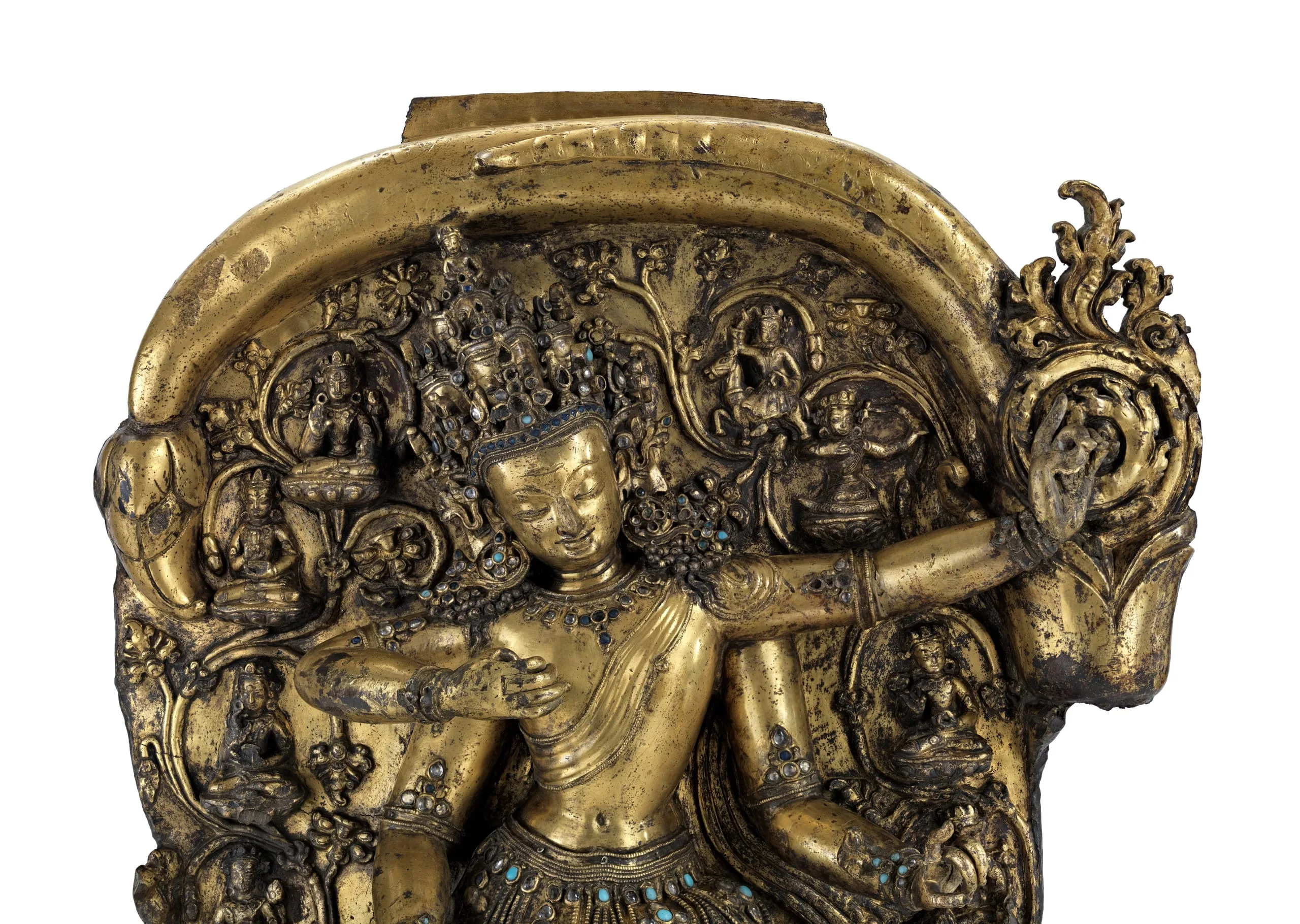
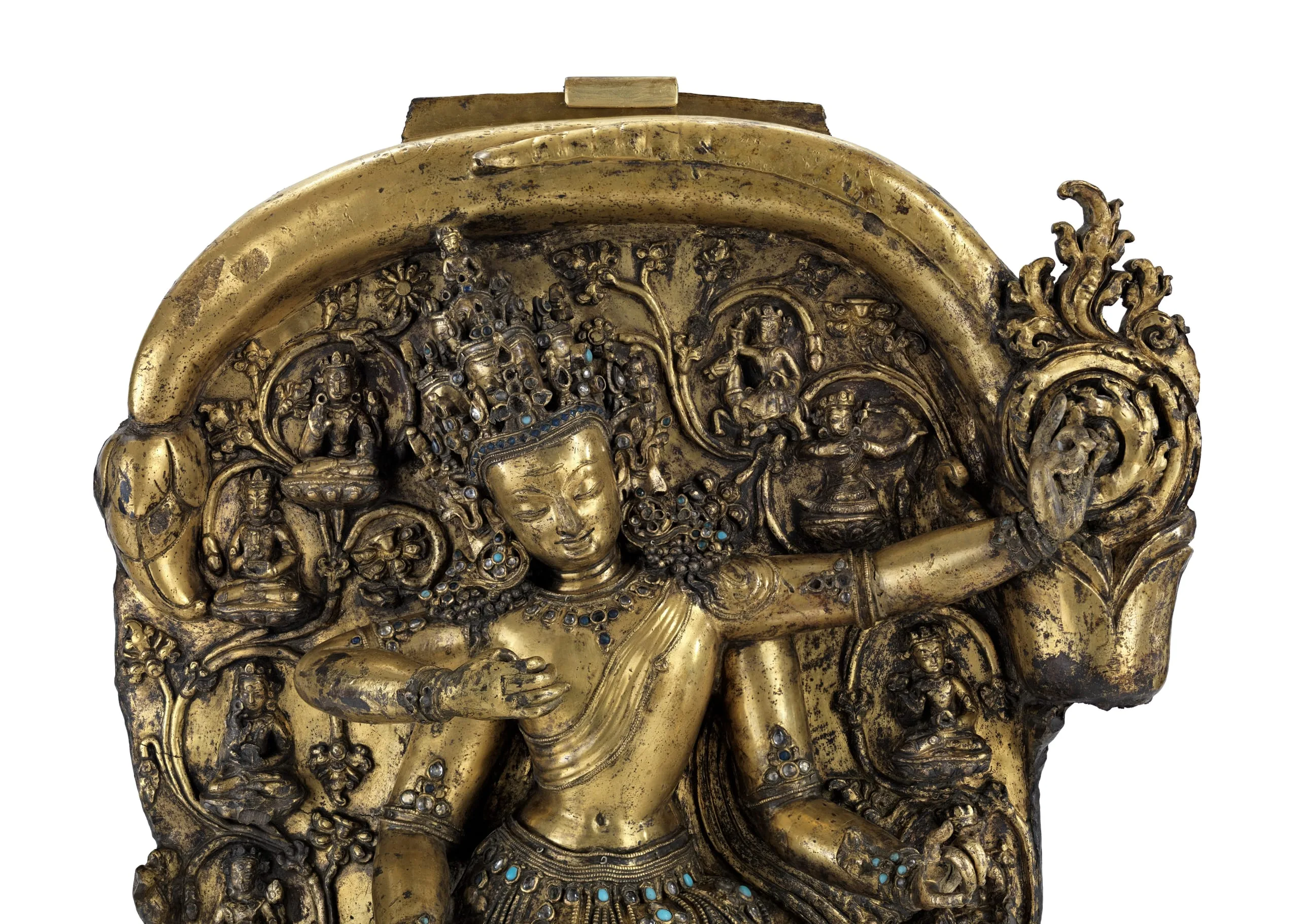
Rahu, Lord of the Planets was originally an ancient Indian demon believed to cause eclipses by seizing and devouring the sun and the moon. Rahu and the planetary deities were often represented on Buddhist and Hindu temple doorways as a protective motif. He is shown here in his evolved Tibetan form with multiple heads, a serpentine body, and shooting a now-missing arrow, which Tibetan Buddhists believe he shoots into the hearts of monks who break their religious vows as a warning to other errant monks. Surrounding Rahu are various subservient guardian deities over which he lords.
This relief is from the great stupa or funerary monument complex at the renowned Densatil monastery in central Tibet. Between 1198 and the early 17th century as many as eighteen stupas were erected at Densatil to either inter the remains of revered Kagyu Buddhist abbots and local princes or to honor their memory. The exteriors of the stupas were adorned with ornate high relief sculptures depicting various deities and subsidiary divinities. Each was encircled by a blossoming lotus tendril that united them in a coherent composition around the base of the monument. This sculpture is probably from one of the five stupas built between 1370 and 1431, most likely from one of the renowned stupas built under the patronage of the eminent Densatil abbot Sonam Gyaltsen (1386-1434). The Densatil monastic complex was destroyed during the Chinese Cultural Revolution between 1966 and 1976.
- Selected Bibliography
- Rhie, Marylin M. and Robert A.F. Thurman. Wisdom and Compassion: The Sacred Art of Tibet. New York: Tibet House, 1991.
- Melwani, L. "Looking for the Perfect Ganesha." Arts and Antiques (October 2000).
- Czaja, Olaf and Adriana Proser. Golden Visions of Densatil: a Tibetan Buddhist Monastery. New York: Asia Society, 2014.
- Lorber, Martin Barnes. "Golden Visions of Densatil." Asian Art Newspaper 17, no.6 (April 2014): 18-19.
- Little, Stephen, Tushara Bindu Gude, Karina Romero Blanco, Silvia Seligson, Marco Antonio Karam. Las Huellas de Buda. Ciudad de México : Instituto Nacional de Antropología e Historia, 2018.
- Little, Stephen, and Tushara Bindu Gude. Realms of the Dharma: Buddhist Art across Asia. Los Angeles: Los Angeles County Museum of Art, 2025.