LACMA

ShopMembershipMyLACMATickets
LACMA
Los Angeles County Museum of Art
5905 Wilshire Blvd.
Los Angeles, CA 90036
info@lacma.org
(323) 857-6000
Sign up to receive emails
Subscribe
© Museum Associates 2026
  • About LACMA
  • Jobs
  • Building LACMA
  • Host An Event
  • Unframed
  • Press
  • FAQs
  • Log in to MyLACMA
  • Privacy Policy
© Museum Associates 2026
Collections

Unknown
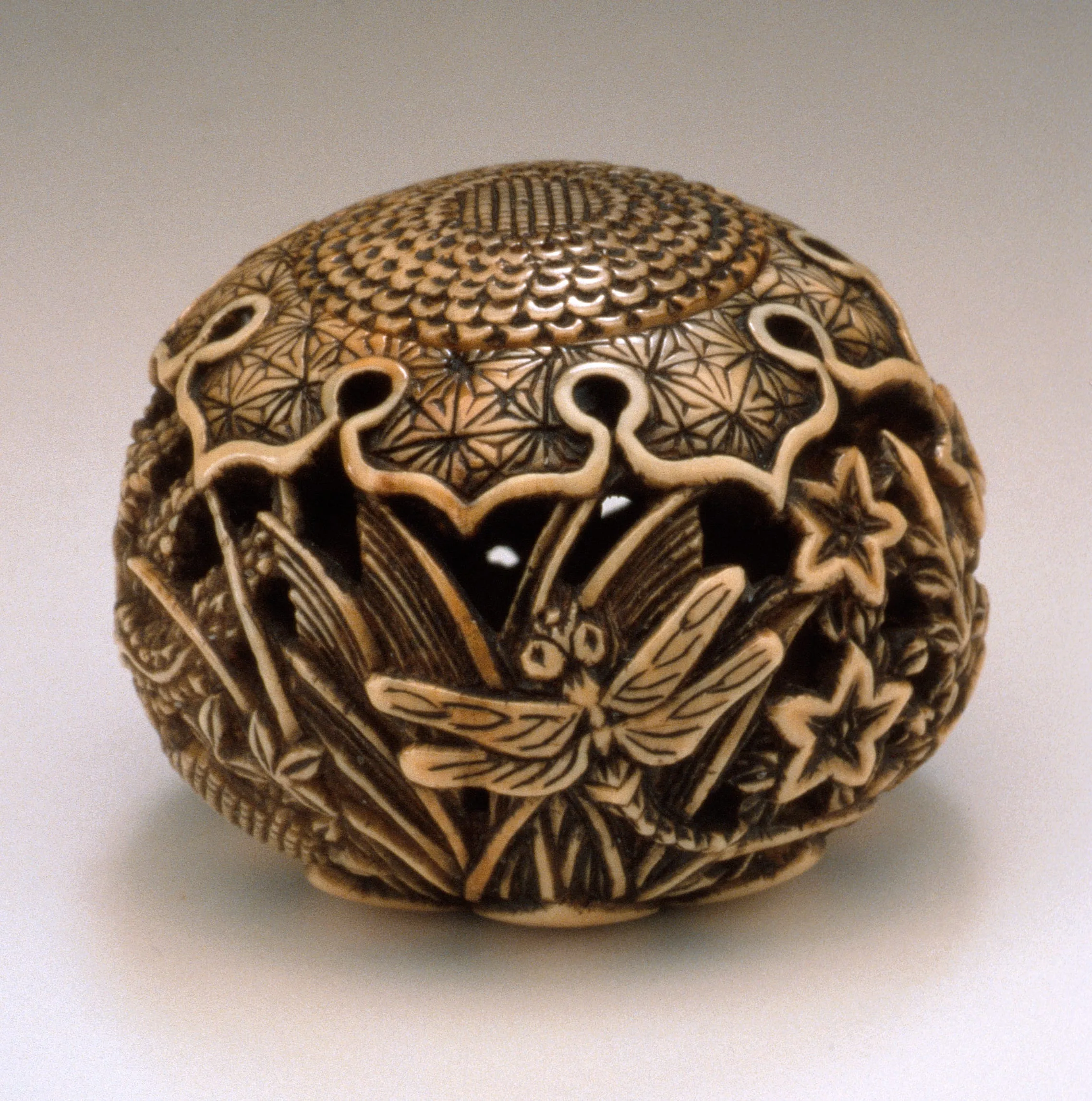
Insects amid Autumn Flowers and Grassesmid- to late 19th century

Not on view
Small hollow ivory or bone sphere with densely carved decoration: a scaled medallion on top, openwork scroll band at the equator, and dragonflies among reeds and flowers below

Unknown, Insects amid Autumn Flowers and Grasses, mid- to late 19th century, Los Angeles County Museum of Art, Raymond and Frances Bushell Collection, photo © Museum Associates/LACMA

Artist or Maker
Unknown
Title
Insects amid Autumn Flowers and Grasses
Place Made
Japan
Date Made
mid- to late 19th century
Period
Edo period (1603-1868) or Meiji period (1868-1912)
Medium
Ivory with staining, sumi; ryūsa type
Dimensions
13/16 x 1 1/8 in. (2.0 x 2.8 cm)
Credit Line
Raymond and Frances Bushell Collection
Accession Number
AC1998.249.301a-b
Classification
Costumes
Collecting Area
Japanese Art
Curatorial Notes

Nature has long played a central role in Japanese life. Animals, birds, insects, flowers, and plants appeared initially in religious contexts but became important subjects in the pictorial and decorative arts from the Heian period (794−1185) onward. The theme of the Seven Grasses of Autumn (Aki no nanakusa) dates to the eighth century, when it is detailed in the Manyōshū, Japan’s first poetry anthology. The seven plants are listed therein as: hagi (bush clover), susuki or obana (pampas grass), kuzu (arrowroot), nadeshiko (pinks), ominaeshi (golden lace), fujibakama (mistflower), and asagao (morning glory). Depictions of this group varied, however, and sometimes included kiku (chrysanthemum) and kikyō (bellflower).

Most examples of the autumn grasses and flowers motif in netsuke date from the nineteenth century, such as this tiny orb carved with plants and a dragonfly. Often their designs include other autumnal elements like flying geese, quail, crickets, or the moon. Netsuke of this type seldom appear in wood; rather, carvers worked ivory or stag antler using a technique called ryūsa, in which spaces around each component are carved away, leaving openings throughout the composition. Ryūsa-style netsuke often combine groups of things such as masks, musical instruments, animals, and the seven Buddhist treasures (see M.87.263.39). This type of netsuke is named after Ryūsa, a carver active in the late eighteenth century who is said to have originated the technique.

2024
Selected Bibliography
  • Goodall, Hollis, Virginia G. Atchley, Neil K. Davey, Christine Drosse, Sebastian Izzard, Odile Madden, and Robert T. Singer. The Raymond and Frances Bushell Collection of Netsuke: A Legacy at the Los Angeles County Museum of Art. Chicago: Art Media Resources, Inc.; Los Angeles: Los Angeles County Museum of Art, 2003.