- Title
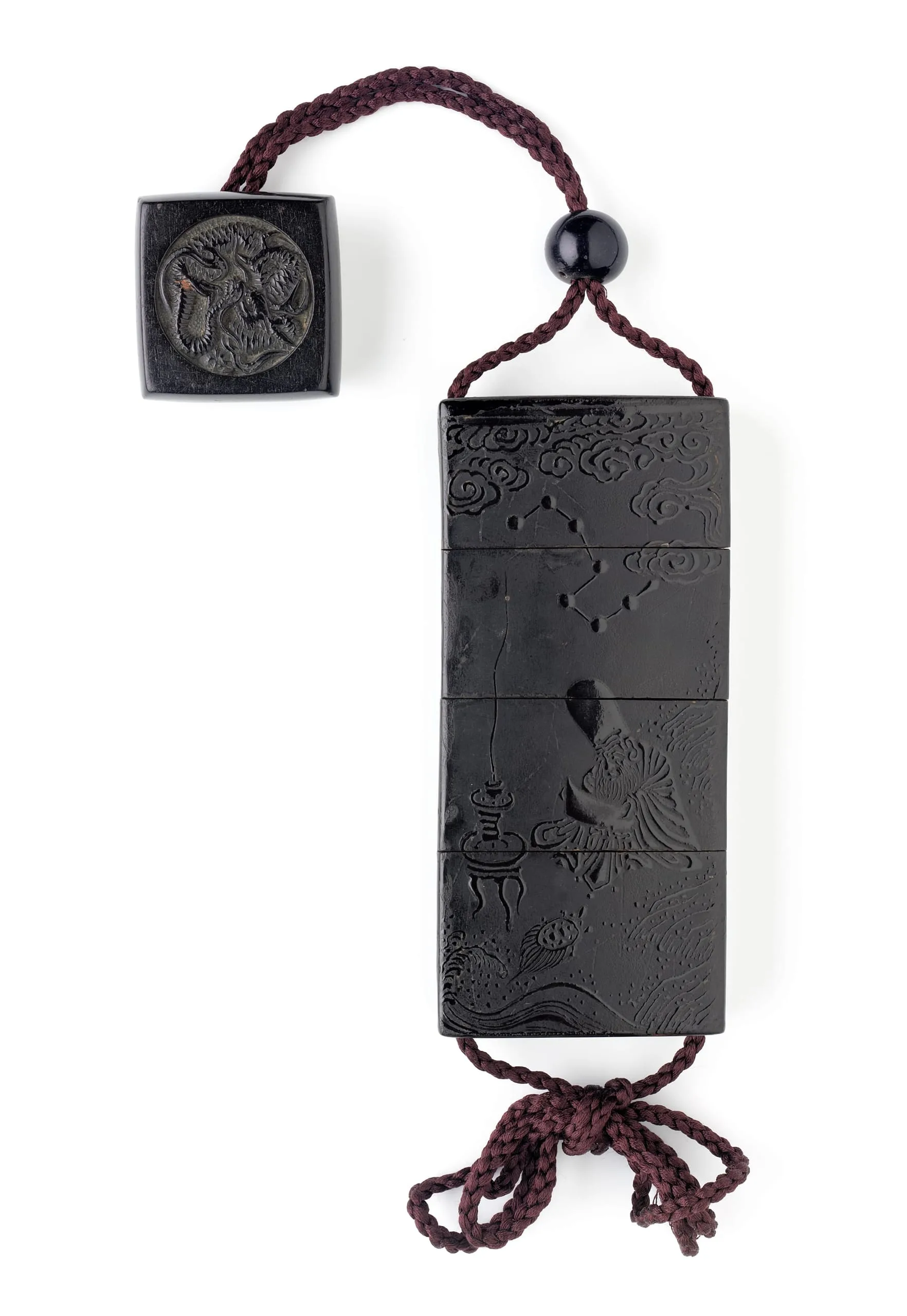
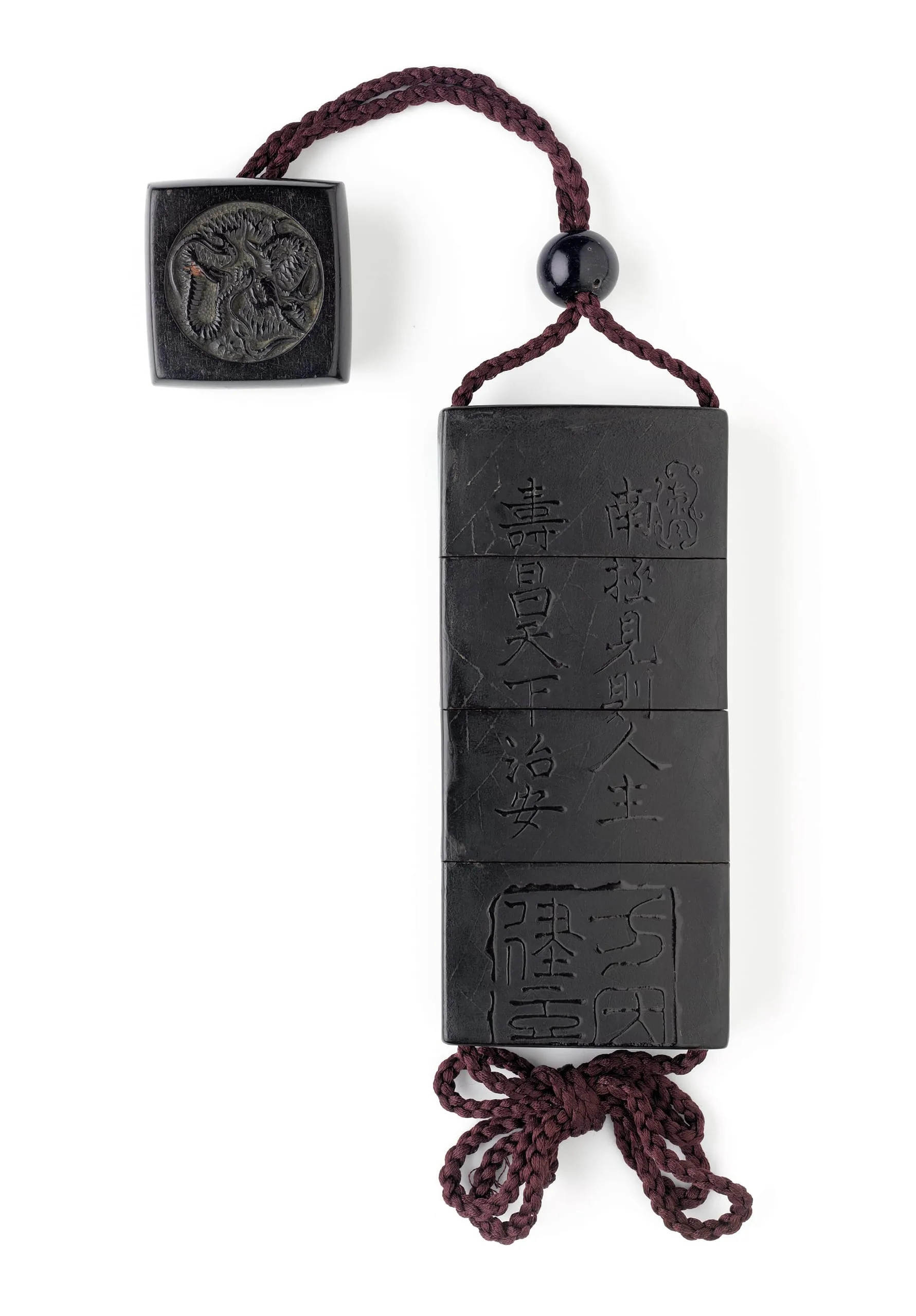
- Inrō, Ojime, Netsuke
- Date Made
- circa mid-19th century
- Medium
- Inrō: black lacquer on substrate; Ojime: black hardstone or glass; Netsuke: ebony; manjū type
- Dimensions
- Inro: 4 1/4 × 1 15/16 × 11/16 in. (10.8 × 4.92 × 1.75 cm)
Ojime: 1/2 × 9/16 in. (1.27 × 1.43 cm)
Netsuke: 1 5/8 × 1 7/16 × 9/16 in. (4.13 × 3.65 × 1.43 cm)
- Accession Number
- AC1998.249.318
- Curatorial Notes
Lacquer artist Ogawa Haritsu, called Ritsuō (1663−1747), was well known for his innovative designs and exploration of materials, and was associated with a style of inrō that took the form of ink sticks. The nineteenth century saw a revival of interest in Ritsuō’s work, prompting lacquer artists of the time to produce Ritsuō-style inrō, such as the one seen here, attributed to Koma Kansai III.
A number of lacquer families produced inrō in Edo-period (1615−1868) Japan. Lacquer artists typically descended from a long line of lacquerers whose decorative styles and techniques were passed down for generations through a system of apprenticeship. Training typically began when a boy was eleven to thirteen years of age and would continue for at least ten years. At the completion of his training, he would be given permission to establish his own studio. Upon the retirement or death of the master, the son or most able apprentice would take over the family business.
The Koma lineage began in the first half of the seventeenth century, and over the course of the Edo period generations of skilled and talented Koma artisans created works for the court and shogunate. Kansai III studied under his father Kansai II (1767−1835) and assumed leadership of the workshop upon his father’s retirement in 1824.
2025
- Selected Bibliography
- Goodall, Hollis, Virginia G. Atchley, Neil K. Davey, Christine Drosse, Sebastian Izzard, Odile Madden, and Robert T. Singer. The Raymond and Frances Bushell Collection of Netsuke: A Legacy at the Los Angeles County Museum of Art. Chicago: Art Media Resources, Inc.; Los Angeles: Los Angeles County Museum of Art, 2003.