- Title
- Inrō, Ojime, and Netsuke
- Date Made
- mid to late 19th century
- Medium
- Inrō: lacquer on substrate, mixed metal flecks; Ojime: agate; Netsuke: ivory
- Dimensions
- Inrō: 2 9/16 x 1 13/16 x 11/16 in. (6.5 x 4.6 x 1.7 cm); Ojime: 7/16 x 1/2 in. (1.1 x 1.2 cm); Netsuke: 1 3/8 x 1 1/2 x 7/8 in. (3.4 x 3.7 x 2.1 cm)
- Accession Number
- AC1998.249.309
- Curatorial Notes
Shibata Zeshin achieved fame for his innovative designs and expertise in working with lacquer, with which he crafted netsuke, inrō, and a variety of boxes and other objects. His earliest teachers were master lacquerer Koma Kansai II (1767−1835) and painter Suzuki Nanrei (1775−1844), who was among the small number of Edo-based artists painting in the style of the Maruyama-Shijō School of Kyoto, which emphasized study from nature and the rendering of subjects as they would be observed firsthand. Zeshin’s training under Nanrei may have sparked his penchant for accurately capturing a subject’s surface textures and mimicking other materials. For instance, many of his designs included metal objects (see M.87.263.49), the rough black surface of which he imitated to perfection using lacquer.
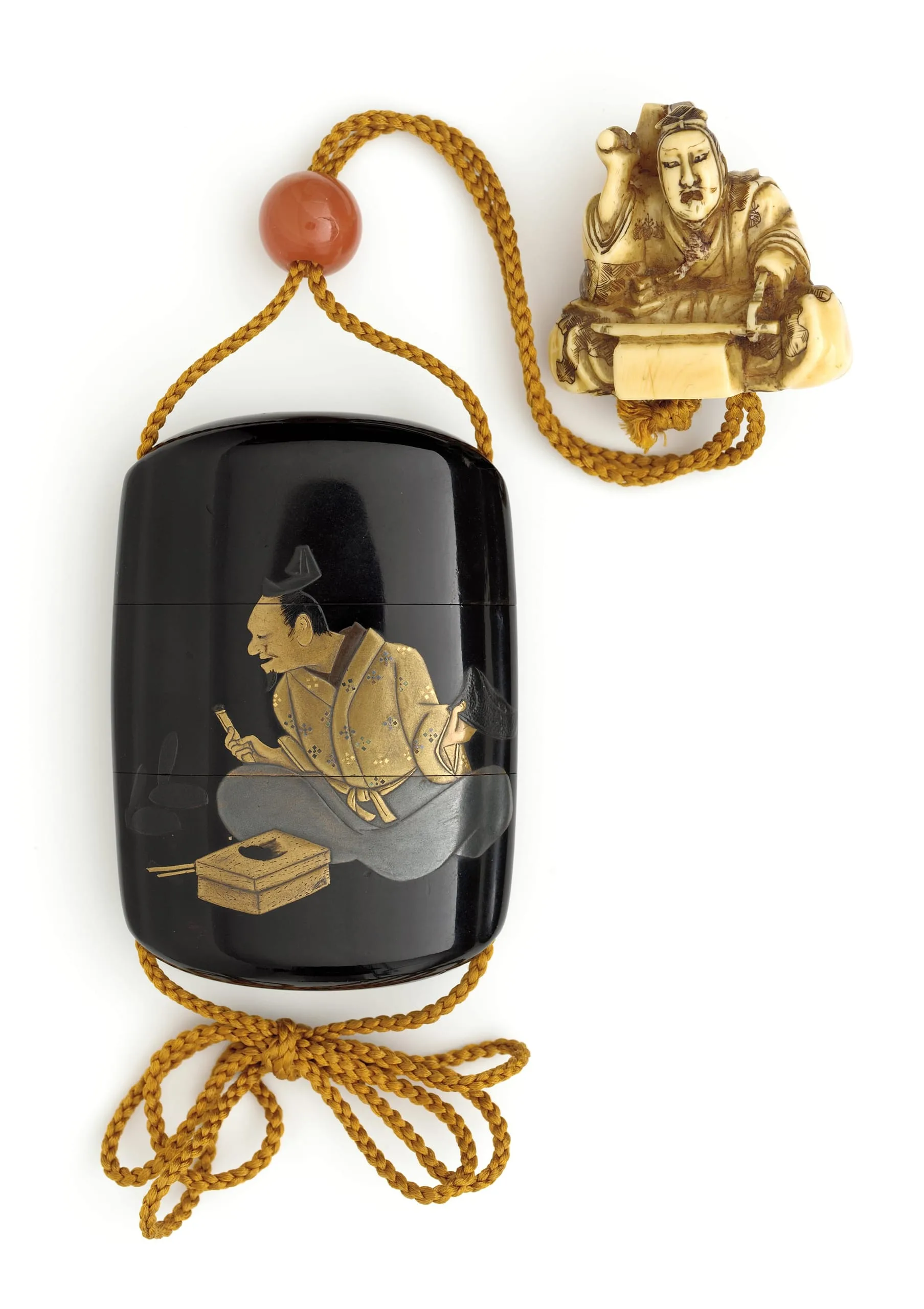
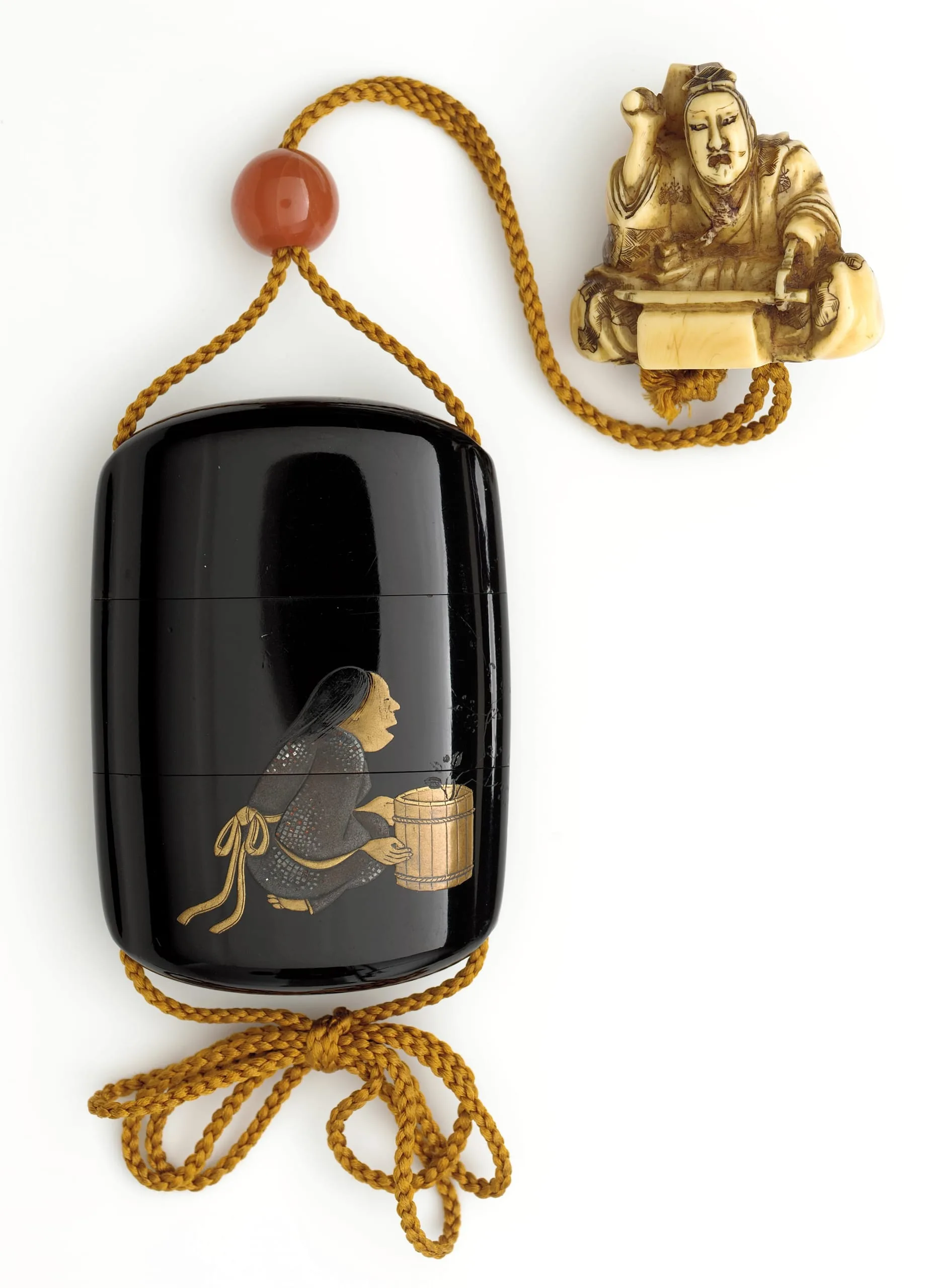
This inrō is decorated with an image of a hatmaker surrounded by the tools and materials of his craft, items that provided Zeshin with an opportunity to exhibit his skill at mimicking textures. On the ground to his right are two kanmuri, a headdress that was part of the most formal traditional vestments worn by Shinto priests. In his left hand is an eboshi, an ordinary or everyday style of hat. Both the kanmuri and eboshi are made of traditional Japanese handmade paper (washi) covered with black lacquer. The hatmaker is in the process of brushing black lacquer onto the surface of the eboshi. He looks to his right, where his wife sits on the back side of the inrō. Beside her is a wooden bucket holding a few small branches that are incised into the black lacquer ground. Inlaid into the robes of each figure are tiny square pieces of gold and silver leaf, a technique called kirigane.
The craftsman theme is reiterated in the carved ivory netsuke, which portrays a swordsmith at work. Holding the hot narrow metal blade against the anvil, he prepares to strike it with the mallet raised over his right shoulder.
2025
- Selected Bibliography
- Bushell, Raymond. The Inr¯o Handbook: Studies of Netsuke, Inr¯o and Lacquer. New York: John Weatherhill, Inc., 1979.
- Goodall, Hollis, Virginia G. Atchley, Neil K. Davey, Christine Drosse, Sebastian Izzard, Odile Madden, and Robert T. Singer. The Raymond and Frances Bushell Collection of Netsuke: A Legacy at the Los Angeles County Museum of Art. Chicago: Art Media Resources, Inc.; Los Angeles: Los Angeles County Museum of Art, 2003.