The Indonesian dagger par excellence is the keris (or kris). The earliest keris may have been produced in Sumatra and in Central Java, while their strongest cultural association is with the Majapahit Empire (1292–1527). Besides being a formidable stabbing weapon, a ceremonial indicator of social status, and a sanctified heirloom (pusaka), keris are also highly spiritual objects often believed to possess supernatural powers. Keris consist of several parts: an asymmetrical blade (wilah) made of iron and nickelous iron with layered patterning; a strengthening metal bolster (selut) connecting the blade and hilt; an ornately or plainly carved hilt (hulu or ukiran) in an abstract, vegetal, or figural form, typically made of wood, ivory, bone, stag antler, rhinoceros horn, elephant’s tooth, silver, and/or gold inlaid with gemstones; and a wooden protective sheath (warangka) sometimes ornamented with an oversheath (pendok) made of precious metals. See Garrett and Bronwen Solyom, The World of the Javanese Keris, exh. cat. (Honolulu: East-West Center, 1978; reprint ed. 1988).
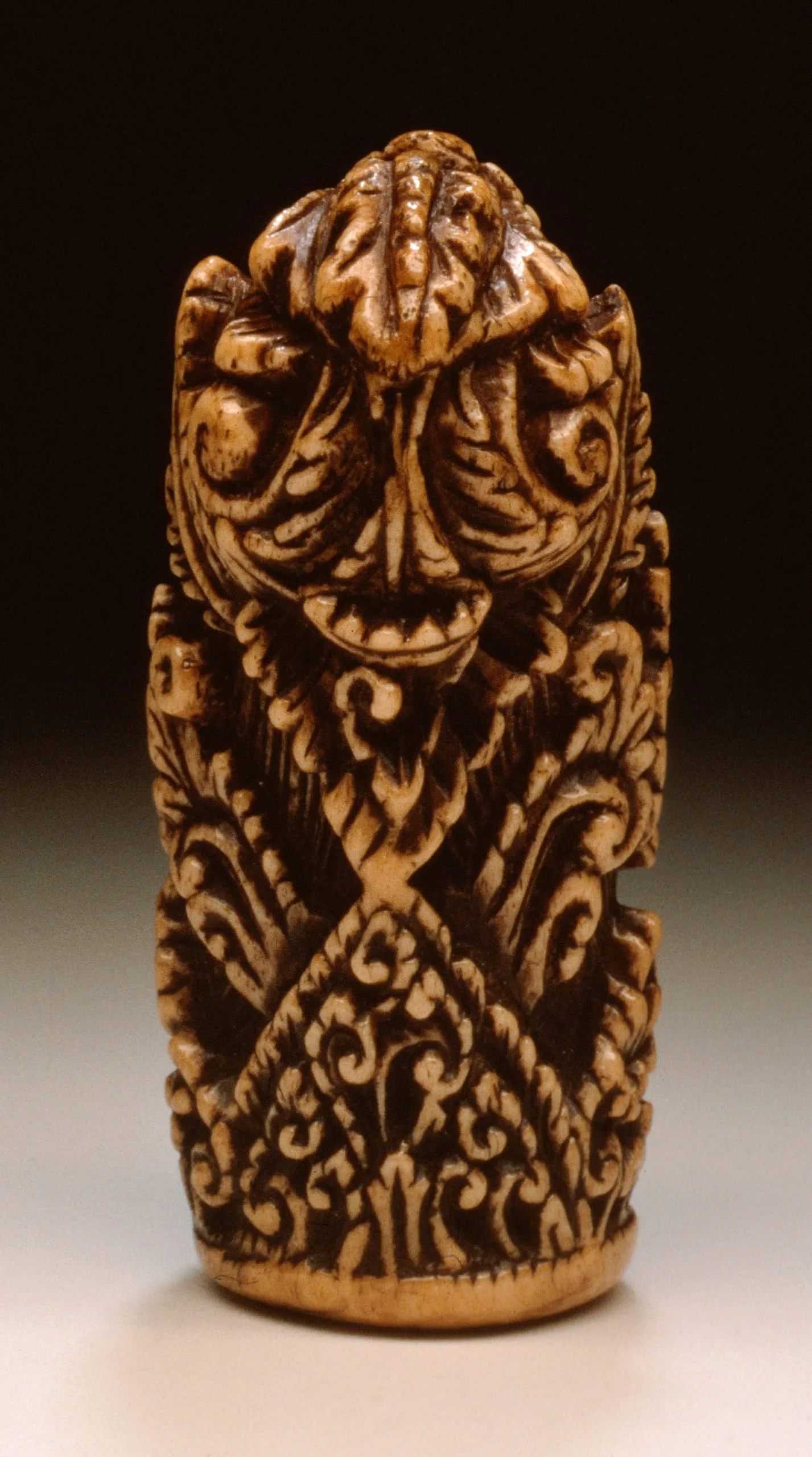
The LACMA keris handle/hilt is made of elaborately carved stag antler. It likely represents a crouching mythical bird, Garuda, whose anatomical features are suggested by various floral motifs and abstracted forms. In the photograph here, the most discernible parts of the Garuda are its foliated eyes and nose, lower row of pointed teeth, and branch-like arms. A band of half-acanthus leaves encircles the base above the now-missing bolster. The foliated body forms are a traditional hallmark of Eastern Javanese art (see M.91.350.2), and parallel certain earlier Mughal artistic traditions (see AC1995.52.1).
Comparable keris handles are in the Wereldmuseum (formerly called the Tropenmuseum), Amsterdam (1772-623 and 1772-661). See also M.91.232.10.
At a later period, the LACMA keris handle was repurposed as a netsuke by drilling a cord hole (himotoshi) through it. (Goodall et al, Raymond and Frances Bushell Collection of Netsuke, p. 535).