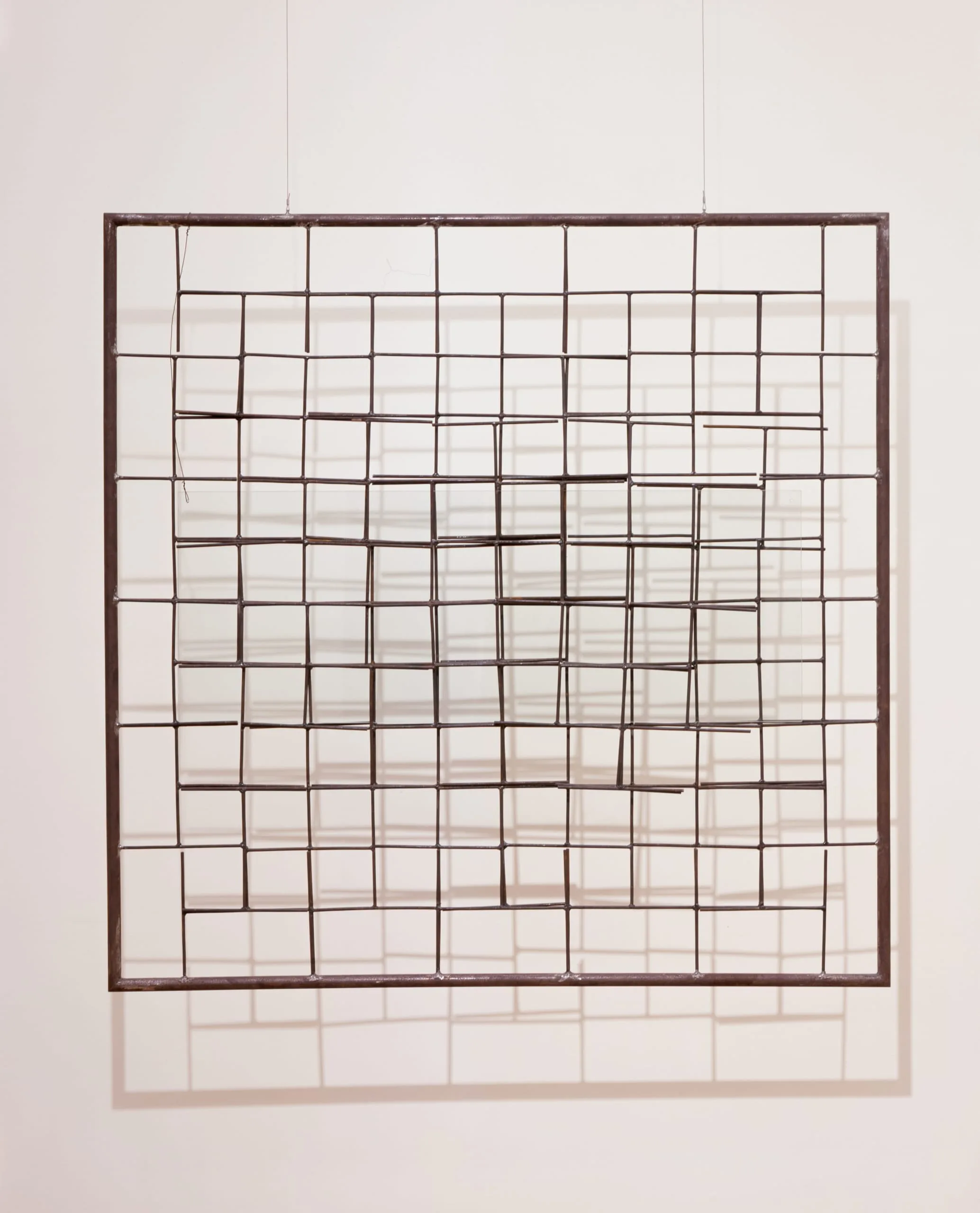
Cildo Meireles constructed Meshes of Freedom by repeating the same linear element in a mathematical sequence now known as a cascade of bifurcations. In theory, this work could extend indefinitely across a single plane and continue to grow volumetrically. Meireles first conceptualized the idea as a doodle and then engaged a local fisherman to execute it in cotton rope, following the same principles of construction as in a fishing net. In this metal version, the basic organizing structure of bifurcating lines is demonstrated through successive components affixed to the wall behind the hanging mesh. Despite its apparent order, the spiky angularity of the grid, with a rectangular sheet of glass trapped in its structure, has more disturbing connotations. Conceived at the height of Brazil’s twenty-year dictatorship (1964–84), the work is an indictment of that regime and a statement about the nature of existence.
Meireles turned to conceptualism early in his career in response to Brazil’s oppressive regime. For example, he added subversive messages to banknotes and reusable Coca-Cola bottles, which he then put back into public circulation. In the early 1970s, he moved to New York, where his work was included in Information, a landmark survey of Conceptual art at the Museum of Modern Art, and Meireles’s first major international exhibition.
Ilona Katzew and Rachel Kaplan
2024