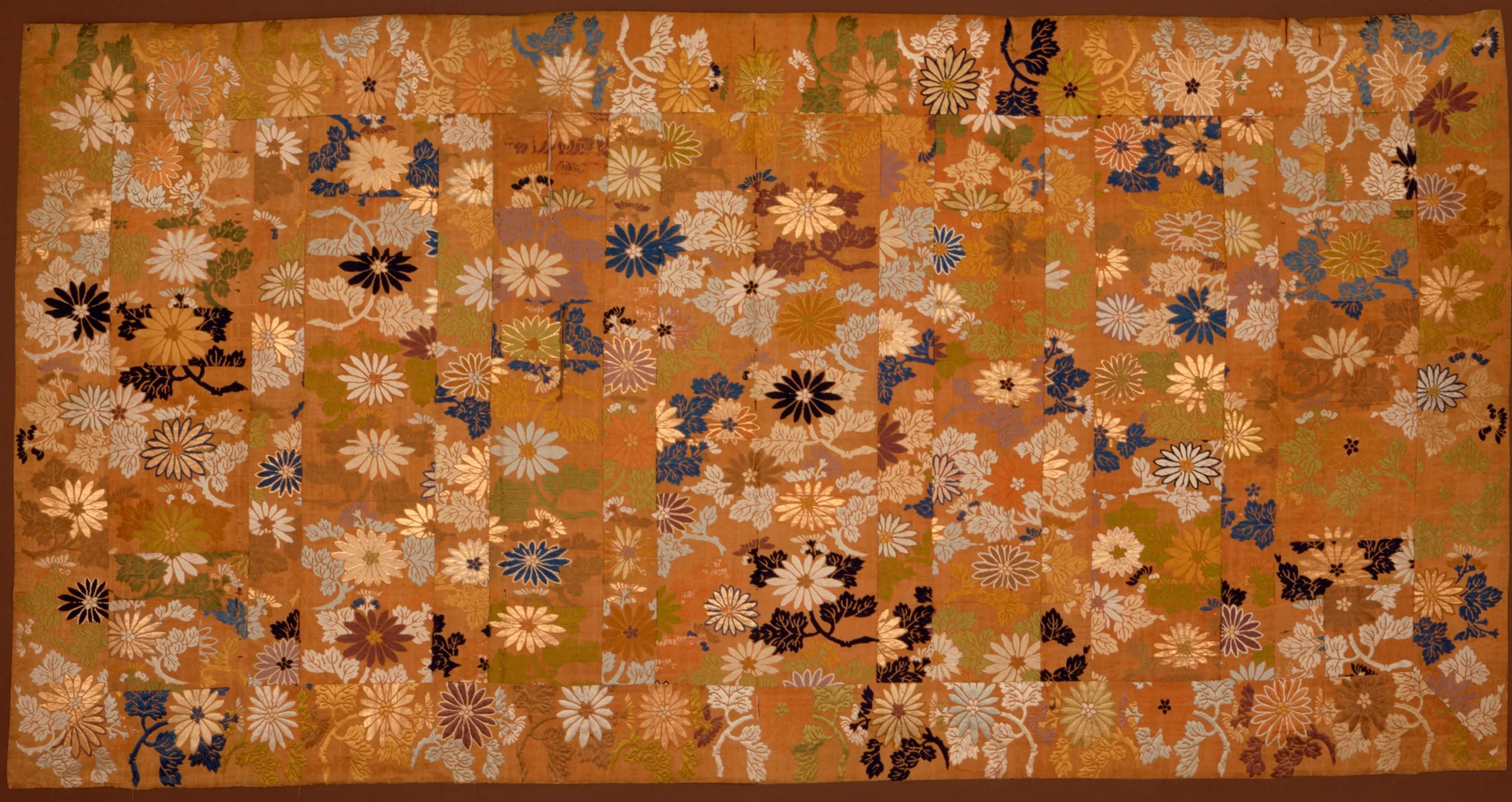
The Buddhist priest's robe, or kesa, is usually made up of seven to twenty-five narrow panels (jo) composed of patchwork squares and assembled into a large, flat rectangle, which, somewhat like a toga, drapes under the left arm and fastens by two corners on the right shoulder. According to legend, its original shape and composition derive from the fine gold kesa that Buddha's mother made for him. Upon Buddha's death a devout disciple carried the kesa to a mountain and there immured himself to await the coming of the future Buddha Maitreya and the end of the world.
The kesa became the prescribed garment for priests. Obeying vows of poverty, they made these robes from donated pieces of old cloth and rags. Eventually the cloaks acquired the status of investiture and were handed down from master to disciple as symbols of priestly descent and authority. As Buddhist ceremonial observance became more complex and hieratic, the patchwork kesa, composed of finer and finer fragments, grew more luxurious.
This seven-jo kesa minimizes the patchwork effect because it was apparently cut from one garment, a Noh robe, and thus retains a strong visual unity. It is patterned with chrysanthemums brocaded on a silk ground; the long floats of silk give the petals their shimmering appearance. Some of the blossoms are outlined in gold. The Four Directional Guardians of Buddhist cosmology are symbolized by the traditional small squares (shitenno) appearing in the kesa's four corners.