LACMA

ShopMembershipMyLACMATickets
LACMA
Los Angeles County Museum of Art
5905 Wilshire Blvd.
Los Angeles, CA 90036
info@lacma.org
(323) 857-6000
Sign up to receive emails
Subscribe
© Museum Associates 2026
  • About LACMA
  • Jobs
  • Building LACMA
  • Host An Event
  • Unframed
  • Press
  • FAQs
  • Log in to MyLACMA
  • Privacy Policy
© Museum Associates 2026
Collections

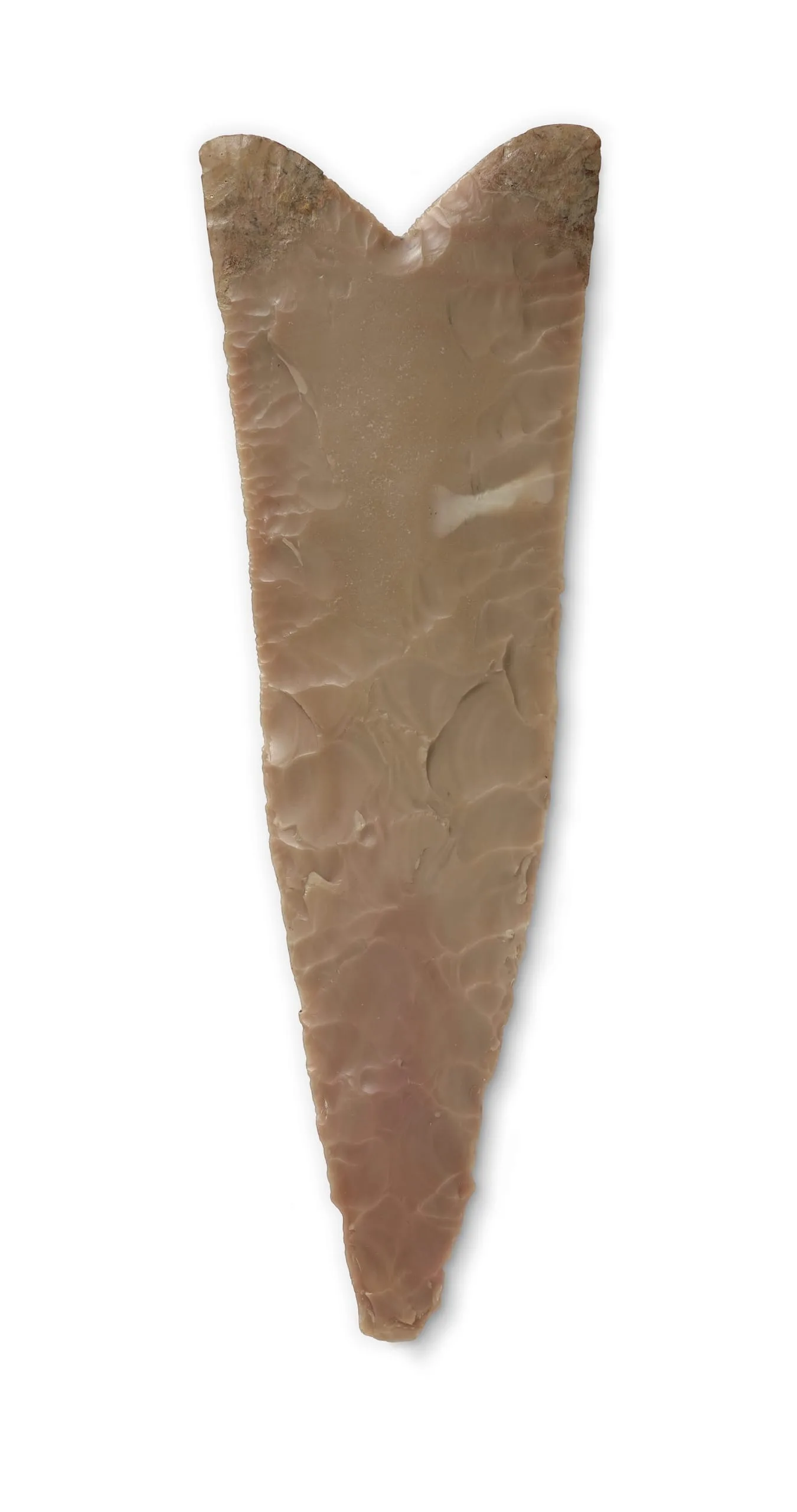
Fish-Tail Knife (pesesh-kef)Predynastic-Early Dynastic Period (3600-2649 BCE)

On view:
Geffen Galleries
Knapped flint or chert point, warm tan and pinkish-brown, with a V-shaped notch at the top and tapering to a sharp tip, showing flake scars across the surface

Unknown, Fish-Tail Knife, Predynastic-Early Dynastic Period (3600-2649 BCE), Los Angeles County Museum of Art, Shinji Shumeikai Acquisition Fund, photo © Museum Associates/LACMA

Title
Fish-Tail Knife (pesesh-kef)
Place Made
Egypt
Date Made
Predynastic-Early Dynastic Period (3600-2649 BCE)
Medium
Flint
Dimensions
6 3/4 × 2 1/4 × 1/8 in. (17.15 × 5.72 × 0.32 cm)
Credit Line
Shinji Shumeikai Acquisition Fund
Accession Number
AC1998.94.1
Classification
Tools and Equipment
Collecting Area
Egyptian Art
Curatorial Notes

Ripple-flaked and sharpened stone blades may have been used in Predynastic Egypt to cut the umbilical cord of an infant and then served as funerary equipment in burials to equip an individual for rebirth in the afterlife. A similar form, known as a pesesh-kef, was used throughout later periods as a tool in the Opening of the Mouth ritual to animate a mummy, that is, to bring it to a state of symbolically breathing and receiving sustenance.

Provenance
Robert de Rustafjaell (1859–1943), London and New York, possibly sold in 1915 at (sale, New York, Anderson Galleries, 29 November–1 December, 1915). Robert Alistair McAlpine (1942–2014), Baron of West Green, England, Australia, Paris, Venice and Southern Italy. [Frederick Schultz Ancient Art, New York, sold 1998 to]; LACMA.