LACMA

ShopMembershipMyLACMATickets
LACMA
Los Angeles County Museum of Art
5905 Wilshire Blvd.
Los Angeles, CA 90036
info@lacma.org
(323) 857-6000
Sign up to receive emails
Subscribe
© Museum Associates 2026
  • About LACMA
  • Jobs
  • Building LACMA
  • Host An Event
  • Unframed
  • Press
  • FAQs
  • Log in to MyLACMA
  • Privacy Policy
© Museum Associates 2026
Collections

Valentin de Boulogne
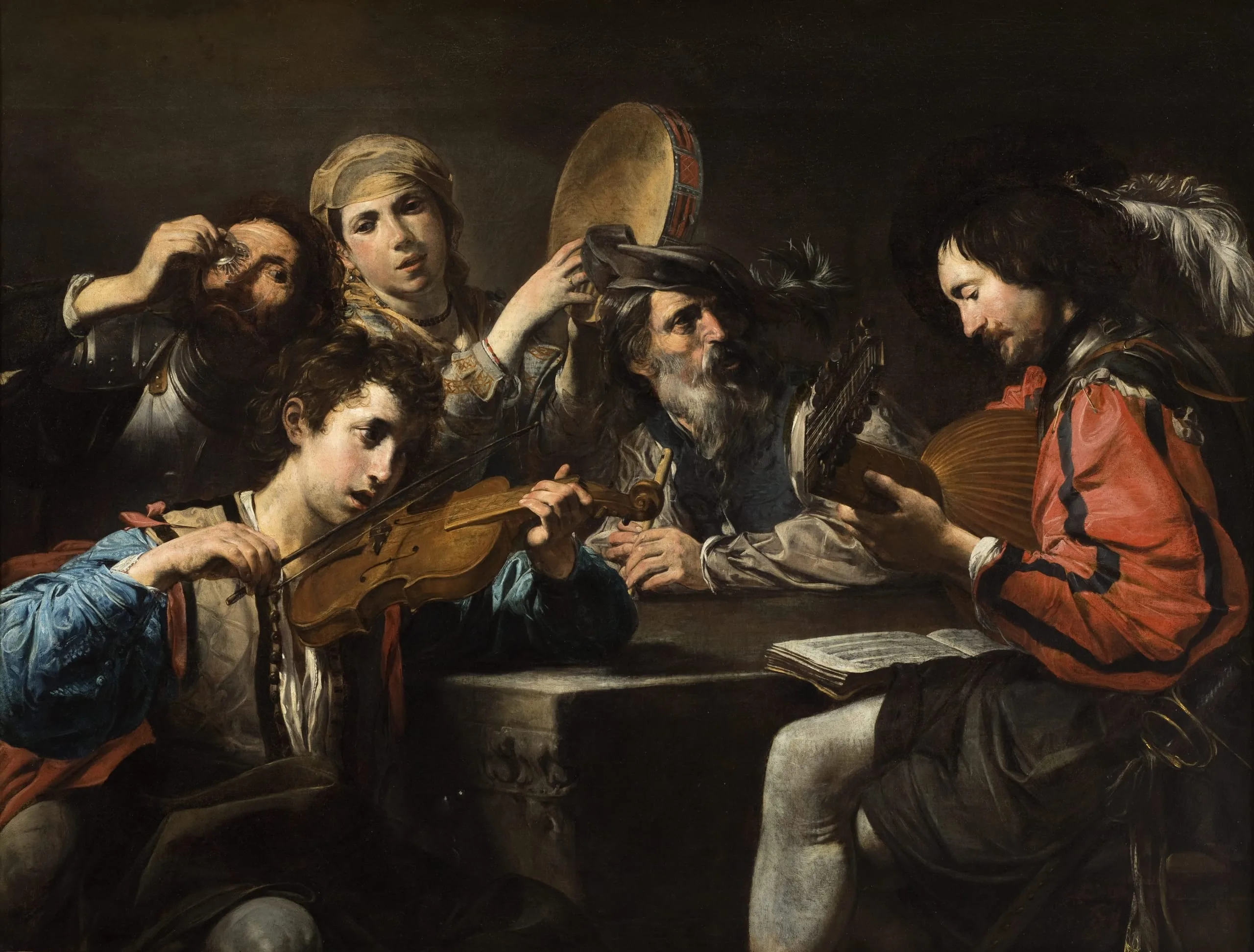
A Musical Partycirca 1623-1626

On view:
Geffen Galleries, Model Lives in Baroque Italy
Oil painting of five figures gathered around a stone ledge, playing violin, lute, and tambourine by warm directional light against a dark background

Valentin de Boulogne, A Musical Party, circa 1623-1626, Los Angeles County Museum of Art, Gift of The Ahmanson Foundation, photo © Museum Associates/LACMA

Artist or Maker
Valentin de Boulogne
France, Coulommiers, 1591-1632
Title
A Musical Party
Date Made
circa 1623-1626
Medium
Oil on canvas
Dimensions
Canvas: 44 × 57 3/4 in. (111.76 × 146.69 cm) Framed: 58 1/2 × 72 × 4 1/2 in. (148.59 × 182.88 × 11.43 cm)
Credit Line
Gift of The Ahmanson Foundation
Accession Number
AC1998.58.1
Classification
Paintings
Collecting Area
European Painting and Sculpture
Curatorial Notes

In Valentin de Boulogne’s A Musical Party, light rakes across an informal gathering of musicians assembled around a fragment of an ancient sarcophagus. A young boy plays the violin while peeking at a lute player, whose gaze is fixed on a musical score. The lute player’s plumed hat and sword suggest he is a member of an aristocratic household. While the diverse age range among the figures may allude to the allegory of the four ages of man, Valentin also represents the different social classes of musicians in seventeenth-century Rome.

A Musical Party exemplifies the radical transformation of concert-themed paintings by the 1620s, shifting from decorous performances of chamber music played in elite circles to scenes of merrymaking in taverns and hostels. Yet, even within these humble settings, there remains a clear subtext of hierarchy: the lute was primarily found in bourgeois settings, while the violin, flute, and drum were associated with peasant festivities and considered “lesser.” Interestingly, according to Italian collector Vincenzo Giustiniani (1564–1637), the use of lutes was almost abandoned by this time. Valentin thus curiously displays socially outmoded music performed on outdated instruments.

Valentin’s tavern compositions generally follow subjects introduced by Bartolomeo Manfredi, a close follower of Caravaggio. Tavern scenes served as metaphors for life in a difficult, ambiguous era. In this world of fragile, fleeting, and unreliable relationships, wine is a perennial solace, and music provides moments of camaraderie and glimpses of transcendence. A Musical Party appears particularly attuned to the relationships and connections that bind the characters together.

2024

Provenance

Louis Jacques Aimé Théodore de Dreux (d. 1719), marquis de Nancré, captain of the Swiss Guards of the duc d’Orléans, to;(1) Philippe de Bourbon (1674–1723), duc d’Orléans, before 1719, by direct descent to; Louis Philippe (1747–1793), later called "Philippe Egalité," duc d’Orléans, Palais-Royal, Paris, by 1727,(2) sold in 1791 to;(3) the vicomte Edouard de Walckiers, Brussels, sold 1792 to his cousin; François Louis Joseph (1761–1801), marquis de Laborde de Méréville, Paris and London, sold to; Jeremias Harman, sold on behalf of the syndicate led by the 3rd Duke of Bridgewater, the 5th Earl of Carlisle, and Lord Gower, later Duke of Sutherland (private contract sale, London, Michael Bryan [1757–1821], 26 Dec. 1798, lot 83, as A Concert, sold to);(4) Francis Egerton (1736–1803), 3rd Duke of Bridgewater, Bridgewater House, by inheritance to his nephew; George Granville Levisin-Gower (1758–1833), later 2nd Marquess of Stafford and 1st Duke of Sutherland, Cleveland House, London, by direct descent to; John Sutherland Egerton (1915–2000), 5th Earl of Ellesmere and 6th Duke of Sutherland, Bridgewater House, London (sale, London, Christie’s, 18 Oct. 1946, lot 162, as "Moise le Valentin, The Senses," sold for £[?]420 to);(5) [Leonard Koetser, London, for]; [Wildenstein & Co., New York and Paris, sold 1998 to]; LACMA.

Footnotes

(1) Also known as Forest Nancré. According to Stryienski 1913, p. 13: " M. de Nancré, compagnon d’armes du duc d’Orléans en Italie et en Espagne, nommé capitaine des Suisses au Palais-Royal, veut-il reconnaître les bienfaits dont il est comblé, il cède gracieusement le dessus du panier de sa collection à son protecteur: quatre Albane, trois Annibal Carrache, un Louis Carrache, un P.-F. Mola, un Valentin—il faut noter que c’était là un joli cadeau pour l’époque: au XVIIIe siècle qui avait dit Carrache avait tout dit: beau comme le Carrache était un dicton courant."

(2) Listed in Saint-Gelais’s 1727 Description des tableaux du Palais Royal . . . / Dédiée a Monseigneur le Duc d’Orléans . . . item 484, "f.481–82 La Musique. Peint sur toile, haut de trois pieds cinq pouces & demi, large de quatre pieds six pouces. Fig. de grandeur naturelle. On voit sur le devant un home auprès d’une table qui touche un luth, & une fille vis-à-vis qui joue du violon. Un vieillard apuié sur la même table regarde le joueur de luth, il y a une fille à côteé de lui qui bat du tambour de basque, & tout proche un Soldat qui boit. Le fond du Tableau est brun" (Getty Provenance Index, Archival Inventories Database). Dézallier d’Argenville 1749, p. 60, lists "Une musique, du Valentin" in the Chambre des Poussins of the Palais-Royal, where it hung with, but apparently not next to, Valentin’s The Four Ages of Man. Both paintings were still in the same gallery in 1757, but thirty years later, Thiéry 1787, p. 243, noted that Valentin’s Four Ages of Man still hung in the Chambre des Poussins, but the Musical Party [Une concert] had been moved to the "Cabinet de la Lanterne," where it hung next to "Le portrait de Clément VII[I], par le Titien and Le martyre de S. Pierre par Giorgion."

(3 Regarding the sale and distribution of the Orléans collection, see "Collection du Palais Royal," in Cabinet de l’amateur 1842–46, vol. 3 (1)844), pp. 497–507.

(4) See Buchanan 1824, pp. 16–20. See also Getty Provenance Index, Sales Catalogues Database, "description of Sale Catalogue Br-A5676, 26 Dec. 1798."

(5) It is unclear why the painting was titled The Senses, apparently a reference to Les cinq sens, one of the three paintings by Valentin in the Orléans collection. Historically, in catalogues of the Bridgewater collection, with its one Valentin, the painting was correctly called A Music Party. See Ottley 1818, vol. 1, no. 48.

Selected Bibliography
  • Marandel, J. Patrice and Gianni Papi. 2012. Caravaggio and his Legacy. Los Angeles: Los Angeles County Museum of Art.
  • Lemoine, Annick, and Keith Christiansen. Valentin de Boulogne: Beyond Caravaggio. New York: Metropolitan Museum of Art, 2016.
  • Fried, Michael. After Caravaggio. New Haven: Yale University Press, 2016.
  • Christiansen, Keith, and Annick Lemoine. Valentin de Boulogne: Réinventer Caravage. Paris: Musée du Louvre, 2017.
  • Merle Du Bourg, Alexis. "L'omniprésence de la musique." Dossier de L'Art no.246 (2017): 64-67.
  • Schmid, Vanessa I., with Julia Armstrong-Totten. The Orléans Collection. New Orleans: New Orleans Museum of Art; Lewes: In association with D. Giles, 2018.
  • Lehmbeck, Leah, editor. Gifts of European Art from The Ahmanson Foundation. Vol. 2, French Painting and Sculpture. Los Angeles: Los Angeles County Museum of Art, 2019.

Related Unframed

Related Unframed

Happy New Year!
Happy New Year!
  • December 31, 2019
  • Madeleine Heppermann