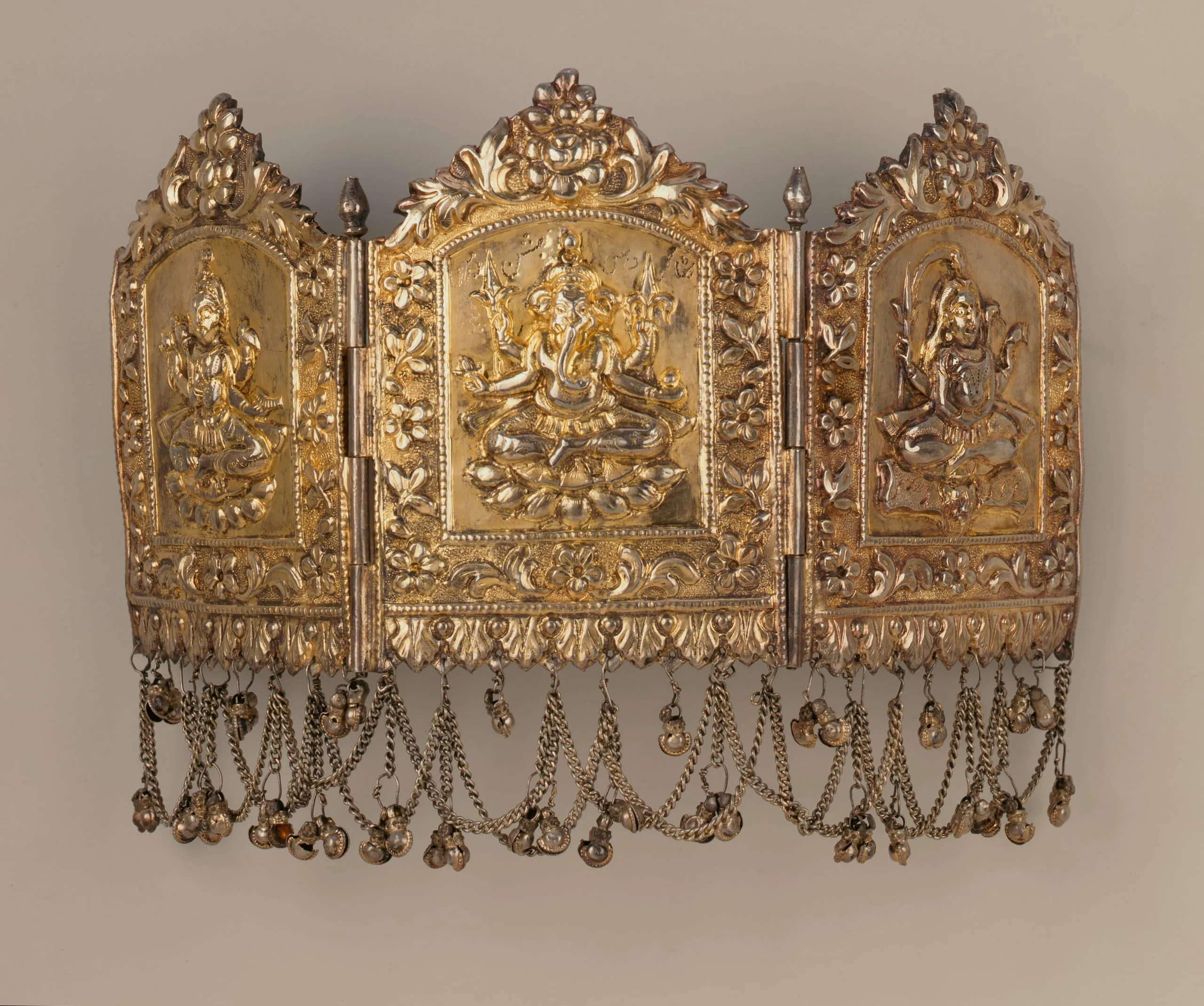
This tripartite bridegroom’s wedding crown depicts the Hindu deities Vishnu, Ganesha, and Shiva (viewer’s left to right). Vishnu, the Lord of Preservation, wears a tall crown and sits on a lotus. He has four arms and holds a club (upper right), lotus (lower right), conch (upper left), and a manuscript symbolic of the scared scriptures, the Vedas (lower left). Ganesha, the elephant-headed Lord of Obstacles, sits on a lotus-supported throne with tall columns on the rear corners (for a similar throne, see M.80.6.6). He has four arms and holds a noose (upper right), lotus (lower right), his broken tusk (upper left), and a bowl of sweetmeats (lower left). Shiva, the Lord of Destruction, has an ascetic’s hairstyle with the River Ganges cascading to earth from its bound summit. He sits on a flayed tiger skin. He has four arms and holds a trident (upper right) and a damaru drum (?) (upper left). His lower two hands are clasped together at his waist. Each divinity is seated within a plain cartouche framed by a broad foliate border with a pointed tympanum.
Wedding crowns of this hinged form graced with auspicious deities were worn by grooms in the Panjab and Himachal Pradesh. The Urdu inscription stippled over Ganesha states that it is the "crown of Thakur Das Bhoshan Dasi," an unknown chieftain. (Translation by Saleema Waraich and Wheeler Thackston.)