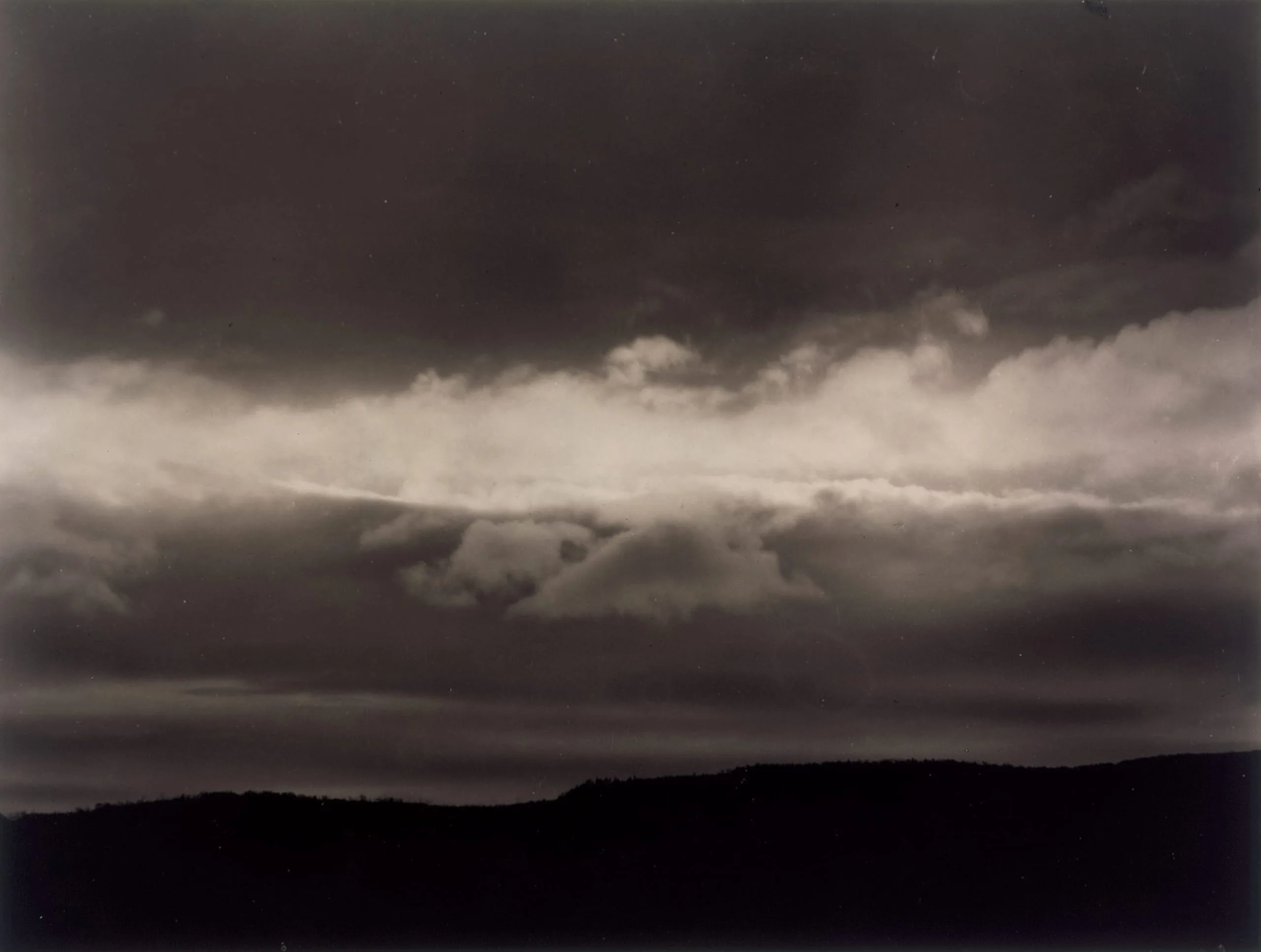
Considered the single most influential American photographer of the twentieth century, Alfred Stieglitz secured the medium’s position within the visual arts through his artwork, publishing, and gallery. Late in his career, at age fifty-eight, Stieglitz sought a new direction for his work and how he might use the camera to create an image that, like music, could be used to express the human soul. At the family home in the Adirondacks, he turned his large-format camera to the sky above Lake George and, with the clouds as subject, began what some consider to be his greatest contribution to photography, the Equivalents. This 1922 gelatin silver print titled Lake George is among the earliest in the group, which ultimately included more than 400 prints made over nine years (Annear 2011: 16). Harnessing the large expanse of sky into a meditative 8 x 10 image, Stieglitz created the first intentional abstract photograph.
That same year, he assembled ten similar cloud photographs into a series he titled Music—A Sequence of Ten Cloud Photographs, No. 1 or Clouds in 10 Movements, No. 1. Stieglitz’s relationship to music began with piano lessons when he was nine years old. Although he gave up formal lessons at age eighteen, he felt free to “open his bound volumes of sheet music where he chose, [and] plunge with voluptuous sentimentality into piano adaptations of tragic arias from the major operas” (Lowe 1983: 55). Music would continue to inform his work, and most specifically his cloud abstractions. ln a 1923 article, he outlined how he came to this work: “I wanted a series of photographs which when seen by Ernest Bloch (the great composer) he would exclaim: Music! Music! Man, why that is music!” (Stieglitz 1923: 255).
In 1925, Stieglitz’s cloud photographs began to shed the surrounding details of the landscape. It was at this time that he began calling them Equivalents, and without reference points, they became almost entirely abstract.
Rebecca Morse, Curator, Wallis Annenberg Photography Department
2024
Bibliography
Annear 2011. Judy Annear. “Clouds to Rain—Stieglitz and the Equivalents.” American Art 25, no. 1 (Spring 2011): 16−19.
Lowe 1983. Sue Davidson Lowe. Stieglitz. New York: Farrar, Straus, Giroux, 1983.
Stieglitz 1923. Alfred Stieglitz. “How I Came to Photograph Clouds.” The Amateur Photographer & Photography, September 19, 1923, p. 255.