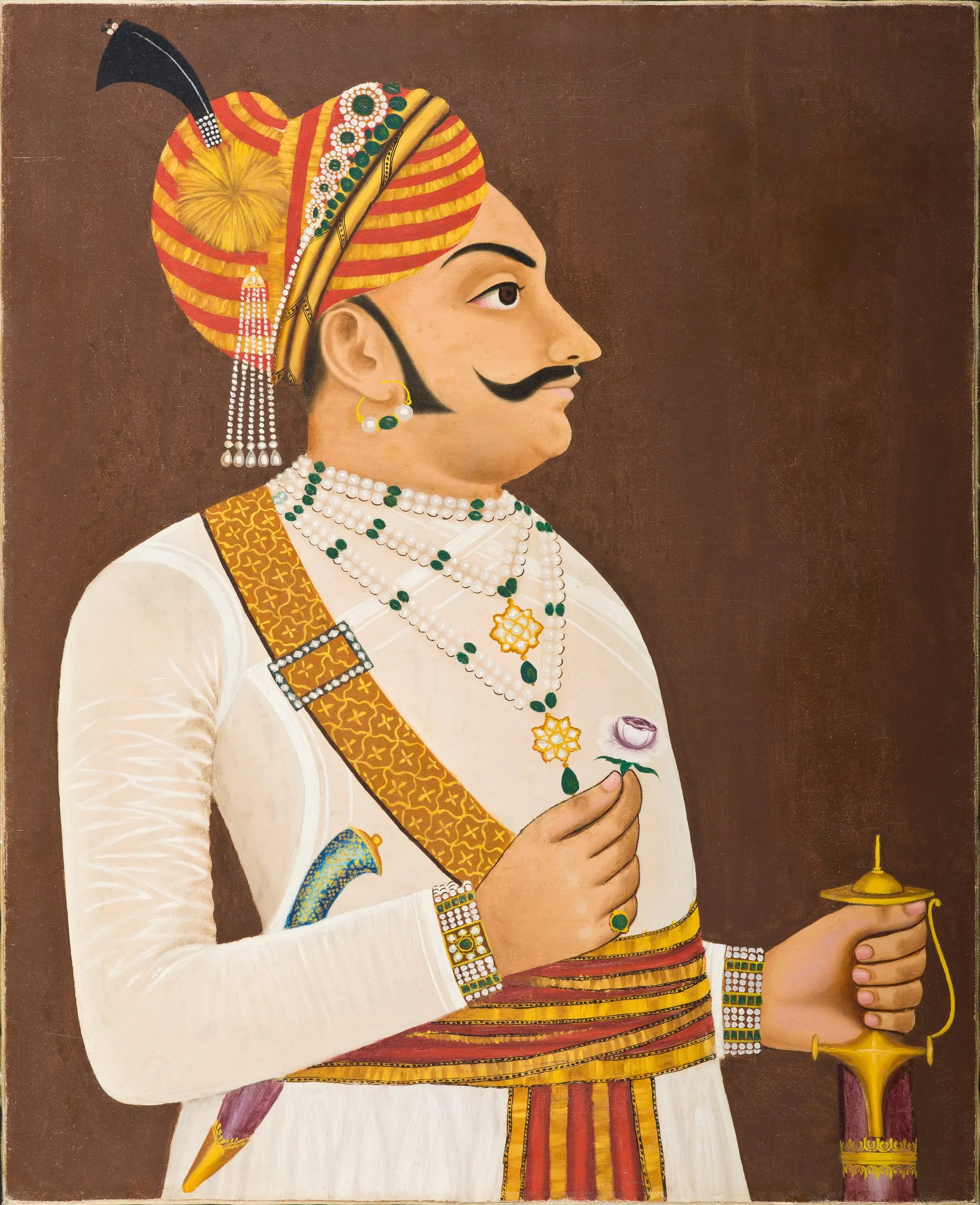
Yaswanta Singh (r. 1688-1707) was a thakur (chief) of Badnor, a fiefdom of the princely state of Mewar in Rajasthan. Badnor was founded in 1554 when Thakur Rao Jaimal (r. 1554-1568) was awarded a land grant (jagir) by Maharana Udai Singh II of Mewar (r. 1537-1572). Badnor’s chiefs thereafter remained closely allied with Mewar’s ruling family. Its chiefs claim as one of their ancestors the famous Rajput hero, Jaimall, who was immortalized by Akbar’s own historians for bravely, though unsuccessfully, defending Chittor Fort from Mughal forces. No paintings from Badnor can be traced before the mid-18th century. This portrait of Yashwanta Singh and its companion AC1998.52.2 were produced in the late 19th century when artists moved freely between the Udaipur court and its various principalities. Unlike many earlier Indian royal portraits, which are painted in opaque watercolor, these works are done in oil. The full potential of the oil medium was not realized, however, as the paintings are treated simply as an oversize portrait executed in a traditional flat style.
Yaswanta Singh wears a turban with a jigha (plume-like ornament akin to an aigrette) and a sarpati (horizontal ornament). He wears necklaces of pearls and emeralds with bejeweled golden pendants, matching armlets, a pearl and emerald earring, and a ceremonial shoulder sash. He has a dagger with an enameled hilt tucked into his waistbelt and holds a sword. He carries a flower symbolic of his cultural refinement.