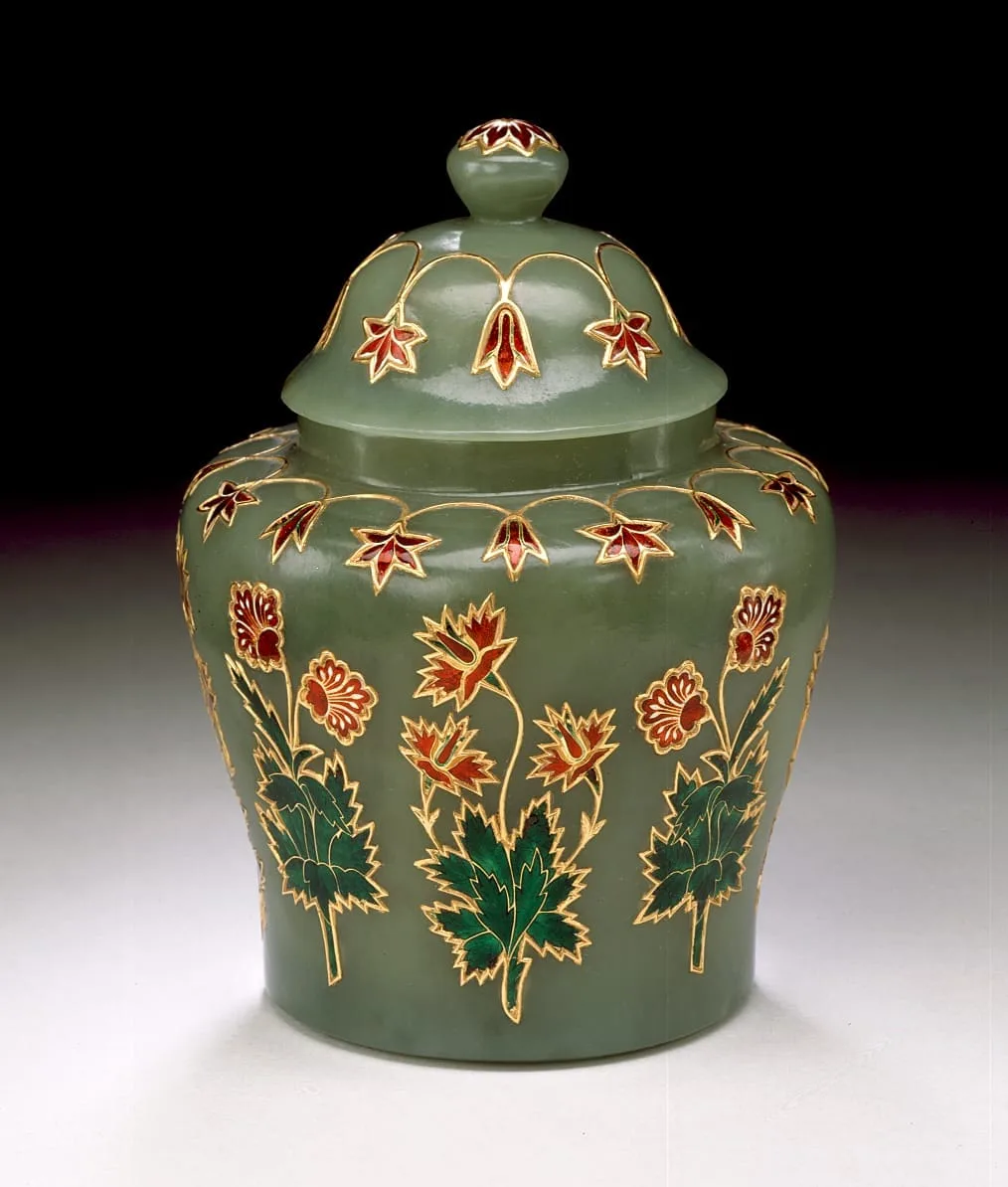
Made of green nephrite jade with red, white, and green enameling set in gold, this elegant covered jar is fashioned in the form of a stout baluster vase with tapering high shoulders and a slight fishtail bottom. The domed lid has a knob finial adorned with an enameled eight-point flower. The primary band of decoration around the vessel waist consists of alternating sprays of stylized poppies and lotuses. Each plant has serrated leaves, despite their botanical inaccuracy for lotuses. Matching scrolling vines with alternating pendent blossoms encircle the vessel’s shoulders and lid.
Deriving from the Mughal tradition of covered jade jars, such as a late 17th-century example in the British Museum, London (1945,1017.258.a-b), this mid-20th-century vessel recalls the rarer form of jade baluster vases, such as a bejeweled specimen attributed to 19th-century Lucknow in the Victoria and Albert Museum, London (688-1874). More exact morphological models may have been the Chinese vessels known as Temple Jars and Ginger Jars, such as a 19th-century Jingdezhen porcelain jar in the Asian Art Museum (B60P339.a-.b). The use of enameling as the surface ornamentation rather than the more common inlaid gemstones also evokes certain 18th-century Mughal vessels, such as an ewer in the Victoria and Albert Museum (IS.02594&A). Ultimately, the LACMA jar likely epitomizes the contemporaneous Mughal-style vessels produced in Jaipur, such as an enameled gold bottle in the British Museum (2001,0521.23).