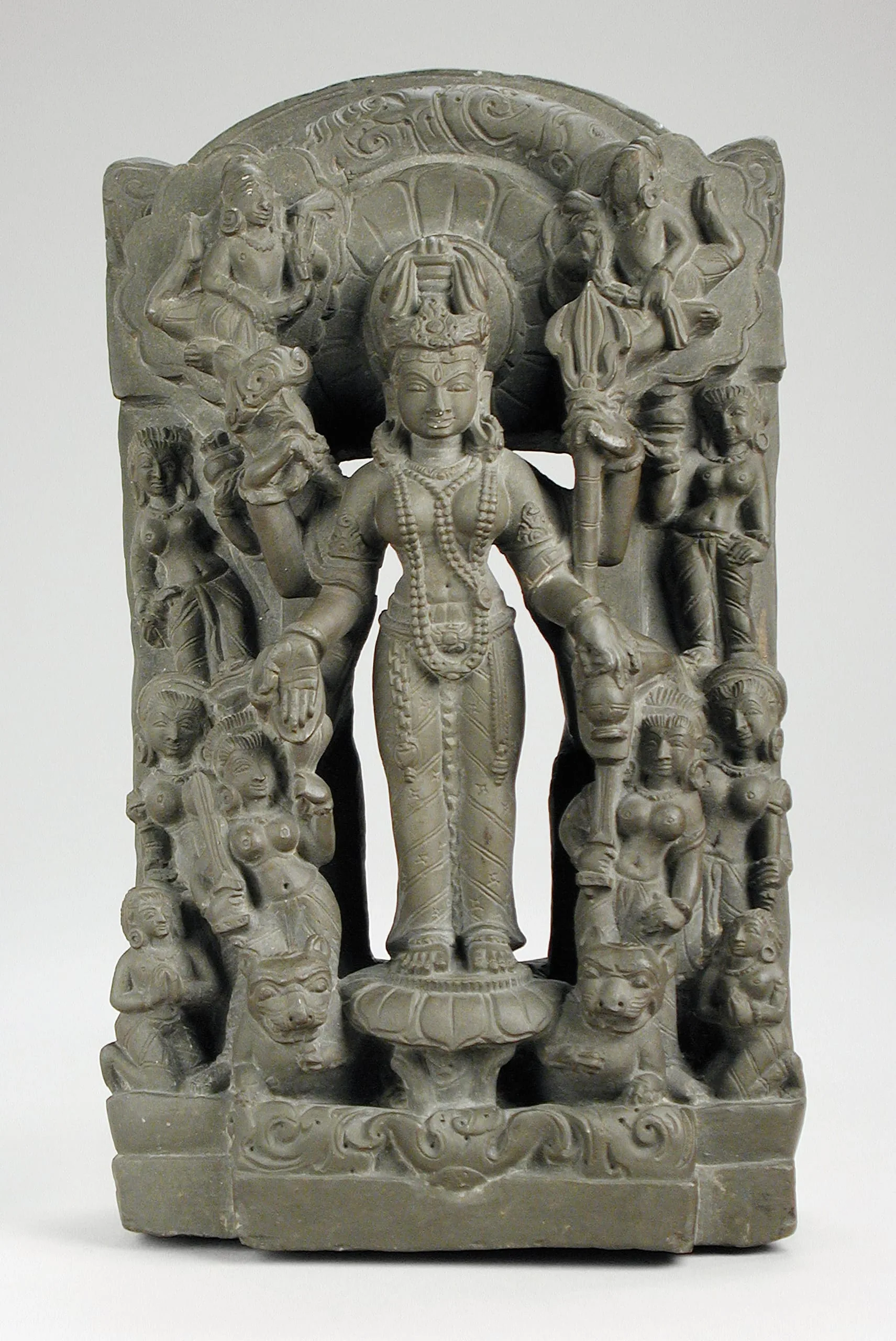
This detailed soapstone sculpture of the Hindu goddess Parvati, spouse of Shiva, is inscribed on the reverse with the name of the otherwise unknown sculptor C. Syama and the date 1870. Likely intended for domestic worship, the colonial trade market, or an exposition, it is a high-quality copy of the renowned 11th-century chlorite schist image of Parvati from the Baijnath Temple Complex in Baijnath, Uttarakhand, now in the National Museum, New Delhi (6415).
Parvati is nimbate, crowned with a tiara, and has ascetic’s piled hair (jata mukuta). The goddess is profusely ornamented and wears a patterned lower garment. She has four arms. In her upper left hand, she holds the trident (trishula) of Shiva. She grasps an ascetic’s water vessel (kamandalu) in her lower left hand. In her upper right hand, she carries a lotus bud. Her lower right hand is extended in the gesture of charity (varada mudra). Parvati stands in a stiff, frontal pose (samapada sthanaka) on a blossoming lotus rising from the cosmic ocean. She is under an arch that doubles as an aureola (prabhavali). Two celestial garland bearers (maladharas) fly above the goddess in her honor. Flanking the central lotus are two lions representing her lion mount (sinha vahana) shared with the goddess Durga. The lions look outward at the viewer rather than gazing at their mistress, as in the original sculpture. Along the edges of the arch are several subsidiary female attendants carrying diverse attributes. They are stand-ins for the twenty-six analogous figures surrounding the goddess in the original sculpture. Two kneeling donor figures with their hands held in adoration (anjali mudra) are in the lower corners, male on her right and female on her left. See also M.82.226 and AC1992.209.1