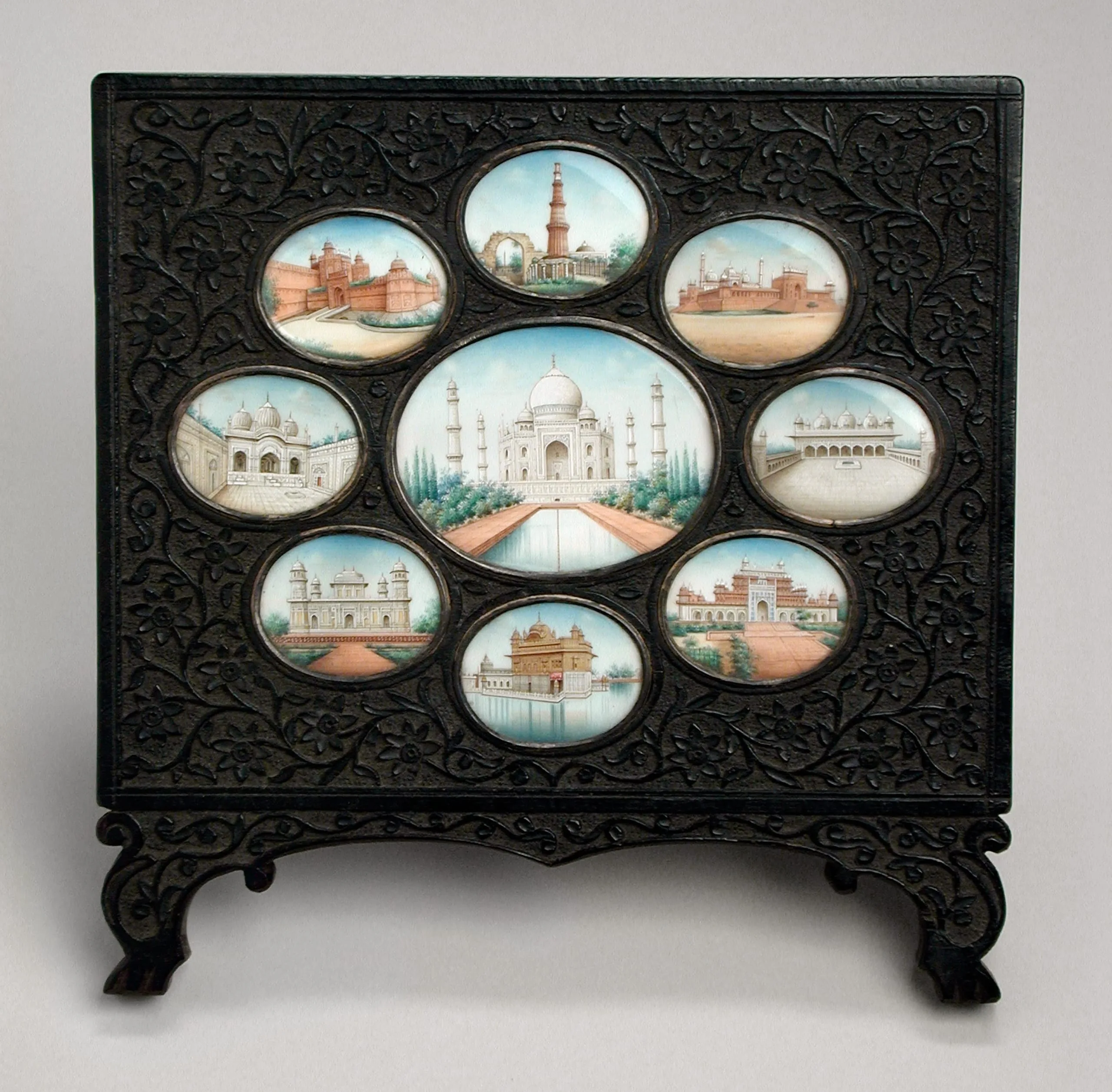
Miniature portraits on ivory of Mughal monarchs (see M.91.23) and views of Indian monuments were avidly collected by members of the East India Companies and European visitors to India beginning by the 1840s. In this group representation, nine oval architectural paintings on ivory are mounted into an ebony frame decorated with flowering vines carved in shallow relief. The Mughal-trained Indian artists who produced the architectural drawings adopted Western spatial perspective to appeal to the collecting tastes of their patrons and clients.
The Taj Mahal, Agra (built in 1632-1643) is centrally placed befitting its iconic status. It is surrounded by eight prominent landmarks of Sultanate, Mughal, and Sikh architecture. The other buildings are (clockwise from 12 o’clock): Qutb Minar (Victory Tower of Qutb ud-Din Aybak of the Delhi Sultanate, r. 1206-1210), Delhi (1199-1220); Jama Masjid (Congregational or Friday Mosque), Delhi (1644-1658); Moti Masjid (Pearl Mosque), Agra (1648-1655); Tomb of Emperor Akbar (r. 1556-1605), Sikandra (1605–1613); Golden Temple of the Sikhs, Amritsar (1581-1589); Tomb of Itimad ud-Daula (d. 1622), Agra (1622-1628); Moti Masjid (Pearl Mosque), Delhi (1659-1660); and the Lal Qila (Red Fort), Delhi (1639-1648).
This was the first South Asian object to enter the museum’s collection.