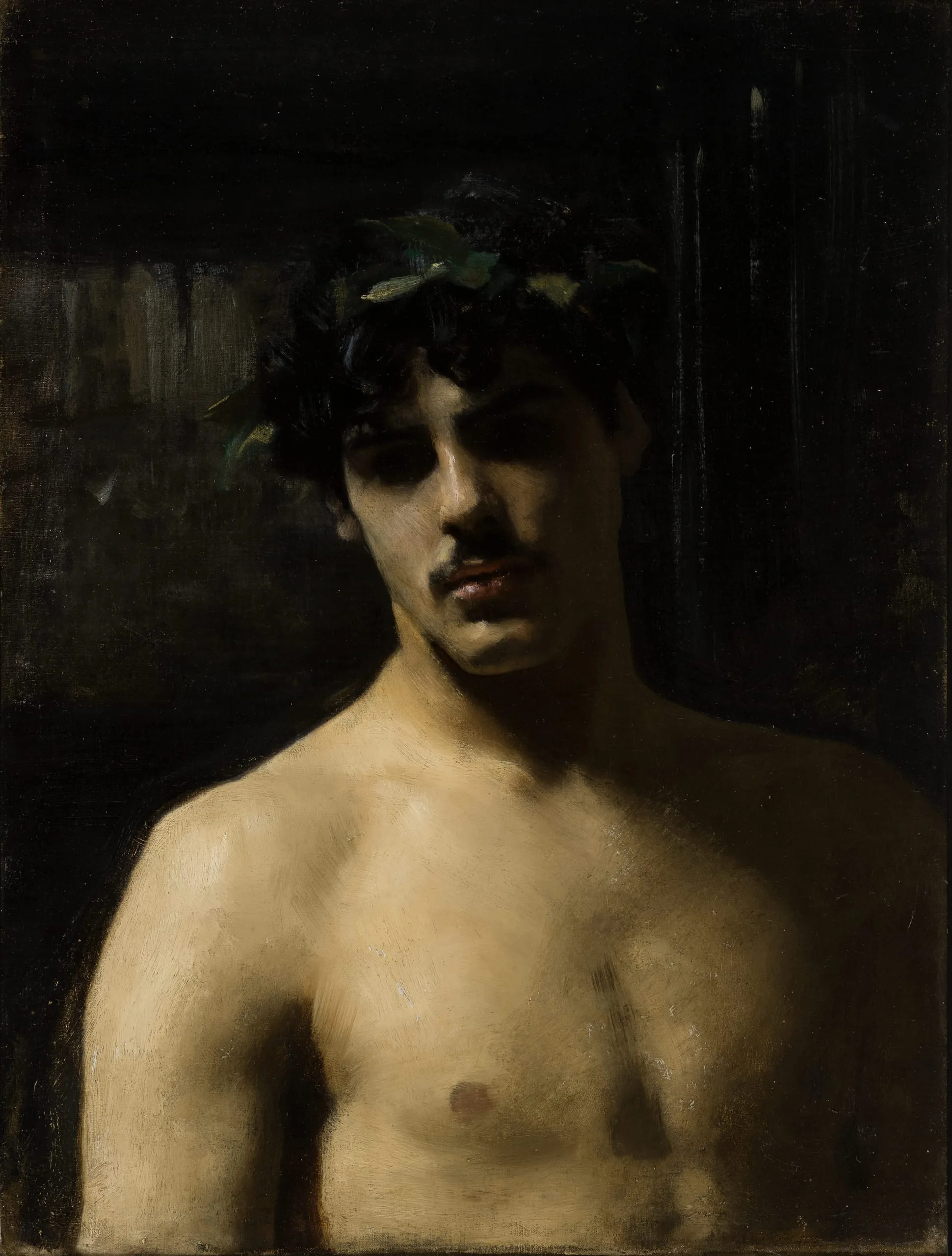
Sargent executed several studies of male nudes, which were probably painted during or soon after his student years at the private atelier of Carolus-Duran. While Man Wearing Laurels is a bust-length study, a more elaborate painting of perhaps the same man wearing laurels, A Male Model Standing before a Stove, late 1870s (Metropolitan Museum of Art, New York), indicates that the figure is a professional model posing in a studio. French academic training extolled the human form as the major vehicle of expression. Usually the student was forced to develop his draftsmanship through meticulous drawings. Only after gaining a command of the human figure was the student permitted to use paint.
Carolus-Duran was considered a radical in his methods because he encouraged his students to merge drawing with painting. He emphasized tonal painting as the means to construct form and stated, "Search for the values.... Establish the half tints (la demiteinte) as a basis, then a few accents and the lights" (quoted in Boston, Museum of Fine Arts, Catalogue of the Memorial Exhibition of the Works of the Late John Singer Sargent, exh. cat., 1925, text by J. Templeman Coolidge, p. ix). Following these tenets, Sargent built up the model’s face by applying lights and darks to convey the sense of three-dimensionality, reserving the strokes of the brightest flesh tints for the nose and chin. Sargent’s strokes are swift and sure, without concern for minute details or surface finishing. The shadowy light, reminiscent of Spanish painting, not only boldly contrasts the model’s chest and face but softens the image.