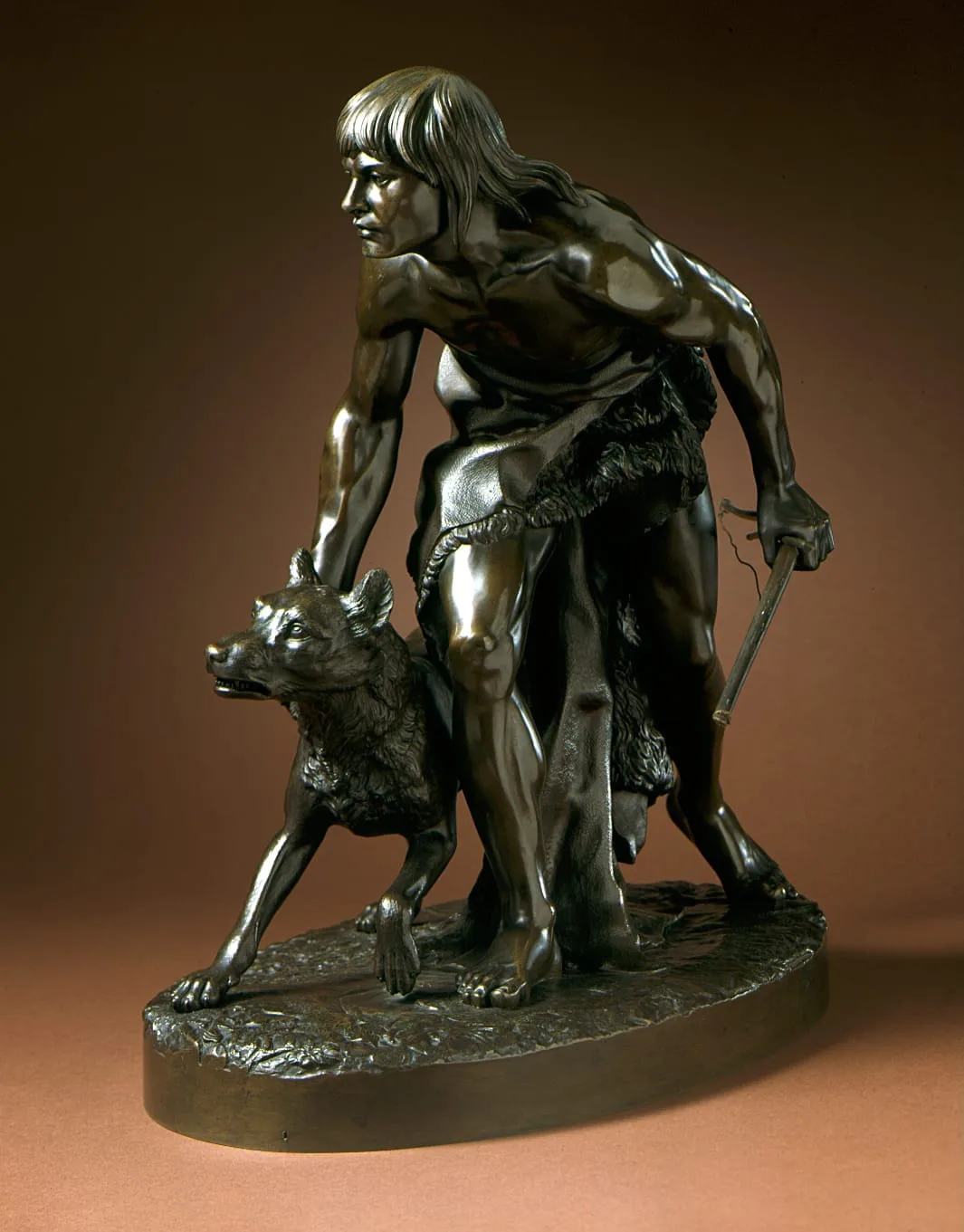
Ward’s reputation was established with his large cast of The Indian Hunter, 1866, the first statue to be placed in Central Park. That statue was modeled after a smaller bronze, of which the museum’s sculpture is one of about fifteen known examples, all dated 1860. They are among the earliest American bronzes.
Although Ward traveled to the Dakotas to study Native American life and physiognomy between his creation of the half-lifesize statuette and the statue in Central Park, the differences between the two sculptures are minor: in the outdoor Indian Hunter the arm holding the bow is slightly raised, the aboriginal quality of the face emphasized, the animal skin reduced, and shape of the base made rectangular rather than oval. Ward based the general pose of The Indian Hunter on the famous classical Borghese Gladiator (Musée du Louvre, Paris), which he may have known from a plaster cast.
This bronze demonstrates Ward’s skill at infusing a figure with an animated realism that was new to American sculpture. The surface of the man’s body is highly polished, and extensive chasing developed texture in other areas. Ward contrasts the textures of the man’s smooth skin, the coarse, thick hair of the pelt, and the soft, curly fur of the dog. Moreover, the poses are those of suspended animation as the hunter stalks his prey, momentarily holding back his dog to concentrate on the quarry.
Ward’s choice of subject matter was important to the work’s success. Mid-nineteenth-century artists had only recently turned to the Native American as a subject. Articles such as "The Indian in American Art" in the 1856 issue of The Crayon encouraged them to depict his character before he disappeared. Ward’s teacher, Henry Kirke Brown, had been the first to do so in bronze, and Ward first modeled this figure while still in Brown’s studio.
Some of the approximately fifteen known casts of the statuette of The Indian Hunter bear the mark of the Henry-Bonnard Bronze Company, New York, and others that of the Gorham Company, Providence, R.I.; yet others were cast by unknown foundries. Three larger than life-size casts are recorded (see Sharp, Ward, pp. 147-49 for list of known examples).