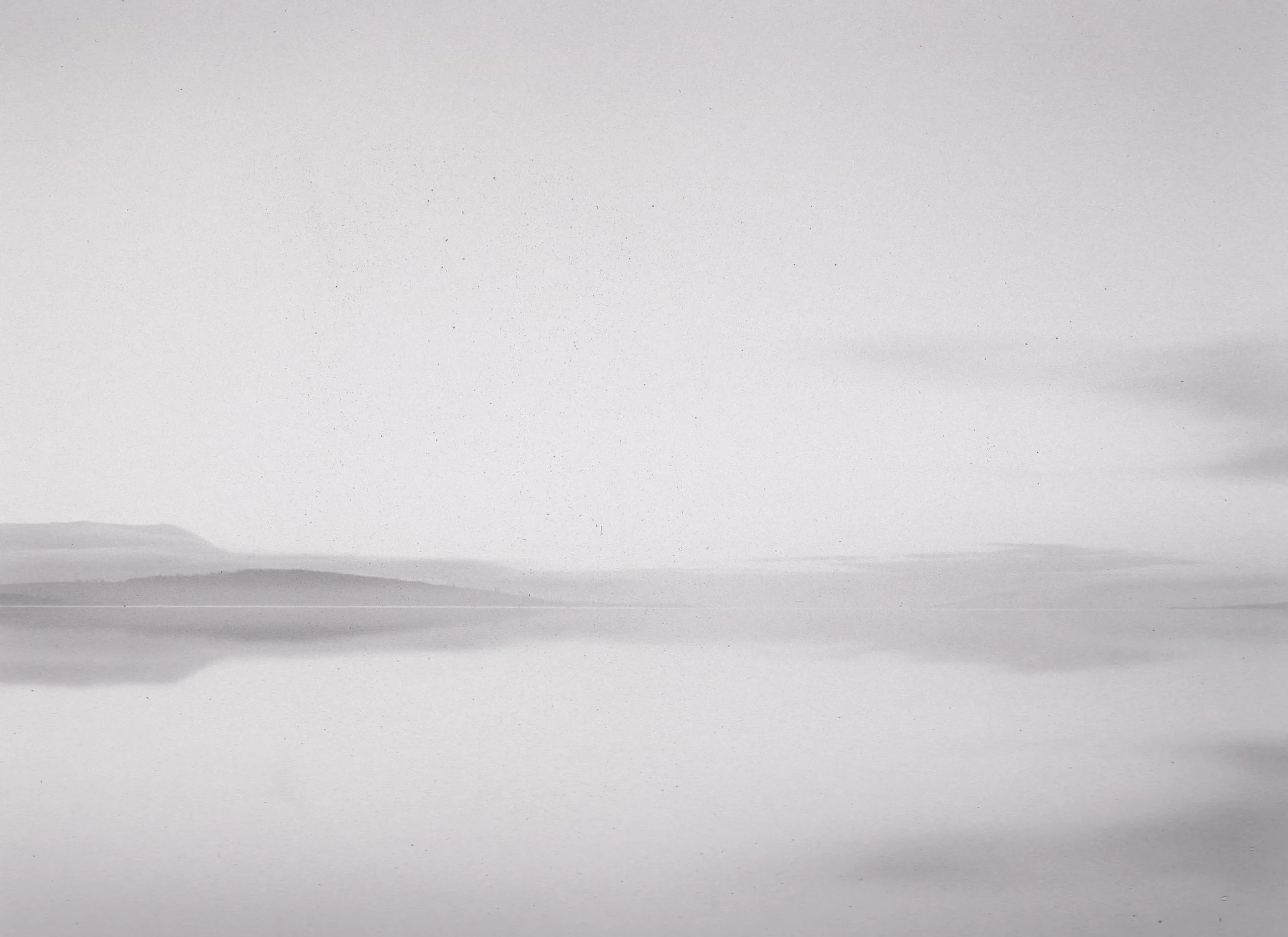
Don Worth’s photographs reflect his lifelong interest in fostering a relationship with nature, accentuating the patterns and forms found throughout the living world. He cultivated exotic plants from the time he was a boy on an Iowa farm, and his photography often focuses on his homegrown succulents, orchids, and bromeliads. By the 1980s, his work became significantly reduced, as in Twilight, near Hobart, Tasmania, which Worth deemed one of his “pale” landscapes. In it, a sliver of land is barely visible between an ethereal sky above and the suggestion of water below. Artist Hal Fischer described this image as “a complete manifestation of nature as a diaphanous vessel of the spirit,” pointing to the emotional, spiritual, and evocative aims of Worth’s photography.
Worth studied music at Mills College, focusing on composition with Darius Milhaud and piano with Alexander Libermann. It was there, in the mid-1950s, that he began photographing with an 8 x 10 view camera. After becoming acquainted with Ansel Adams, he moved to San Francisco to work as his assistant. Worth’s last musical score was composed for the film Ansel Adams, Photographer in 1958. His photographic work can be organized into five major subjects: plant forms, landscape views, still life, urban scenes, and male nudes. While his shift to photography has been described as an effort to create something “more durable,” his images were not intended to be documents. Rather, they should be considered in the context of Alfred Stieglitz’s notion of the “equivalent,” in which the emotion of the source is captured in the photographic image.
Rebecca Morse, Curator, Wallis Annenberg Photography Department
2024
Bibliography
Don Worth: Photographs 1955−1985. Intro by Hal Fischer. Carmel, California: The Friends of Photography, Untitled 40, 1986.