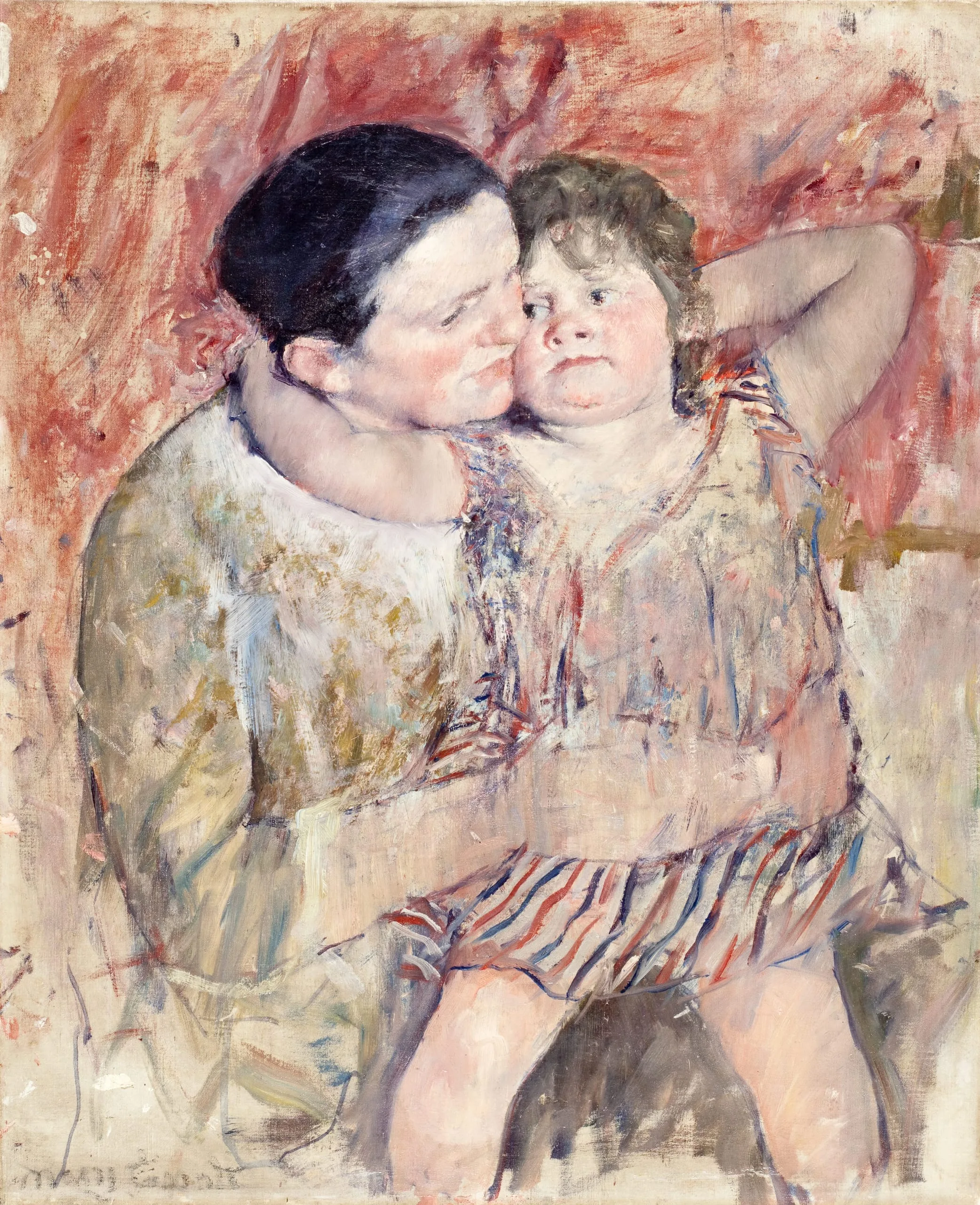
Through the generosity of Deborah and John Landis, the museum acquired its second Mary Cassatt painting, Woman and Child (Mathilde Holding a Child). Cassatt was one of the foremost American artists of the 19th century. Almost her entire career was spent in France as an expatriate, and it was there she became a confidant of Degas and a member of the radical circle of French impressionists. The only American invited to exhibit with them in Paris, Cassatt first presented her famous “mother and child” images at their annual shows. Mother About to Wash Her Sleepy Child (1880), the museum’s other Cassatt oil, is believed to be the artist’s earliest dated modern Madonna. Woman and Child is slightly smaller but equally rich in palette.
Manifold are the discussions about Cassatt’s maternal themes and their relationship both to her own life (she remained single, but lived in close rapport with her extended family) and to a contemporary religious revival in France. Recently, scholars have begun questioning the identity of these so-called mothers, and clues can sometimes be found in their attire. Is the woman in our 1880 painting the mother or a servant? She appears to be wearing intimate at-home attire, but an upper-middle-class woman probably would have relegated the domestic chore of her children’s toilet to a nursemaid. One of Cassatt’s servants, Mathilde Vallet, often posed for the artist; but in the context of Woman and Child is she to be read as the mother? There is not enough detail to know what she is wearing. Moreover, although the young child hugs Mathilde, her eyes express a slight skepticism rather than the confidence one would expect.
Woman and Child actually has two subjects, for the paint surface is as significant as the imagery. The canvas was intentionally left unfinished (it is signed), suggesting that the artist wanted the viewer to luxuriate in the paint’s physicality. Its surface consists of neutral-colored passages of underpaint as well as areas finished to varying degrees. Cassatt varied her approach, using sweeping strokes, wiggles, parallel lines, and even rubbing out the pigment. The canvas also offers insight into the artist’s working methodology. Typical of an academically trained artist, the faces are the most fully realized. Yet Cassatt built up her three-dimensional forms, first drawing in cobalt blue a quick, sure outline, than applying strokes one over another so that her figures simultaneously suggest solidity and movement. Cassatt had been criticized for her defective drawing by her teachers, who considered her approach slovenly. Today we realize how brilliant a draftsman she was.
Mother About to Wash Her Sleepy Child and Woman and Child document Cassatt’s importance to both American and French painting.