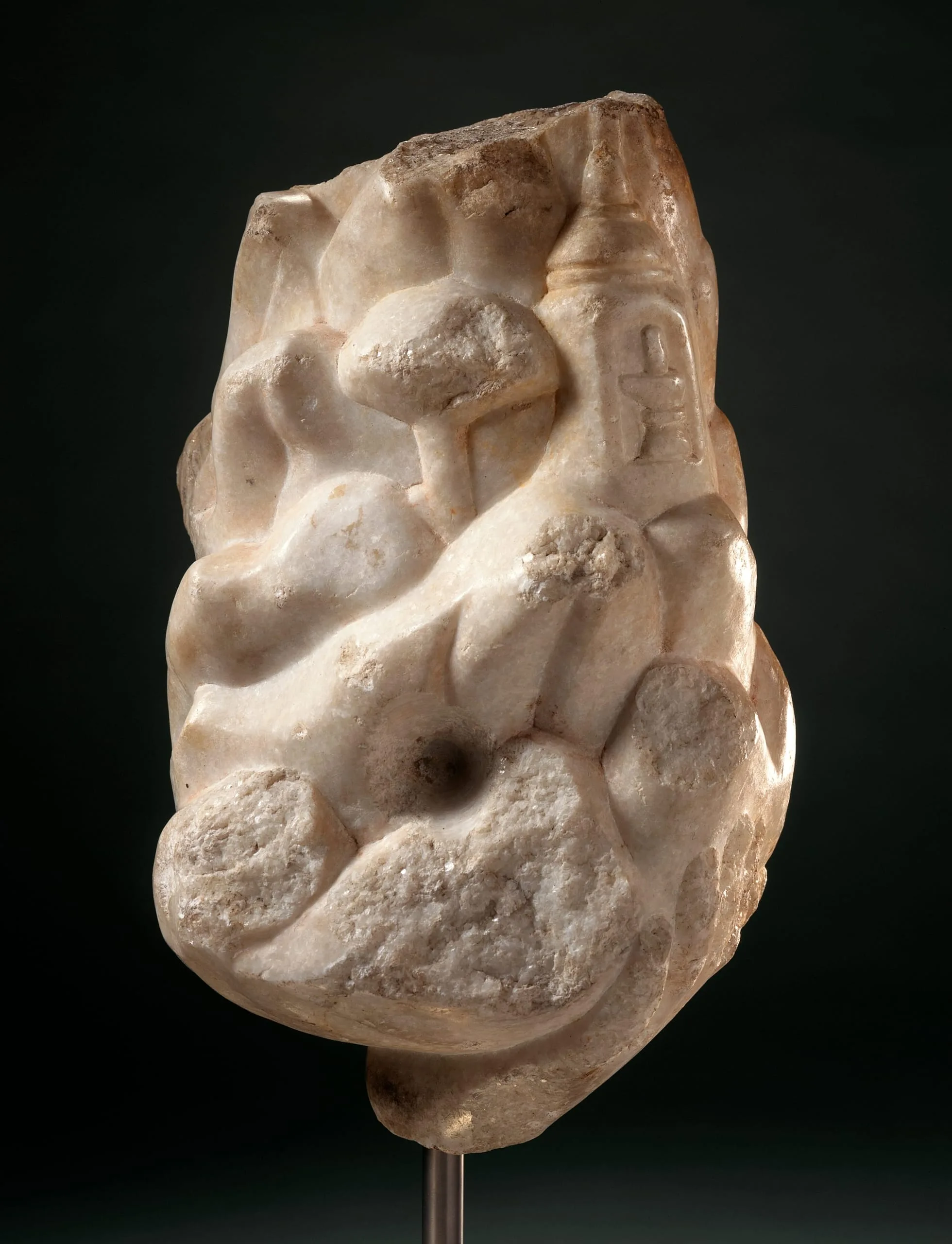
This white marble fragment of an over-life-size sculpture is the Himalayan mountaintop with medicinal herbs carried by Hanuman, The Divine Monkey in the great Indian epic, the Ramayana (Adventures of Rama). Hanuman had fetched the herbaceous peak of Mount Vindaya to heal the heroic warrior brothers Rama and Lakshmana after they had been struck down the magical arrows shot by the demon-king Ravana’s son Indrajit (Ramayana 6:60:48-61:68). Hanuman was also the protagonist of the long Hindi poem, the Ramacharitmanas (Holy Lake of the Deeds of Rama) by Tulsidas (1532-1623). It differs primarily from the Ramayana in that it portrays Rama as divine rather than mortal and gives considerably increased emphasis to the role and personality of Hanuman by honoring the valiant monkey with the most dramatic and largest number of depictions, particularly his fierce battles, staunch loyalty, and crucial acts that turned the tide of the war. Hanuman’s immense cultural popularity in the 17th–19th centuries gave rise to his moist iconic form, continuing to the present day, of the supersized simian bearing the mountaintop with the lifesaving medicinal herbs. See also M.89.159.1 and M.85.291.1.
The mountaintop has forested hillocks with a Shivalinga in a shrine. The detached summit is being born aloft in Hanuman’s left hand visible on the underside.
A closely comparable complete rendition of this iconographic form of Hanuman sculpted in white marble is in the National Museum of Scotland, Edinburgh (A.1960.997). Therein attributed to the 14th century, it more likely dates from the 19th century.
A contemporaneous painting of Hanuman carrying the mountaintop of herbs and leading his army is in the National Museum of Asian Art, Washington (57.70.6). Attributed to Rajasthan, circa 1800, it aptly conveys his later cult status.
Ramayana verse citations from Robert P. Goldman, Sally J. Sutherland Goldman, and Barend A. van Nooten, trans., The Ramayana of Valmiki: An Epic of Ancient India., Vol. 6. Yuddhakanda (Princeton: Princeton University Press, 2009), pp. 326-332.