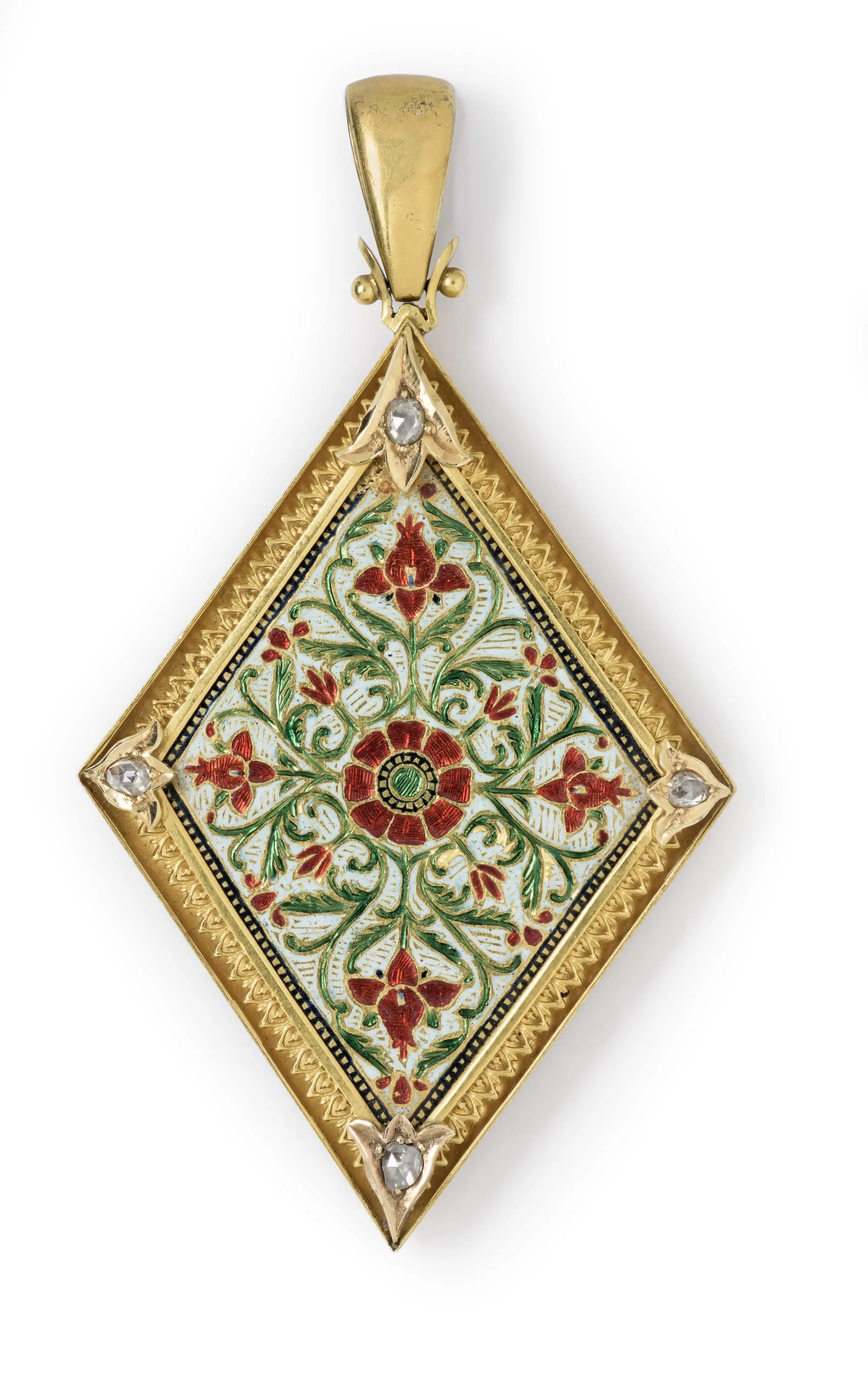
This stylish gold pendant is atypically ornamented on the front with an inset diamond-shaped panel featuring translucent enamels of brilliant red, green, and dark blue; opaque white; and traces of opaque powder-blue enamel in a hybrid floral composition. The symmetrical arrangement is centered by an eight-petaled open blossom. It has large lotuses at the four points and smaller lotuses at intermediary positions. Connecting all the blossoms is an intricate network of translucent green stems, split acanthus leaves, and bracts set in gold. The opaque white background is punctuated with hatching of fine parallel lines of gold. The pendant form and dedcoration are modeled upon mid-19th-century Victorian design.
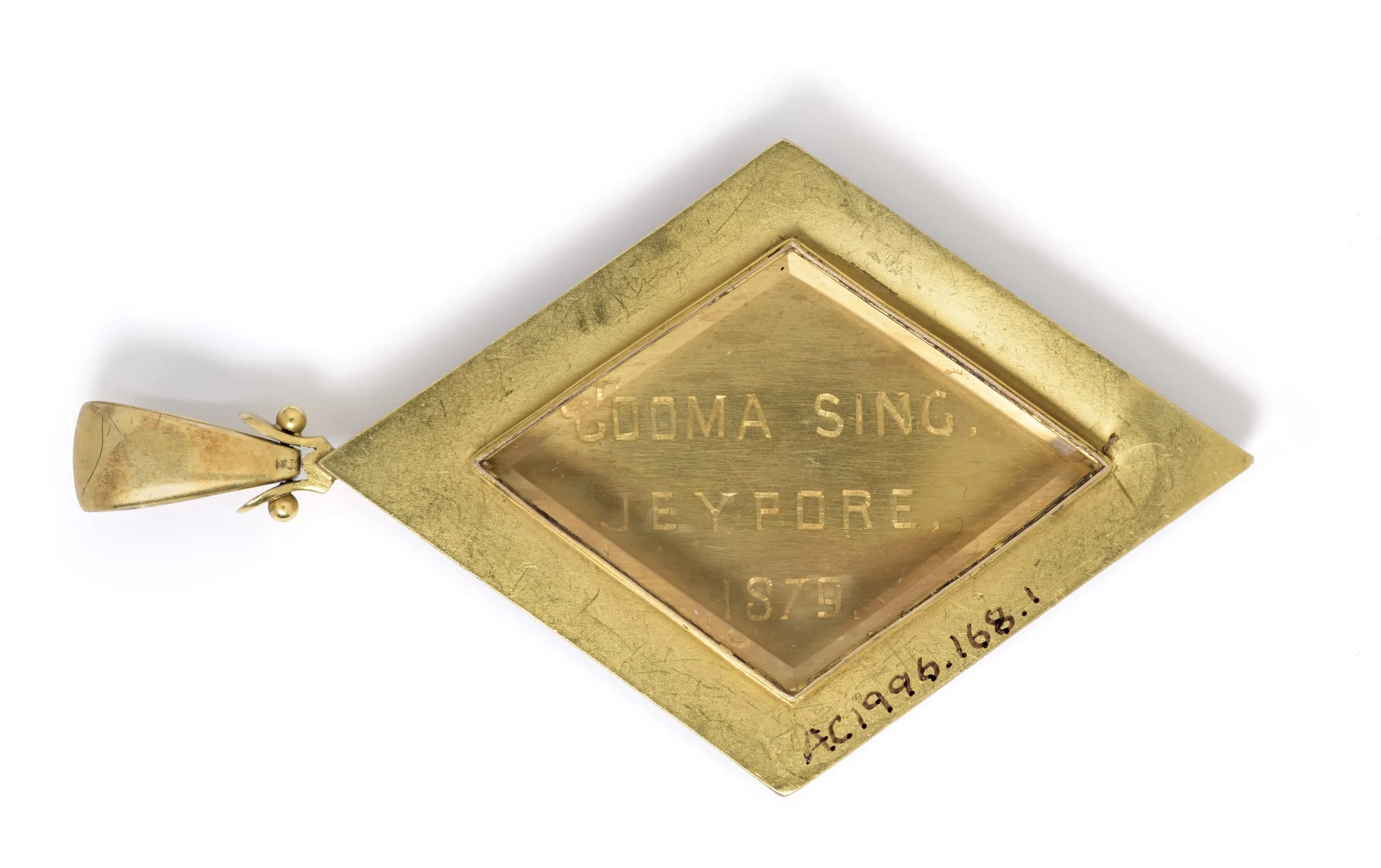
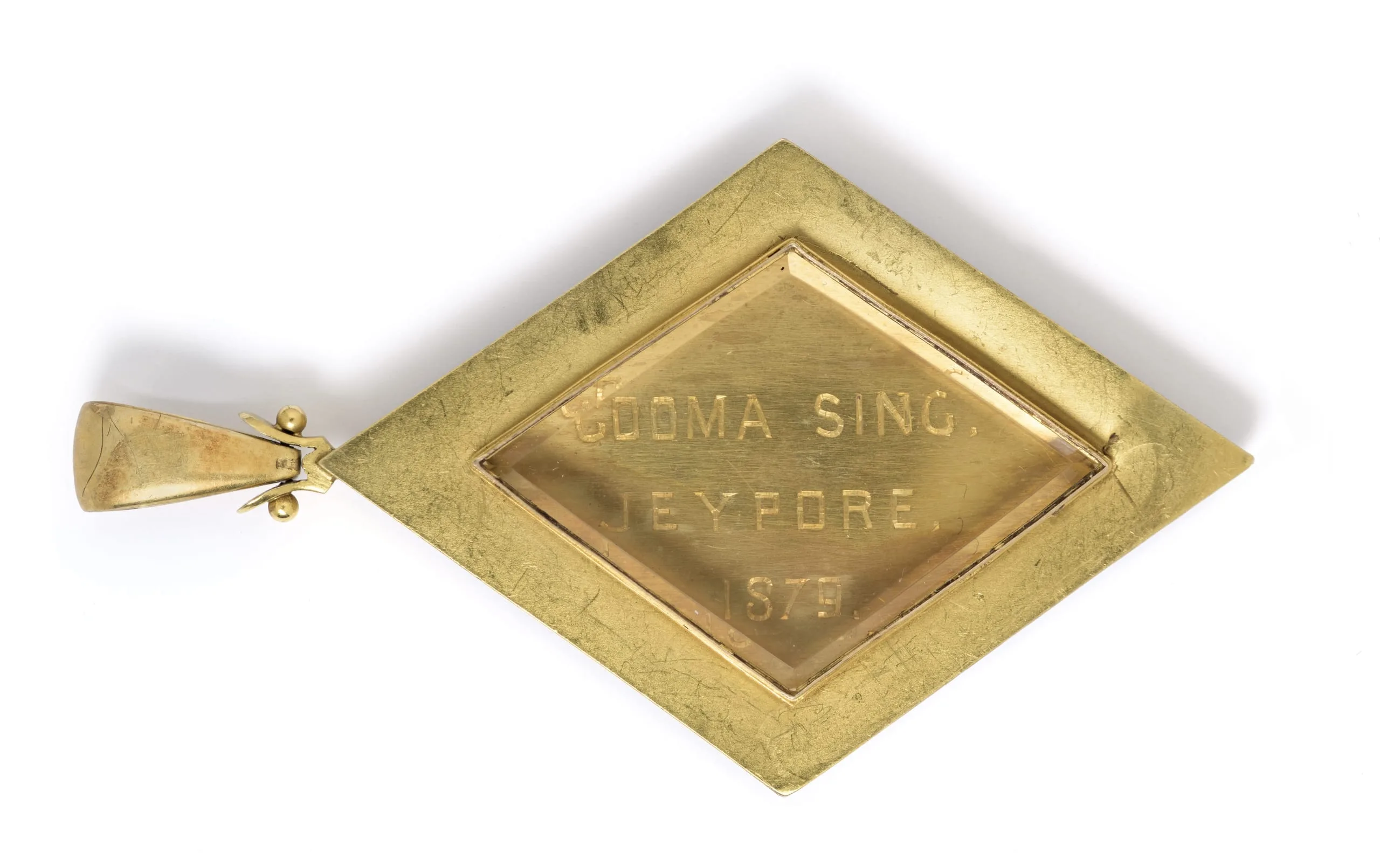
Not only is the enameling of extremely high quality but the pendant is one of the very few signed and dated examples of Jaipur enamel work. The back bears a hand-chiseled inscription in English, "Gooma Sing, Jeypore [Ghuma Singh, Jaipur], 1879." Ghuma Singh was an award-winning Sikh enameler from Jaipur, whose long career spanned the second half of the 19th century. Jaipur enameling is traditionally (but somewhat unconvincingly) said to have begun with the arrival of five Sikh enamelers from Lahore at the court of Amber (the ancestral court of Jaipur) during the reign of Man Singh (r. 1589–1614). The Amber enamelers subsequently moved to Jaipur in the mid-18th century. In 19th-century exhibition catalogues, Jaipur enameling was generally recognized as the finest enameling in all of India. Ghuma Singh and his fellow Jaipur enamelers were not directly employed in a court studio. Rather, enameling was a hereditary occupation that was practiced at home jointly by family members. Their occupational independence notwithstanding, Jaipur enamelers did not generally market their wares themselves. Rather, they worked on commission for the court and wealthy jewelry merchants. About one-third of Jaipur’s enamel production was made for the European market.