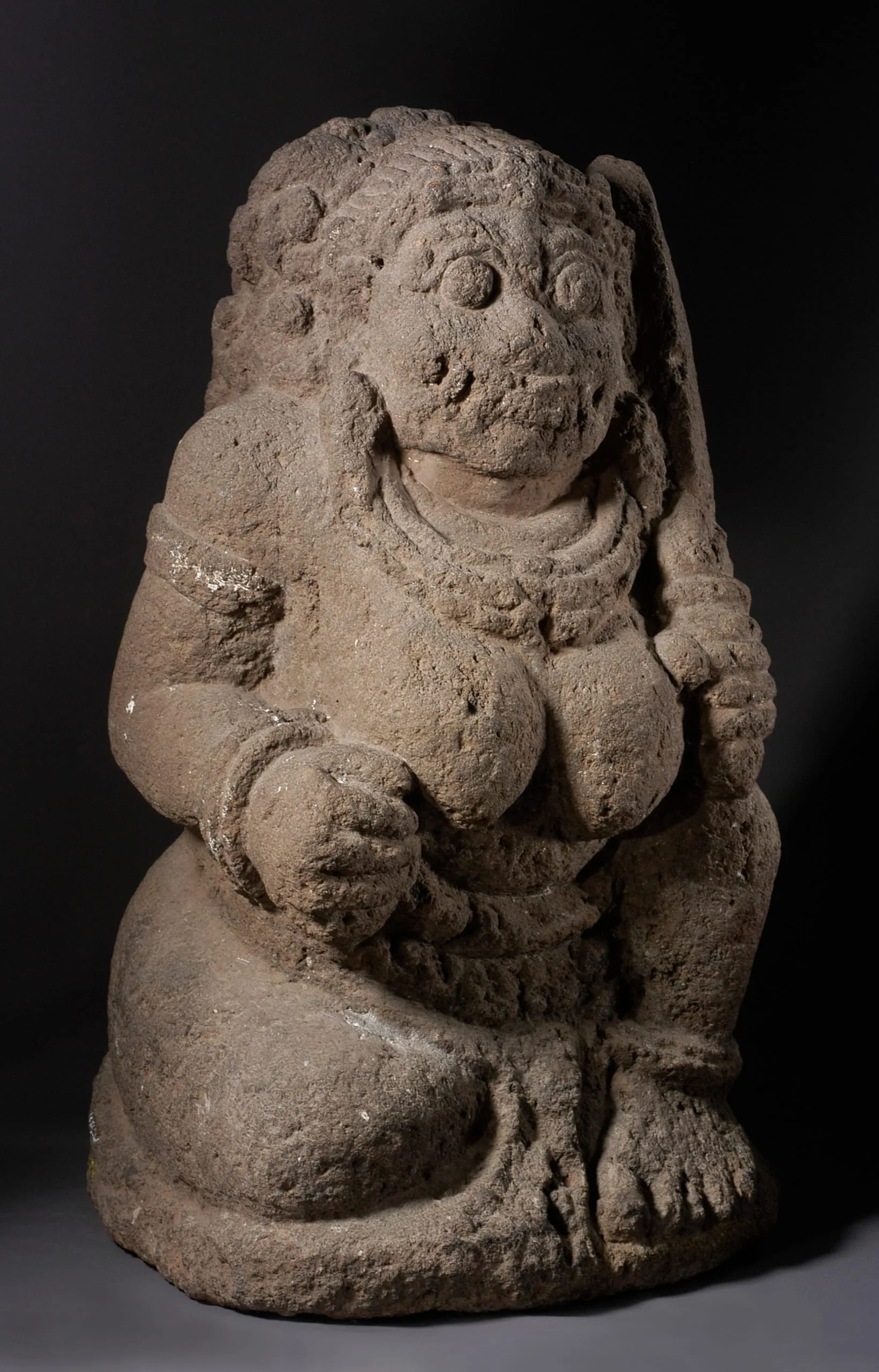
In Hindu Puranic mythology, demons (asuras or rakshasas [male] and rakshasis [female]) were created by Brahma, the God of Creation. They were born at night from his thigh or buttocks in a moment of darkness or spiritual passion. Due to their bloodlust and voracious hunger, the demons represent the chaos and dark negative energy (tamas) necessary to balance the positive forces of the gods. Rakshasas have the power to change their shape at will and appear as animals, monsters, or seductive beautiful women. In Indonesian art, large stone statues of rakshasas or rakshasis were placed at entrances as protective gatekeepers (dvarapala) to temples and at doorways to sacred spaces. Designed to ward off evil spirits, they are typically depicted with fearsome features, including bulging eyes, fangs, and a potbellied physique. They often hold a club or chopper.
The LACMA rakshasi follows the standard iconographic conventions for a Javanese guardian demon. Envisioned as an ogress with a ferocious visage and pendulous breasts, she sits in the relaxed posture (lalita asana) and carries a club.
Comparable Eastern Javanese stone demonic guardians are in the Metropolitan Museum of Art, New York (51.104.3) and Musee Guimet, Paris (MG 18052). See also M.80.61.