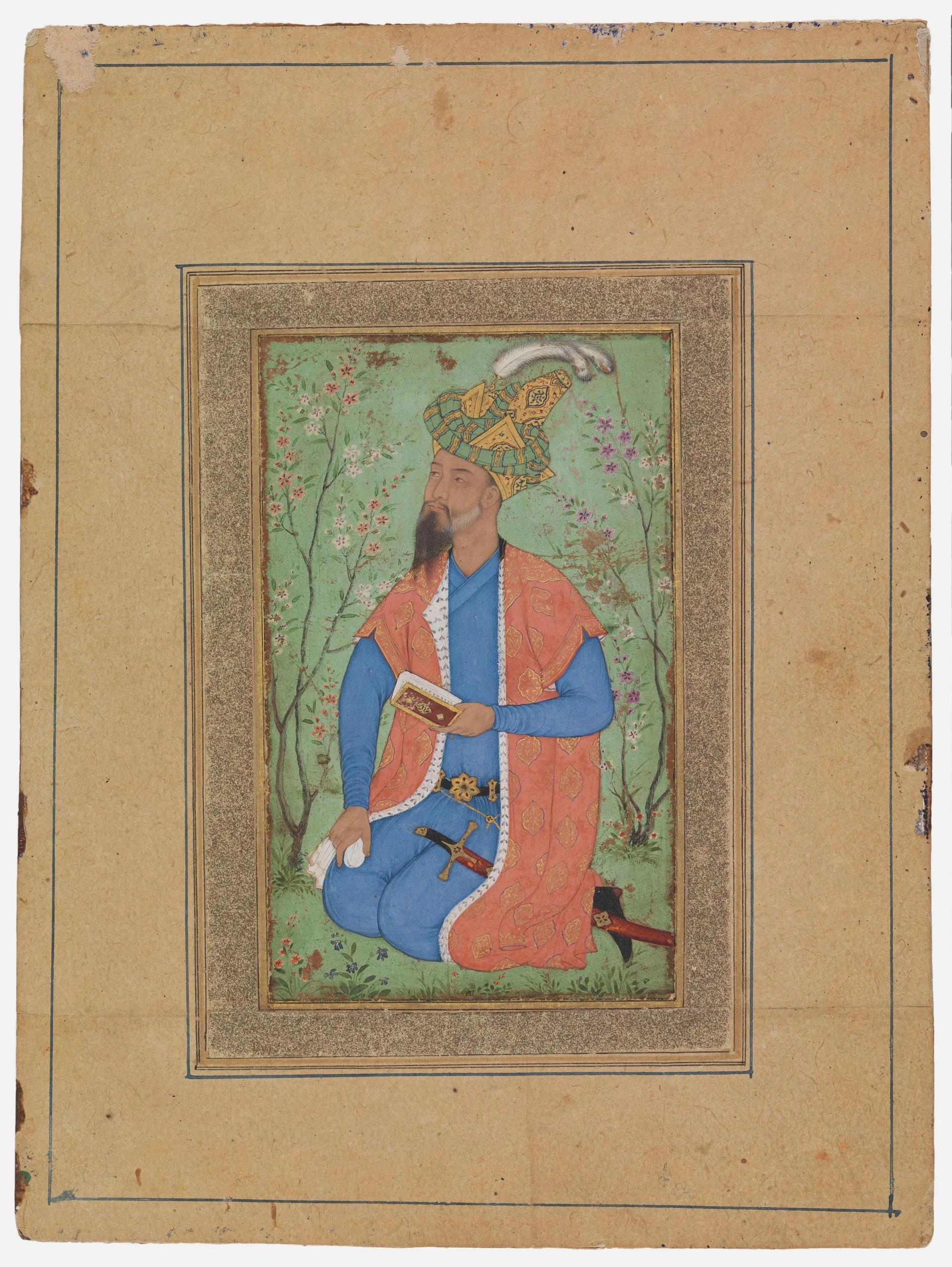
The face of the distinguished subject of this portrait has been rendered with great perception —note his graying beard, wrinkled skin, and thickened eyelids. The distinctive headgear conforms to the fashion of the reign of the second Mughal emperor Humayun (r. 1530−40 and 1555−56). This characteristic type of turban with feathers was referred to as the taj-i ‘izzat, or crown of glory. It was worn only by Humayun, his brothers, and select courtiers, as evidenced by their depictions, and it was discontinued during the succeeding rule of Akbar (1556−1605).
Though LACMA’s painting is not a portrait of Humayun (who likely would have had a black egret feather added to his cap), the sitter’s headdress, gold and jeweled belt and sword hilt, and sumptuous fur-lined coat suggest someone of importance from the emperor’s entourage, perhaps one of his brothers such as Mirza Hindal (d. 1551). The book held in the figure’s left hand points to the erudition and high status of a prince. While the likeness is that of a Mughal notable of the mid-sixteenth century, the painting belongs to the early seventeenth century, when the naturalistic depiction of princes and courtiers against green backgrounds was common. A later inscription on the back of the painting that reads “Mir Timur Gurgan” suggests an identification of the figure with Timur (r. 1370−1405), founder of the Timurid dynasty to which the Mughals traced their descent.
Linda Komaroff
2025