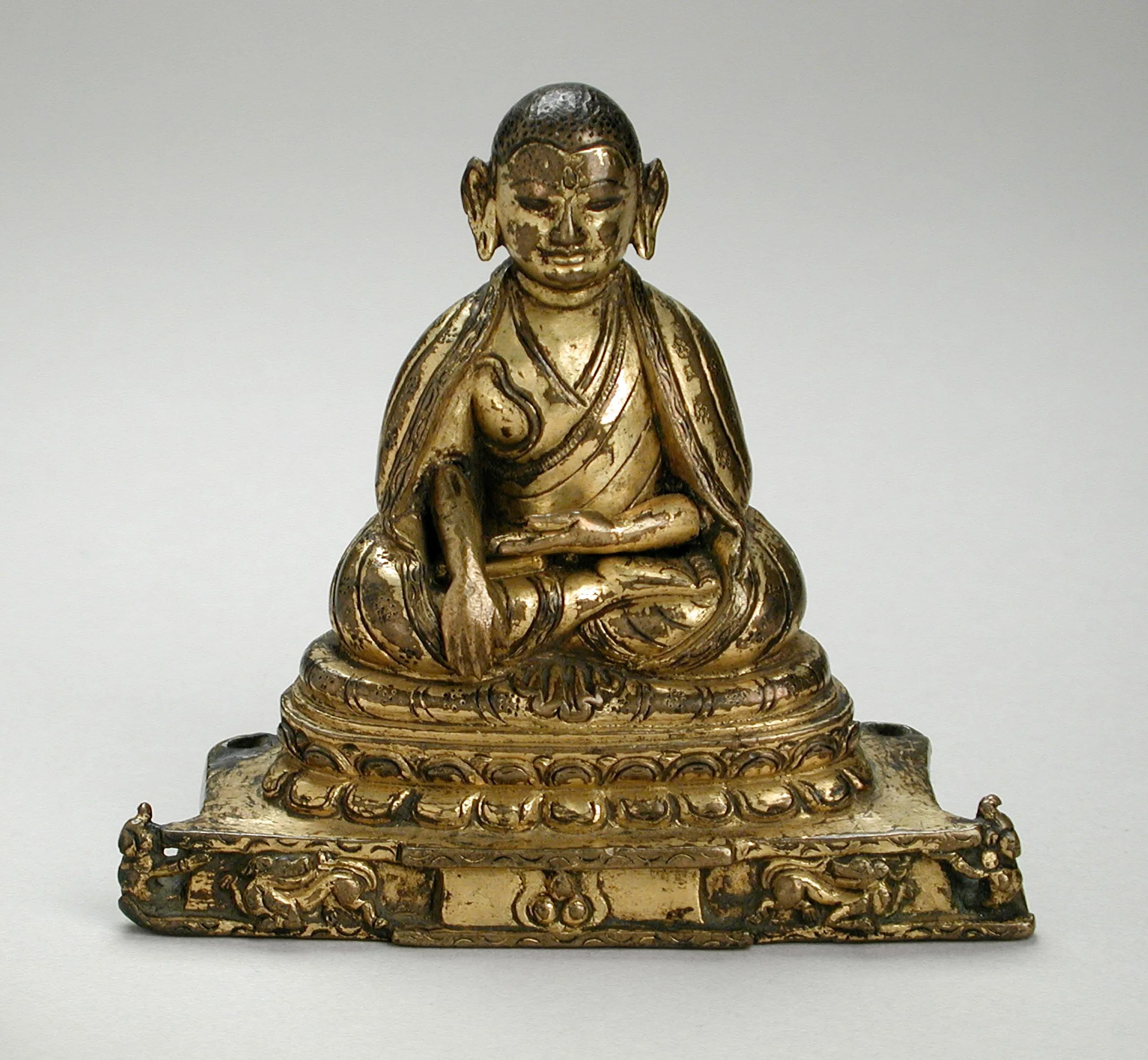
Unidentified by an inscription, this unknown Tibetan Buddhist monk has an ascetic’s shorn head with dots of black paint suggesting sprouts of hair. Like the Buddha, he has elongated earlobes symbolizing his abandonment of the mundane world. Between his eyes at the bridge of his nose is a circular sacred marking (urna) that signifies his prominence and spiritual insight. He wears the "triple robe" set of monk garments (tricivara) comprised of a lower under-robe (antarvasa), upper robe (uttarasanga), and outer cloak/heavy robe (sanghati). His left hand is in his lap held palm upward in a half-gesture of meditation (ardha dhyana mudra). His right hand lightly grasps his right knee. The monk sits in the meditation posture (padma asana) on a cushion on a double lotus base and lion throne. In the center of the throne are the wish-fulfilling Precious Gems symbolic of the Three Jewels (triratna) of Buddhism: the Buddha (the enlightened one), the Dharma (the teachings and path to enlightenment), and the Sangha (the community of practitioners). The gems are flanked by animated lions kneeling on one forepaw with their head turned back towards the jewels. The front corners of the throne are supported by a serpent (naga) with a human body with its arms upraised like an Atlantid figure. The rear corners of the throne have lug holes indicating that there was originally a detachable aureole (prabhavali).
Pratapaditya Pal believes this monk belonged to the Sakyapa order (Pal 1983 and 1990, pp. 218-129, no. S30.)
See Himalayan Art Resources, no. 85772, https://www.himalayanart.org/items/85772