LACMA

ShopMembershipMyLACMATickets
LACMA
Los Angeles County Museum of Art
5905 Wilshire Blvd.
Los Angeles, CA 90036
info@lacma.org
(323) 857-6000
Sign up to receive emails
Subscribe
© Museum Associates 2025

Museum Hours

Monday

11 am–6 pm

Tuesday

11 am–6 pm

Wednesday

Closed

Thursday

11 am–6 pm

Friday

11 am–8 pm

Saturday

10 am–7 pm

Sunday

10 am–7 pm


  • About LACMA
  • Jobs
  • Building LACMA
  • Host An Event
  • Unframed
  • Press
  • FAQs
  • Log in to MyLACMA
  • Privacy Policy
© Museum Associates 2025
Collections

Emanuel Gottlieb Leutze
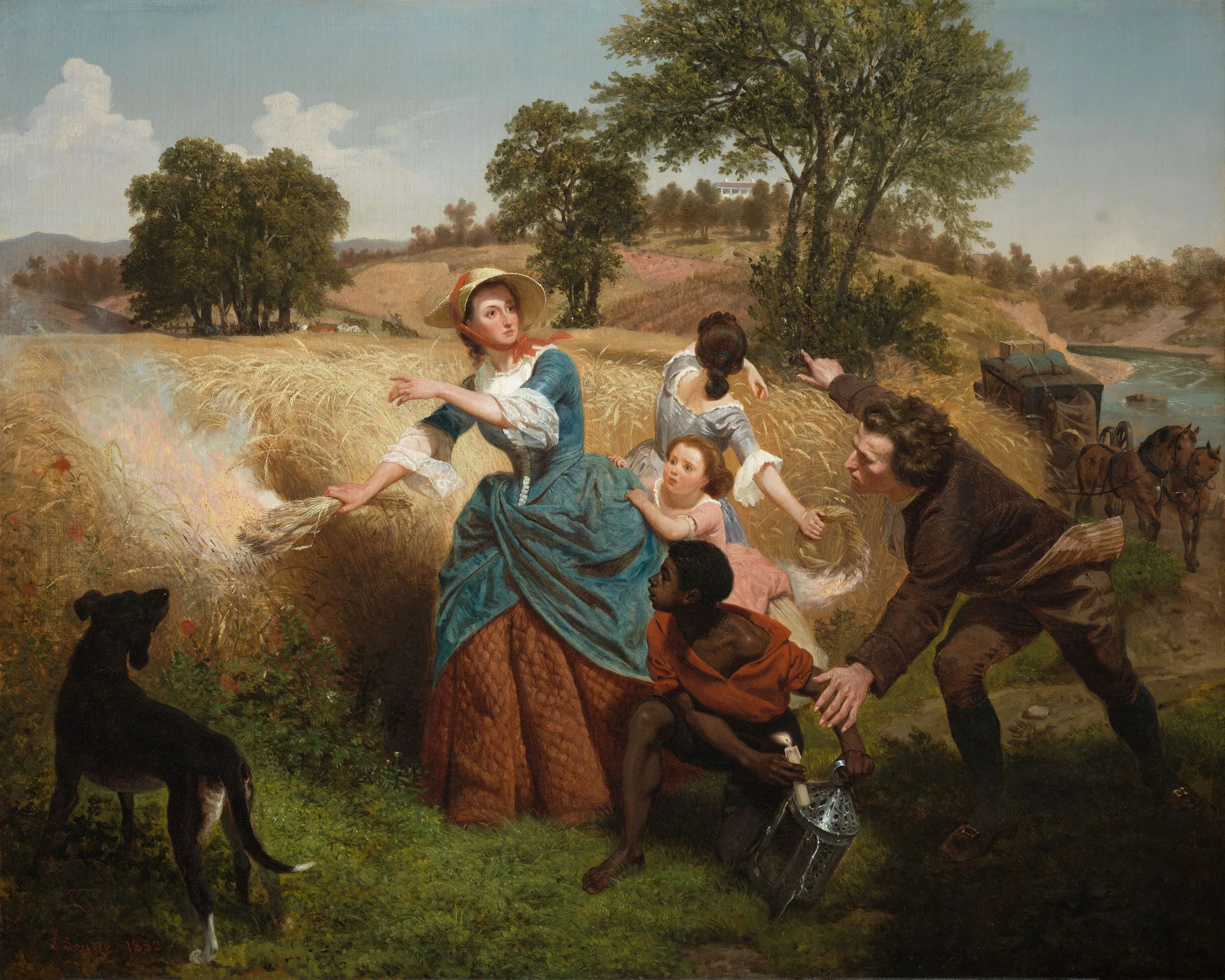
Mrs. Schuyler Burning Her Wheat Fields on the Approach of the British1852

Not on view
Oil painting of five figures reacting to a wheat field fire, with a crouching figure holding a metal bucket, a woman in a teal skirt reaching toward flames, children, and a black dog at left
Artist or Maker
Emanuel Gottlieb Leutze
Germany, Gmünd, active United States, 1816-1868
Title
Mrs. Schuyler Burning Her Wheat Fields on the Approach of the British
Place Made
United States
Date Made
1852
Medium
Oil on canvas
Dimensions
32 x 40 in. (81.28 x 101.6 cm)
Credit Line
Bicentennial gift of Mr. and Mrs. J. M. Schaaf, Mr. and Mrs. William D. Witherspoon, Mr. and Mrs. Charles C. Shoemaker, and Jo Ann and Julian Ganz, Jr.
Accession Number
M.76.91
Classification
Paintings
Collecting Area
American Art
Curatorial Notes
Leutze returned to this country from Düsseldorf in September 1851 to be present during the exhibition in New York and Washington of his phenomenally successful showpiece Washington Crossing the Delaware. By February 1852, working in his New York studio, he had begun Mrs. Schuyler Burning Her Wheat Fields on the Approach of the British. It was to be the second of some dozen subjects from the Revolutionary War that he was to paint, capitalizing on the fact that the sensational response to his Washington Crossing the Delaware was henceforth to link his name with such subject matter. Patriotic feelings stirred by the Mexican American War had already inspired patronage for other artists’ efforts on such themes.
Catherine Van Rensselaer Schuyler (1734-1803), wife of General Philip Schuyler, is shown setting fire to her wheat fields to keep them from the enemy, whose imminent arrival is announced by a messenger. The first account of this act of heroism to appear in print was a passage in the chapter on Mrs. Schuyler in Elizabeth F. Ellet’s The Women of the American Revolution (1848), one of the many anthologies of Revolutionary War feminine heroism popular during the period. It was based on the account of Mrs. Schuyler written in 1846 by Catherine Van Rensselaer Cochrane, Mrs. Schuyler’s youngest daughter. Surviving documents do not support this family tradition, however. Although General Schuyler pursued a scorched-earth policy and Mrs. Schuyler traveled twice to the estate to pack furnishings during July 1777, the British under John Burgoyne arrived at Saratoga (now called Schuylerville) on September 13 to find the large plantation virtually intact.
The painting reflects the skillful history painting tradition of Düsseldorf in its clearly subordinated composition and use of antique sculptural models for two of the figures.
Leutze’s freedom in adding genrelike secondary activity of his own invention is balanced by his efforts to obtain an accurate portrayal of Mrs. Schuyler by studying a portrait in the family’s possession (probably one now in the New-York Historical Society). Leutze’s reputation as an outstanding colorist is supported by the painting’s rich harmonies.
Selected Bibliography
  • LACMA: Obras Maestras 1750-1950: Pintura Estadounidense Del Museo De Arte Del Condado De Los Angeles. Mexico, D.F.: Museo Nacional de Arte, 2006.