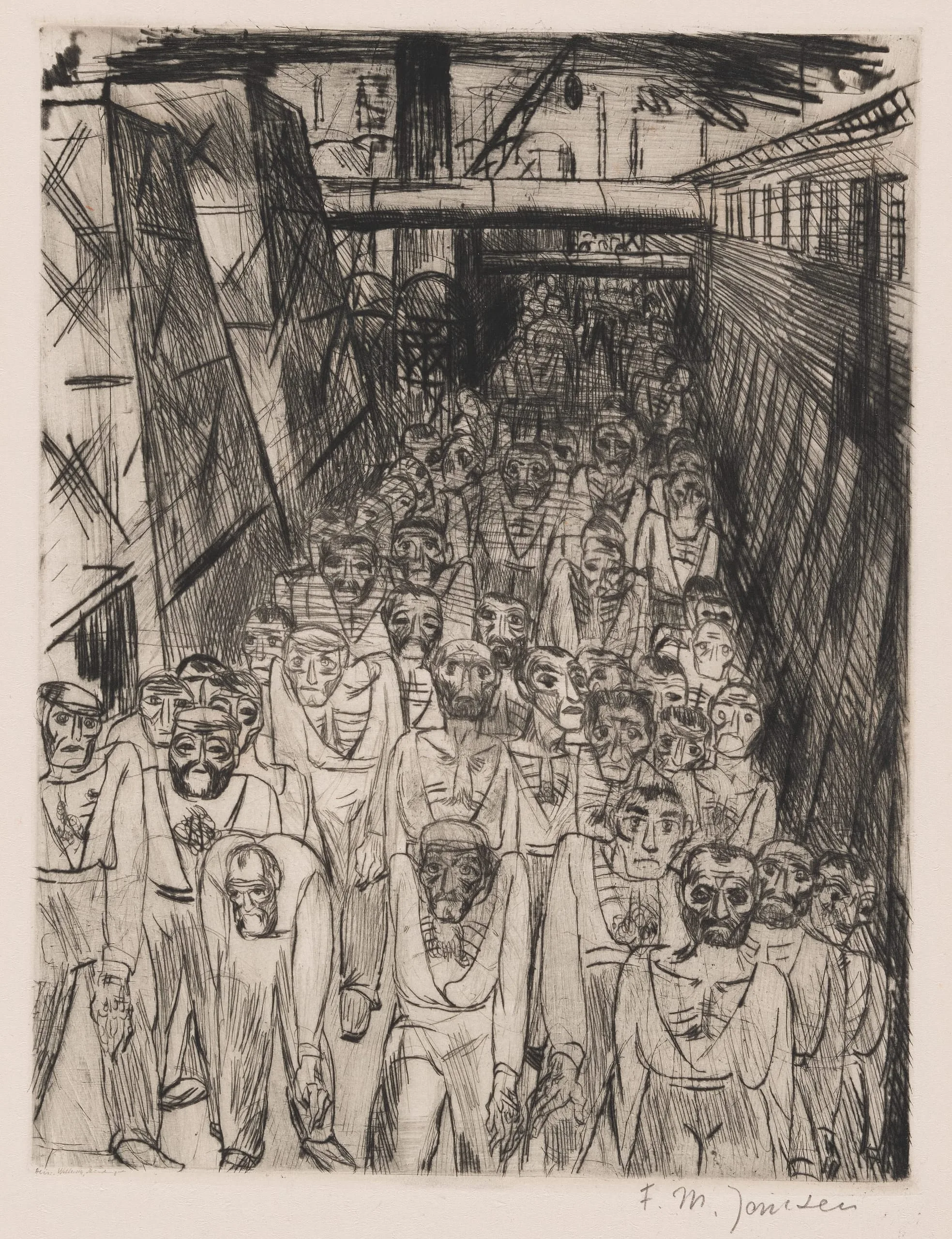
This etching is one of ten prints in a portfolio titled Industry in which the artist focused on the impact of industrialization on the working class in the Ruhr Valley. It depicts the proletariat transformed by dehumanizing living and working conditions into skeletal men, women, and children with hunched shoulders, gaunt features, and sunken eyes. A seemingly endless phalanx of workers advances toward the viewer, which anticipates scenes from Fritz Lang’s film Metropolis (1927), where the proletarian masses labor invisibly underground, their movements synchronized to the clock. Jansen’s workers are hemmed in by the imposing industrial architecture on either side, and by the dense, dark cloud of pollution above.
Franz M. Jansen studied architecture in Vienna but opted to become an artist after he returned to his native Cologne in 1911. In 1918, aligned with social causes and the revolutionary Novembergruppe (November Group; 83.1.1), he issued a manifesto, “Über den Expressionismus” (On Expressionism), in which he argued that debating formal artistic questions was irresponsible in the face of injustice and the needs of the working class: “In glorious truth: a new generation is here, a new generation for whom being an artist means nothing and being a human means everything” (Jansen 1918). Jansen combined his politics and his profession by producing graphic art. Prints such as Payment (Löhnung) played a significant role in his career, and he made woodcuts and etchings with equal facility. Due to the leftist focus of his early printmaking, he published his works frequently in Franz Pfemfert’s political journal Die Aktion.
Erin Sullivan Maynes
2022 (adapted from Pressing Politics: Revolutionary Graphics from Mexico and Germany, 92)
Bibliography
Jansen 1918. Franz M. Jansen. “Über den Expressionismus.” Volksmund, unabhängige Zeitung 13, no. 62 (August 3, 1918): unpag.