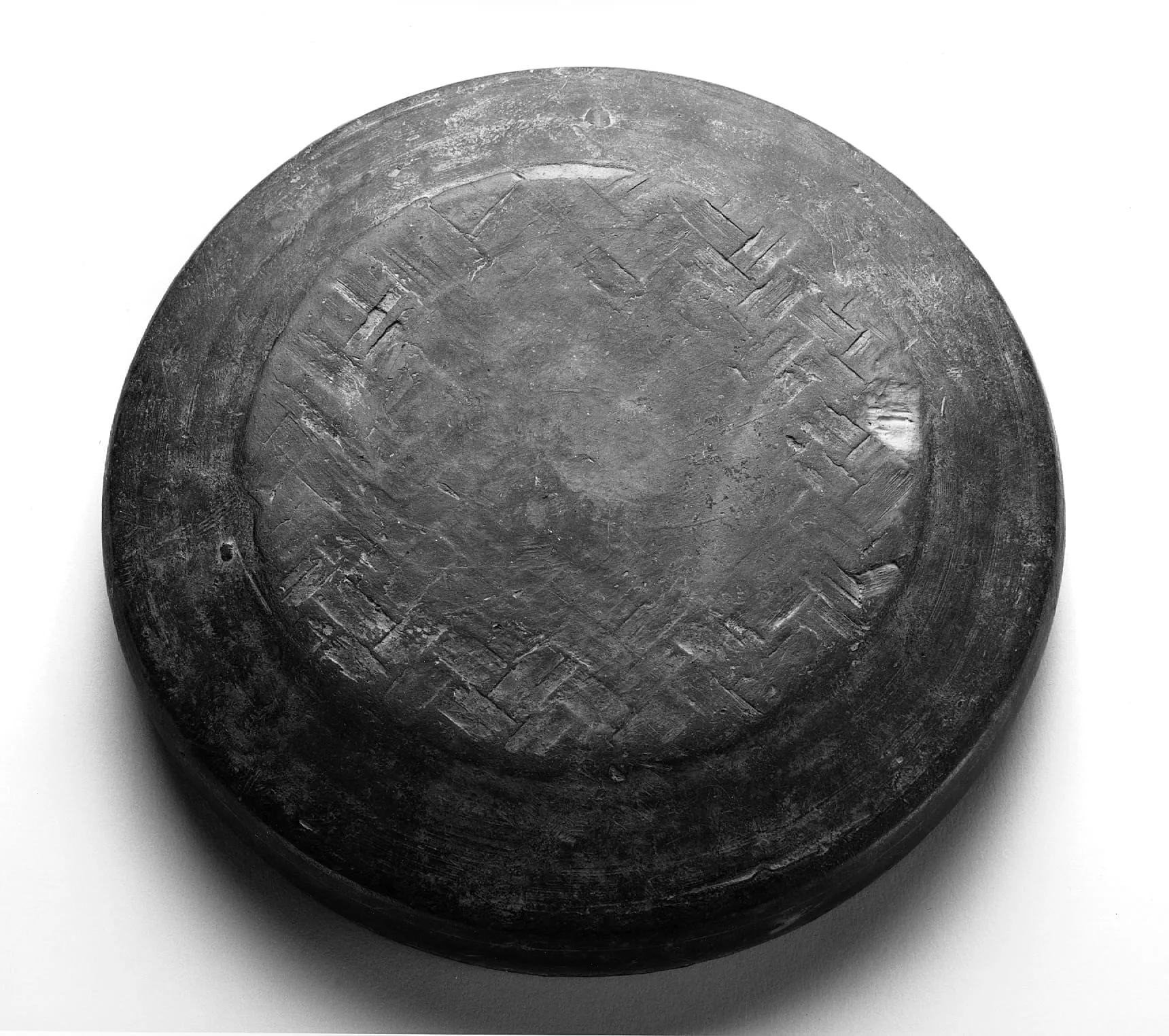
The ancient capital and important urban center of Chandraketugarh and its environs, located approximately 25 miles northeast of Kolkata (Calcutta) in the Ganges River delta, has yielded an abundance of artistically accomplished pottery of diverse object types and ceramic wares, as well as sculptures and plaques. Among the ceramic wares stratigraphically attributed to the Mauryan period (300–200 BCE) and Shunga period (200 BCE–50 CE), are various tablewares and vessels with stamped and/or rouletted designs.
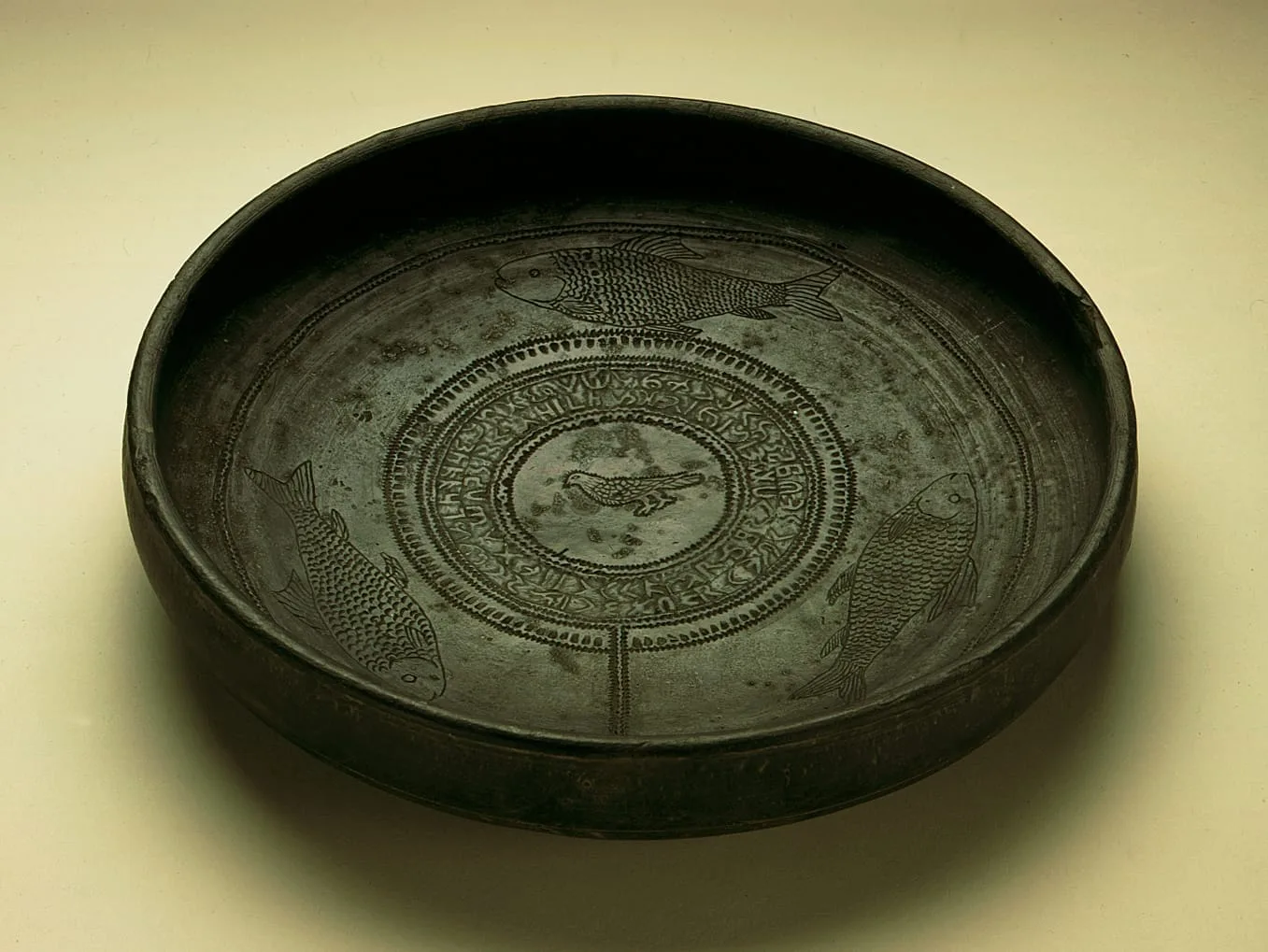
The Plate with a Bird and Fish is made of black-slipped gray ware with an incurved rim. It has stamped and rouletted designs. The plate was thrown on the wheel from gray clay and then, prior to firing, a smooth black slip was uniformly applied to the surface, giving it a glossy appearance. In the center is a bird shown in profile. Surrounding it are concentric bands consisting of a rouletted border, an inscription in two rows, three adjacent rouletted borders, a plain band with three evenly spaced fish, and a final rouletted border. The symbolic meanings of the bird and fish motifs are unknown. The inscription is in an ancient Bengali script that has been discussed by several authors, including H. Falk (2014), B. N. Mukherjee (2007–1990), R. Salomon (1983), D. K. Chakravorty (1977), S. K. Ray (1966), and K. G. Goswami (1948). A closely related plate with a bee pollinating a lotus in the central medallion is in the Metropolitan Museum of Art, New York (1993.371).