LACMA

ShopMembershipMyLACMATickets
LACMA
Los Angeles County Museum of Art
5905 Wilshire Blvd.
Los Angeles, CA 90036
info@lacma.org
(323) 857-6000
Sign up to receive emails
Subscribe
© Museum Associates 2026
  • About LACMA
  • Jobs
  • Building LACMA
  • Host An Event
  • Unframed
  • Press
  • FAQs
  • Log in to MyLACMA
  • Privacy Policy
© Museum Associates 2026
Collections

Carlo Saraceni
The Martyrdom of St. Ceciliacirca 1610

On view:
Geffen Galleries, Model Lives in Baroque Italy
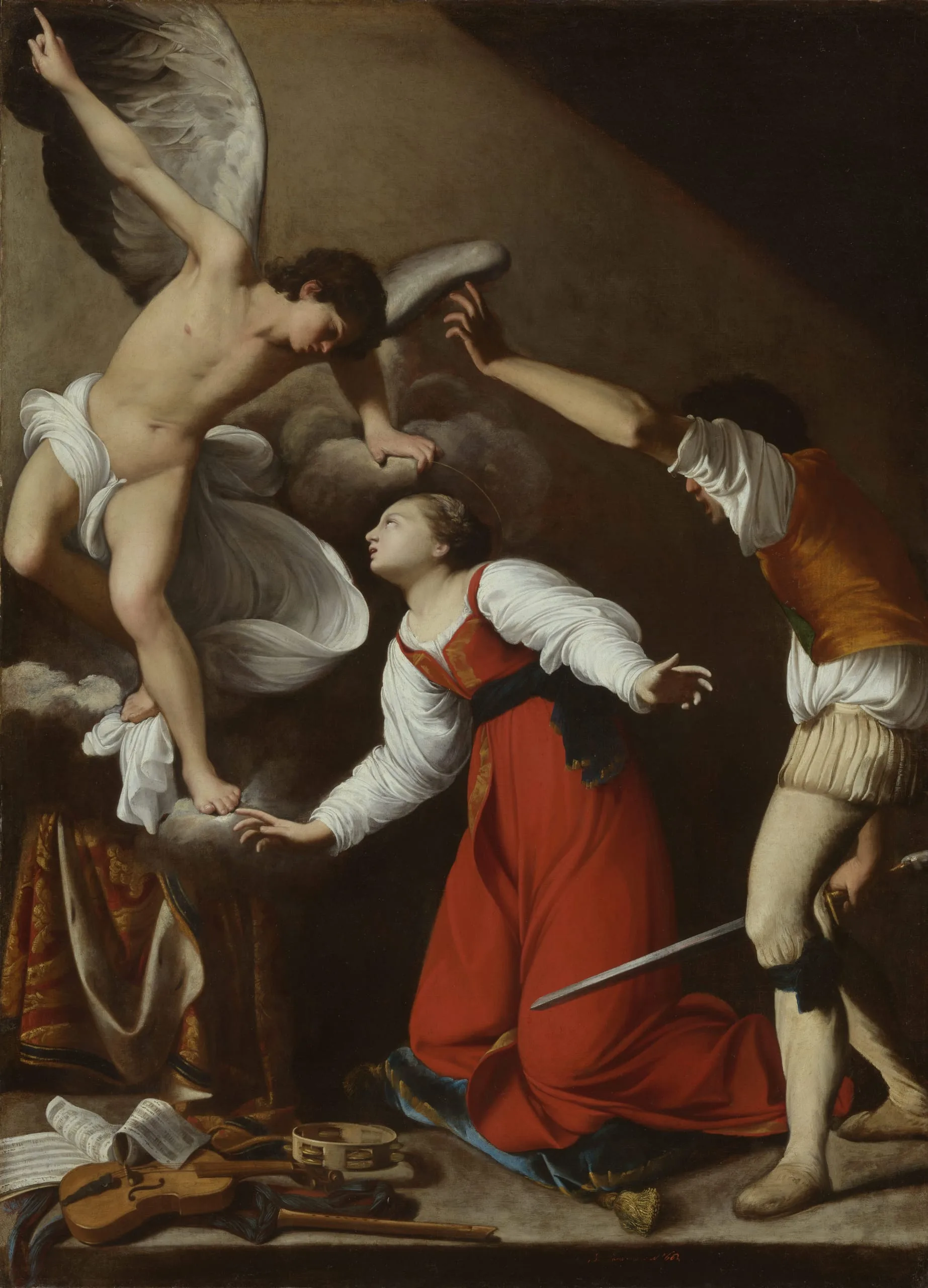
Oil painting, dramatic narrative scene with a winged angel descending toward a kneeling woman in red, a recoiling man to the right, musical instruments on the stone floor below

Carlo Saraceni, The Martyrdom of St. Cecilia, circa 1610, Los Angeles County Museum of Art, Gift of The Ahmanson Foundation, photo © Museum Associates/LACMA

Artist or Maker
Carlo Saraceni
Italy, Venice, circa 1579-1620, active Rome
Title
The Martyrdom of St. Cecilia
Date Made
circa 1610
Medium
Oil on canvas
Dimensions
Canvas: 53 1/2 × 38 3/4 in. (135.9 × 98.4 cm) Framed: 64 3/8 × 50 × 2 1/2 in. (163.5 × 127 × 6.35 cm)
Credit Line
Gift of The Ahmanson Foundation
Accession Number
AC1996.37.1
Classification
Paintings
Collecting Area
European Painting and Sculpture
Curatorial Notes

Carlo Saraceni’s dramatic representation of Saint Cecilia, the patron saint of music since the fifteenth century, captures the moments preceding the virgin martyr’s decapitation. Positioned in a kneeling stance, she extends her arms in acceptance of her fate; the crimson hue of her gown alludes to imminent bloodshed. Pointing heavenward to signify eternal salvation, an angel descends from the sky, unbeknownst to the executioner, whose non-Christian faith obstructs his vision of the celestial messenger. The saint’s attributes, including a violin, flute, and tambourine, accompanied by some roughly painted musical scores, are among the details that Saraceni skillfully illuminates in raking light. These serve as reminders of the vibrant soundscape of devotion in church. In early modern Italy, particularly in Rome, the connection between sonic elements and spiritual transcendence was profoundly direct. The listener’s parsing of the music was a privileged path toward union with the divine. Saraceni’s interpretation of the story of Saint Cecilia, as evidenced by his emphasis, omissions, and sequencing of the episode, transforms the observer into an active participant within the unfolding narrative—simultaneously signaling one’s auditory landscape and setting the stage for a spiritual encounter.

The composition reflects the revived popularity of Saint Cecilia’s cult but also the objectives of the Counter-Reformation. Natale Rondanini, a member of the Congregation of Saint Cecilia, likely commissioned Saraceni’s painting for his private chapel. The story of her martyrdom especially appealed to the Catholic church following the miraculous discovery of her remains in her Roman church in 1599. An essential aim of the Counter-Reformation was to employ art and architecture as potent instruments to propagate the Catholic faith and promote spiritual rejuvenation. This endeavor included an effort to renew the popularity of saints, intended to combat the beliefs of Protestantism, which rejected the veneration of saints.

2024

Provenance

Probably Natale Rondanini (1540–1627), Rome, by inheritance to his son;(1) Alessandro Rondanini (d. 1639), by inheritance to his wife; Felice Zacchia Rondanini (1593–1667), Rome,(2) by inheritance to her grandson; Alessandro (1660–1740), Marchese Rondanini, Villa alle Terme di Diocleziano, Albano, outside Rome,(3) by inheritance to; Giuseppe (1725–1801), Marchese Rondanini, by inheritance in 1809 to; Don Camillo Zacchia Rondanini, Rome, by inheritance to; Bartolomeo (1782–1864), Marchese di Capranica, Rome.(4) [Matthiesen Fine Art, Ltd., London, sold 1986 to]; Barbara Piasecka Johnson (1937–2013), Princeton, sold 1996 through; [Matthiesen Fine Art, Ltd., London, sold 1996 to]; LACMA.

Footnotes

(1) Waddingham 1985, was the first to associate the painting with that mentioned in the Rondanini inventory.

(2) Inventory, 2 June 1662, no. 30, Rome, Archivio di Stato, Miscellanea Famiglie, Busta 7. Reprinted in Salerno 1965, p. 280.

(3) Inventory 19–25 January 1741, fol. 110, item 79, Getty Provenance Index, Archival Inventory Database, I-1117, Saraceni.

(4) According to the inscription on the painted surface of the picture (Prohaska 1990, p. 200).
Selected Bibliography
  • Jeromack, Paul. "High Taste, Low Budget." Art & Auction 24, no.2 (2002): 84-93.
  • Beckett, Sister Wendy. Sister Wendy's American Collection, Toby Eady Associates, ed. Harper Collins Publishers, 2000.
  • Brown, Beverly Louise, ed. The Genius of Rome, 1592-1623. London: Royal Academy of Arts, 2001.
  • Marandel, J. Patrice and Gianni Papi. 2012. Caravaggio and his Legacy. Los Angeles: Los Angeles County Museum of Art.
  • Aurigemma, Maria Giulia, ed. Carlo Saraceni, 1579-1620: Un Veneziano tra Roma e l'Europa. Rome: De Luca, 2013.

  • Weller, Dennis P. Sinners & Saints: Darkness and Light: Caravaggio and his Dutch and Flemish Followers. Raleigh: North Carolina Museum of Art, 1998.
  • Lehmbeck, Leah, editor. Gifts of European Art from The Ahmanson Foundation. Vol. 1, Italian Painting and Sculpture. Los Angeles: Los Angeles County Museum of Art, 2019.
  • Caravaggio, Bernini: Early Baroque in Rome. Veurne, Belgium: Hannibal Publishing, 2019.

Related Unframed

Caravaggio in Our Time
  • November 8, 2012