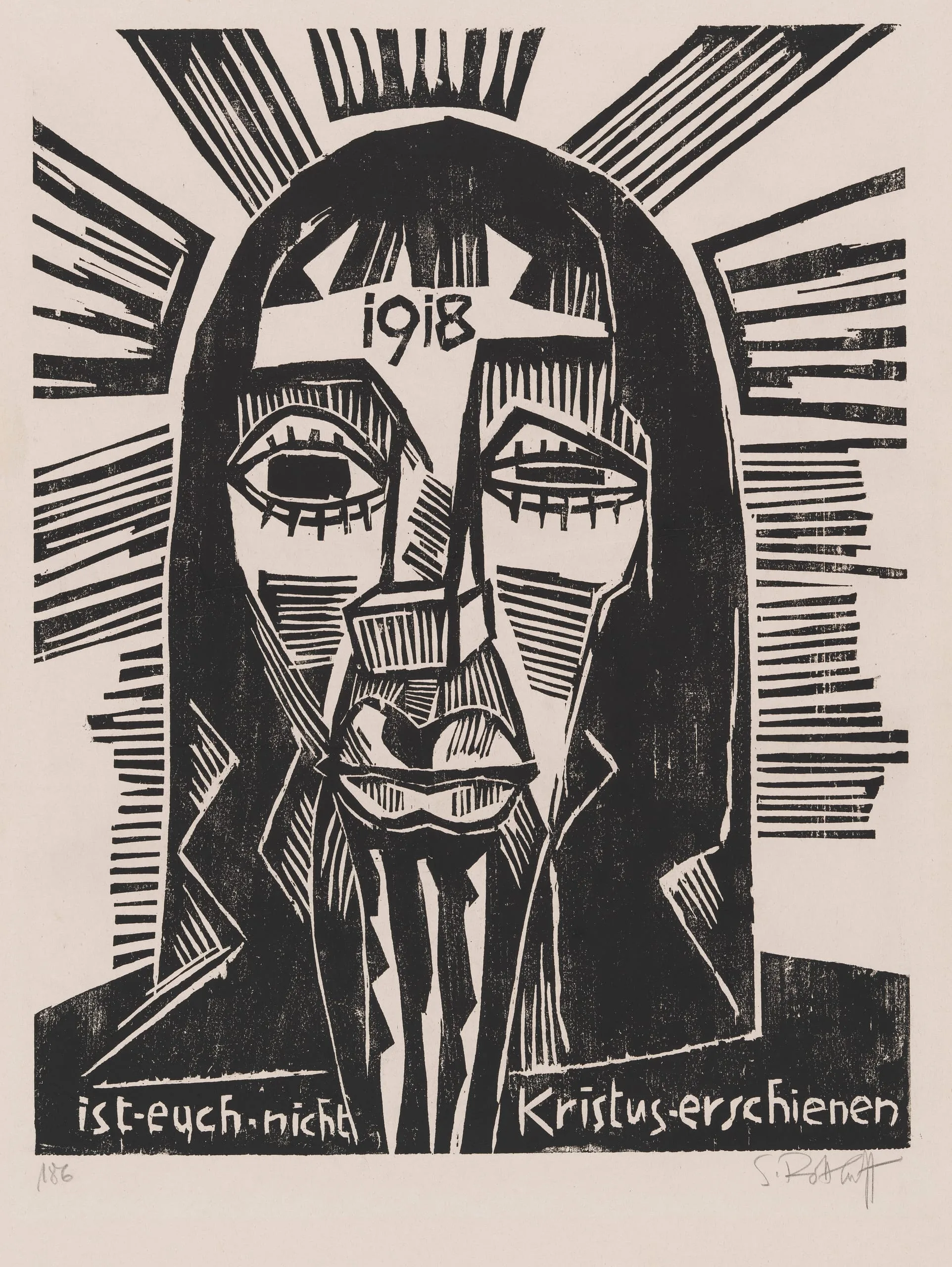
This print is from the portfolio Nine Woodcuts (Neun Holzschnitte), a series that centers on episodes from Christ’s life and addresses themes of redemption and salvation. Here, however, there is no certain Second Coming. Instead, Christ (Kristus) offers a more ambiguous image for a new age of humankind that may or may not be dawning. Christ’s forehead is branded with the number 1918, the year World War I ended and the revolution began. The text reads, “In 1918, Christ did not appear to you,” or alternatively, “Did Christ appear to you?” (Hogan 1993).
Unlike his Expressionist contemporaries, Schmidt-Rottluff did not confront World War I directly in his work, even though he served three difficult years on the Eastern Front in Russia and Lithuania. Trauma from the experience left him unable to paint, but he found carving to be therapeutic and focused on making woodcuts. Indeed, the artist’s material exploration of wood is the formal subject of this work; the striations on and around Christ’s face are an accommodation of the woodblock matrix but also resemble the rough-hewn texture of wood sculptures made by Schmidt-Rottluff and contemporaries such as Ernst Ludwig Kirchner. Schmidt-Rottluff’s formal experiments are also heavily reliant on his appropriation of elements from African and Oceanic sculpture (see also M.82.288.263). Finally, the presentation of Christ’s visage evokes the static appearance of a Byzantine icon, while the inclusion of text recalls revolutionary posters and graphics.
Erin Sullivan Maynes
2022 (adapted from Pressing Politics: Revolutionary Graphics from Mexico and Germany, 38)
Biblography
Hogan 1993. Erin Hogan in Reinhold Heller and Stephanie DʼAlessandro, eds., Stark Impressions: Graphic Production in Germany, 1918−1933 (Evanston, IL: Mary and Leigh Block Gallery, Northwestern University, 1993), 116.