LACMA

ShopMembershipMyLACMATickets
LACMA
Los Angeles County Museum of Art
5905 Wilshire Blvd.
Los Angeles, CA 90036
info@lacma.org
(323) 857-6000
Sign up to receive emails
Subscribe
© Museum Associates 2026
  • About LACMA
  • Jobs
  • Building LACMA
  • Host An Event
  • Unframed
  • Press
  • FAQs
  • Log in to MyLACMA
  • Privacy Policy
© Museum Associates 2026
Collections

Hubert Robert
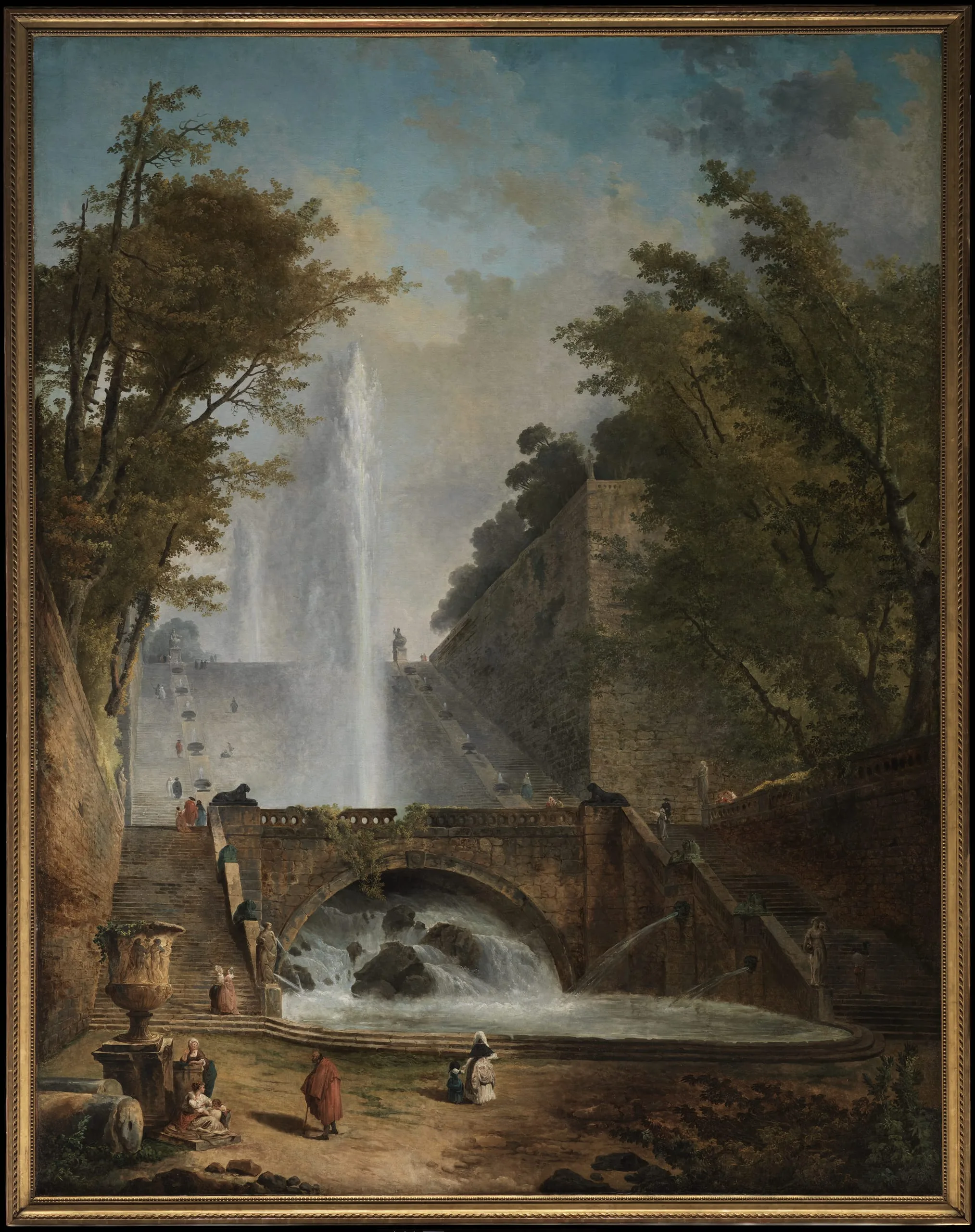
Stair and Fountain in the Park of a Roman Villacirca 1775 (?)

On view:
Geffen Galleries, floor 2
Vertical oil painting of an Italian garden with a tall fountain jet rising above a stone arch bridge, cascading pool, broad staircase, and small figures in the foreground
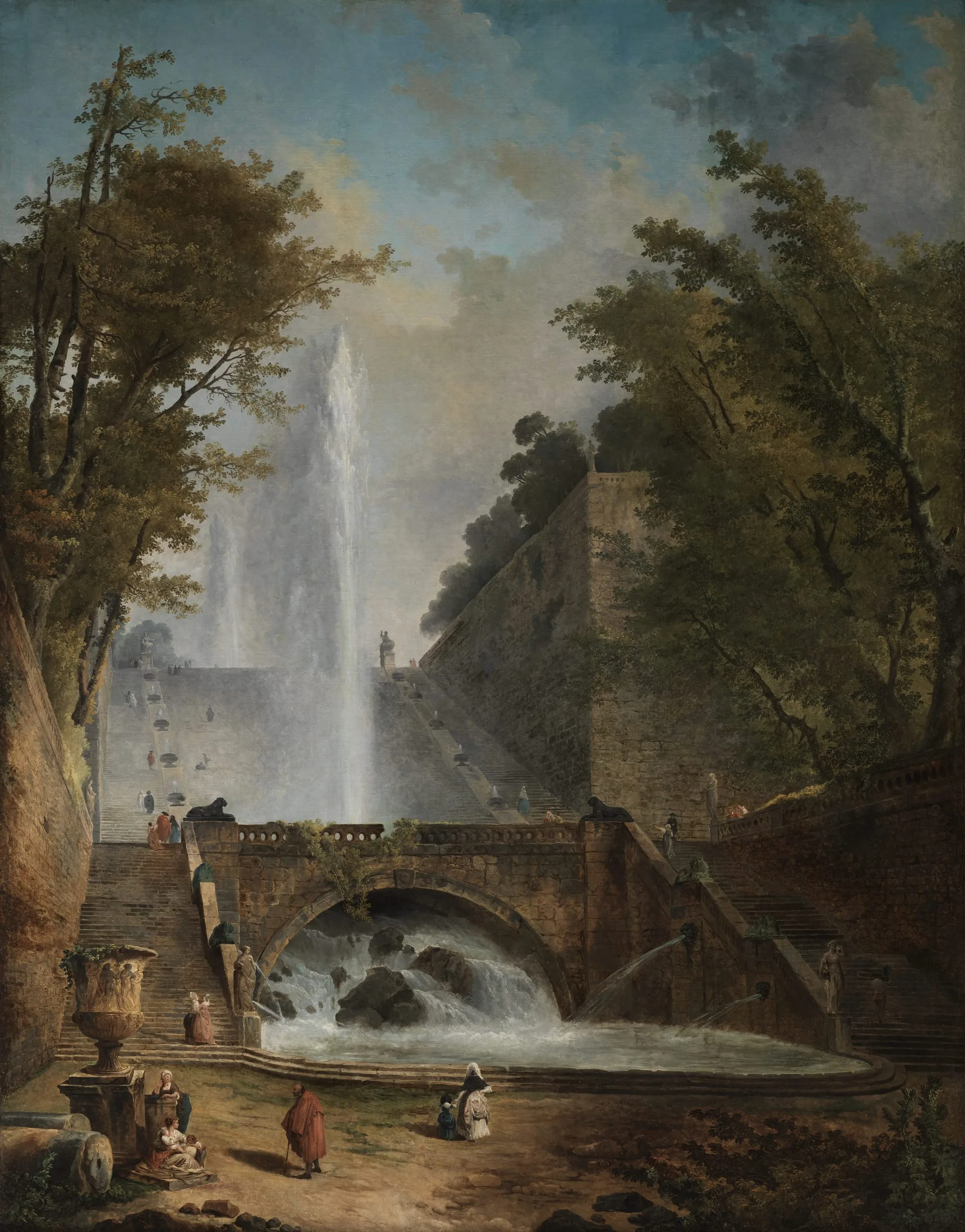
Oil painting of an Italian garden landscape featuring a tall fountain jet rising behind a stone bridge with arched waterfall below. Small figures in 18th-century dress populate the foreground and cascading stone stairways. Dense trees frame a cloudy blue sky, with a decorative stone urn at lower left.

Hubert Robert, Stair and Fountain in the Park of a Roman Villa, circa 1775 (?), Los Angeles County Museum of Art, Gift of The Ahmanson Foundation, photo © Museum Associates/LACMA

Artist or Maker
Hubert Robert
France, Paris, 1733-1808
Title
Stair and Fountain in the Park of a Roman Villa
Date Made
circa 1775 (?)
Medium
Oil on canvas
Dimensions
Canvas: 133 7/8 × 110 1/4 in. (340 × 280 cm) Framed: 143 × 113 × 3 in. (363.22 × 287.02 × 7.62 cm)
Credit Line
Gift of The Ahmanson Foundation
Accession Number
AC1995.170.1
Classification
Paintings
Collecting Area
European Painting and Sculpture
Curatorial Notes

Hubert Robert was renowned for his creation of imaginary views. This immense canvas can be described as a capriccio, a painting that blends real and invented architectural features in a fantastical setting. Here, the fountain’s design defies the laws of physics, and the dual staircases rise toward a distant plateau where the figures at the top seem to vanish into the horizon. As a young artist, supported by the French Academy, Robert traveled to Rome, where he sketched ancient monuments and famous sites. This spectacular view appears to be directly inspired by the Teatro dell’Acqua at the Villa Aldobrandini and the terraced garden at the Villa d’Este in Tivoli. Created in 1560, the Tivoli garden had fallen into disrepair by the time of Robert’s visit in 1762; while some fountains still functioned, much of the garden had been reclaimed by nature. Like all artists who were sent to Rome by the French government, Robert was encouraged to copy antquities; here, the Borghese Vase makes an appearance in the lower left corner as a ruin. The mother and child walking toward the fountain’s basin, however, wear the elaborate wigs and fashions of 1770s France, reminding the beholder of the artist’s heritage.

Robert returned to Paris in 1765. This painting was executed a few years later, by which time his artworks were avidly sought by royalty and a wide aristocratic clientele across Europe. In 1778, he was appointed designer of gardens to the king of France, a role in which he was able to devise new layouts and architectural features for the grounds of royal residences at Versailles and Rambouillet. Robert also helped established the Louvre as a museum, having organized temporary exhibitions there before its official opening in 1801.

2024
Provenance
Camille Groult (1837-1908), by 1905; by descent in the family to; [Elizabeth Royer, Paris, sold 1995 to]; LACMA.
Selected Bibliography
  • Grasselli, Margaret Morgan, and Yuriko Jackall. Hubert Robert. Washington, D.C.: National Gallery of Art, 2016.
  • Marandel, J. Patrice. Abecedario: Collecting and Recollecting. Los Angeles: Art Catalogues; LACMA, 2017.

  • Lehmbeck, Leah, editor. Gifts of European Art from The Ahmanson Foundation. Vol. 2, French Painting and Sculpture. Los Angeles: Los Angeles County Museum of Art, 2019.

Related Unframed

Imagining Rome
Imagining Rome
  • July 9, 2018
  • David Bardeen