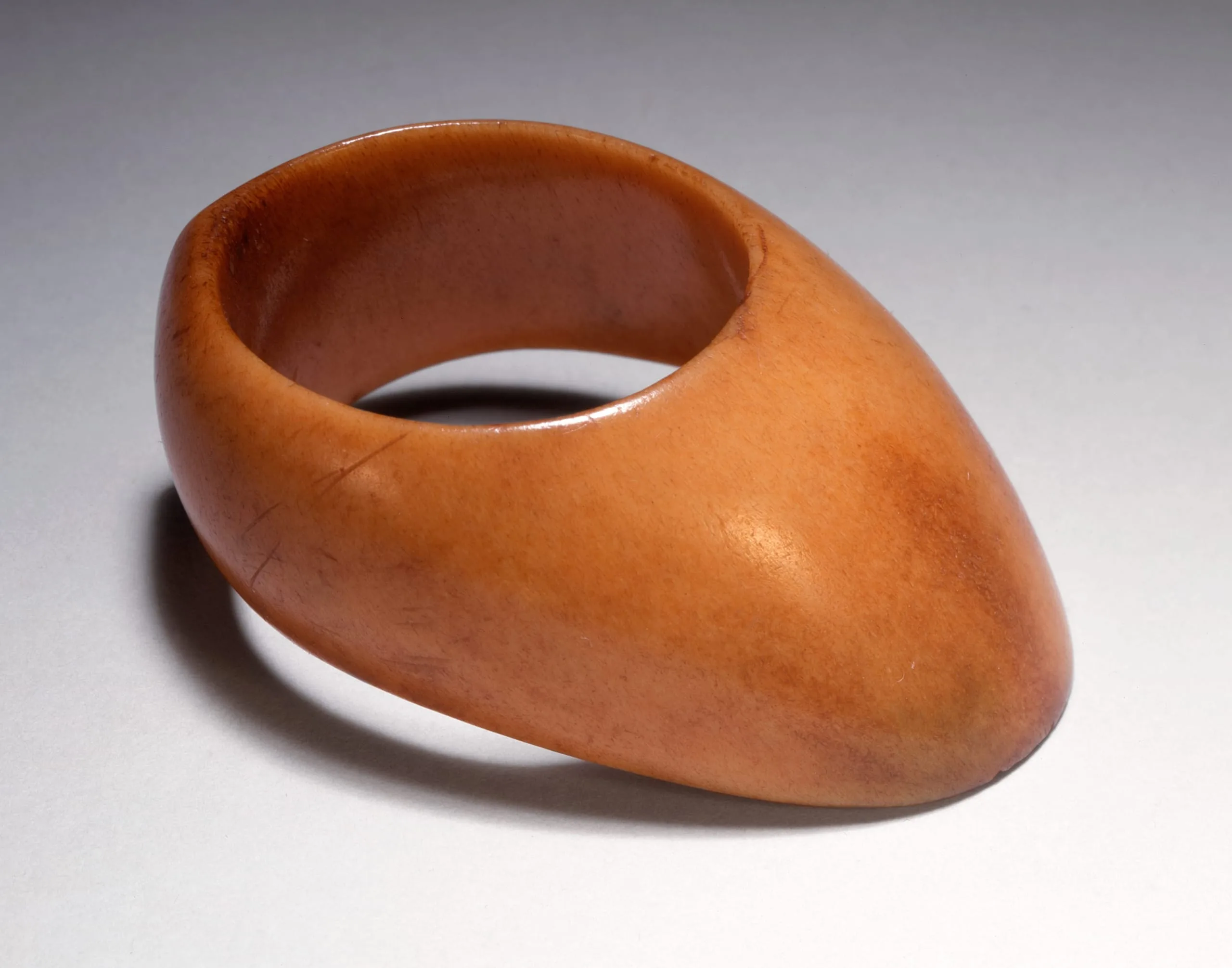
This archer’s thumb ring was designed to be worn when executing a so-called Mongolian or "thumb" draw, which was the traditional Asiatic method to release an arrow in which the thumb is used to draw the bowstring, rather than the index and middle fingers being used to pull the bowstring as is done in a "Mediterranean draw." The thumb ring is typically worn with the long plane next to the inner thumb to protect it from pressure and abrasion when the bowstring is drawn and released.
This thumb ring has an elongated contour with a rounded front and a drooping pointed back. Its profile and proportions compare closely to dated examples from the reign of the Mughal Emperor Shah Jahan (r. 1628-58).
South Asian archer’s thumb rings were made in a wide range of materials, including gold, jade, agate, carnelian, coral, chalcedony, rock crystal, ivory, bone, and tortoise shell. This thumb ring is made of unadorned walrus ivory, which suggests it may have been intended for functional use as well as ceremonial. Purely ceremonial thumb rings are characteristically embellished with inlaid gemstones that could snag on the bowstring. Ceremonial thumb rings were also displayed suspended from their owner’s waist sash as an emblem of royalty.