- Title
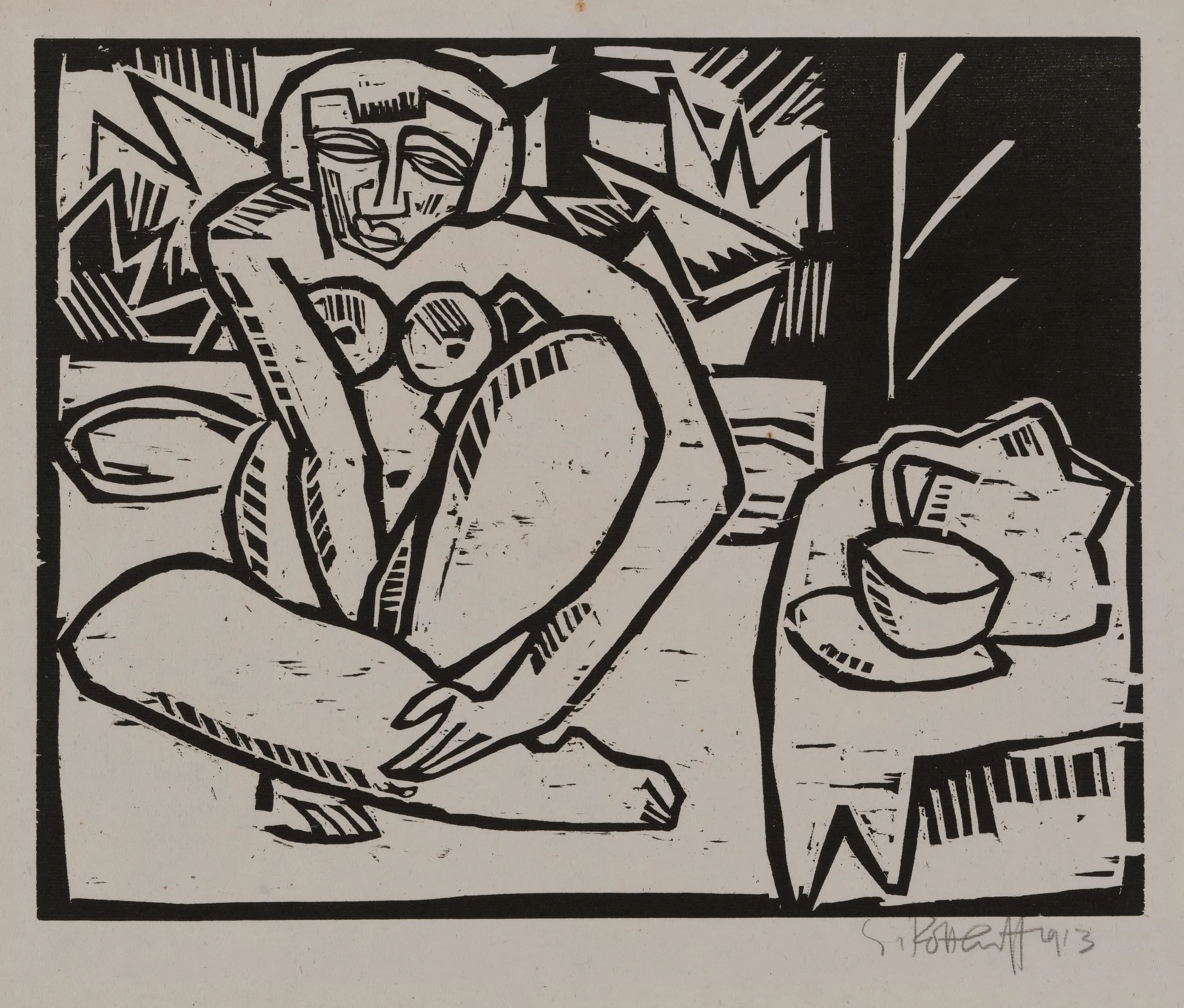
- Seated girl
- Date Made
- 1913
- Medium
- Woodcut on wove paper
- Dimensions
- Image: 14 1/8 x 17 3/4 in. (35.8 x 45 cm); Sheet: 18 5/16 x 23 5/8 in. (46.5 x 60 cm)
- Accession Number
- M.82.288.263
- Curatorial Notes
Seated Girl (Sitzendes Mädchen) contains all the elements of Schmidt-Rottluff’s signature style: a sensitivity to the strong black and white contrasts possible in the woodcut medium, a bold handling of form, and a clarity of compositional structure and sense of order that some attribute to his early architectural training. Along with Erich Heckel, Schmidt-Rottluff studied architecture at the Technical College in Dresden, where they met Fritz Bleyl and Ernst Ludwig Kirchner. In 1905, they founded Die Brücke (The Bridge), the influential artists group that sowed the seeds of German Expressionism. Around 1910, the Brücke artists became intensely interested in African and Oceanic art, an interest expressed in Schmidt-Rottluff’s art in volumetric forms that are both heraldic and symbolic. He was especially captivated by the Cameroonian headdresses in the Berlin Ethnological Museum, as reflected in the eyes and other features of the Seated Girl’s masklike face. Similarly, the autonomous quality of the figure’s arms, legs, and breasts lends the subject a monumentality that the Expressionists associated with tribal artifacts. The striated patterns and triangular forms are elements of a visual vocabulary developed by Schmidt-Rottluff that could be repeated throughout a composition as well as carried from one print to another. As his close friend the art historian Rosa Schapire suggested, his “art is a synthesis, a concentrated summary, a bringing forth of the essential, the reduction of things to their most direct components. Composition, style, monumentality in the most fortunate creation takes the place of mere fragments of nature.”
Timothy Benson
2017
- Selected Bibliography
Davis, Bruce. German Expressionist Prints and Drawings: The Robert Gore Rifkind Center for German Expressionist Studies. Los Angeles, CA: Los Angeles County Museum of Art, 1989; Munich, Germany: Prestel, 1989.
- Schapire, Rosa. Karl Schmidt-Rottluffs graphisches Werk bis 1923. Berlin: Euphorion Verlag, 1924.
Thiem, Gunther. Prints by Erich Heckel and Karl Schmidt-Rottluff: A Centenary Celebration. Los Angeles County Museum of Art: Los Angeles, 1985.
- Benson, Timothy O. and Andrea Gyorody. A New Generation of Creators: Selections from The Robert Gore Rifkind Center for German Expressionist Studies. Los Angeles: Los Angeles County Museum of Art, 2017.
- Copyright
- © Artists Rights Society (ARS), New York / VG Bild-Kunst, Bonn