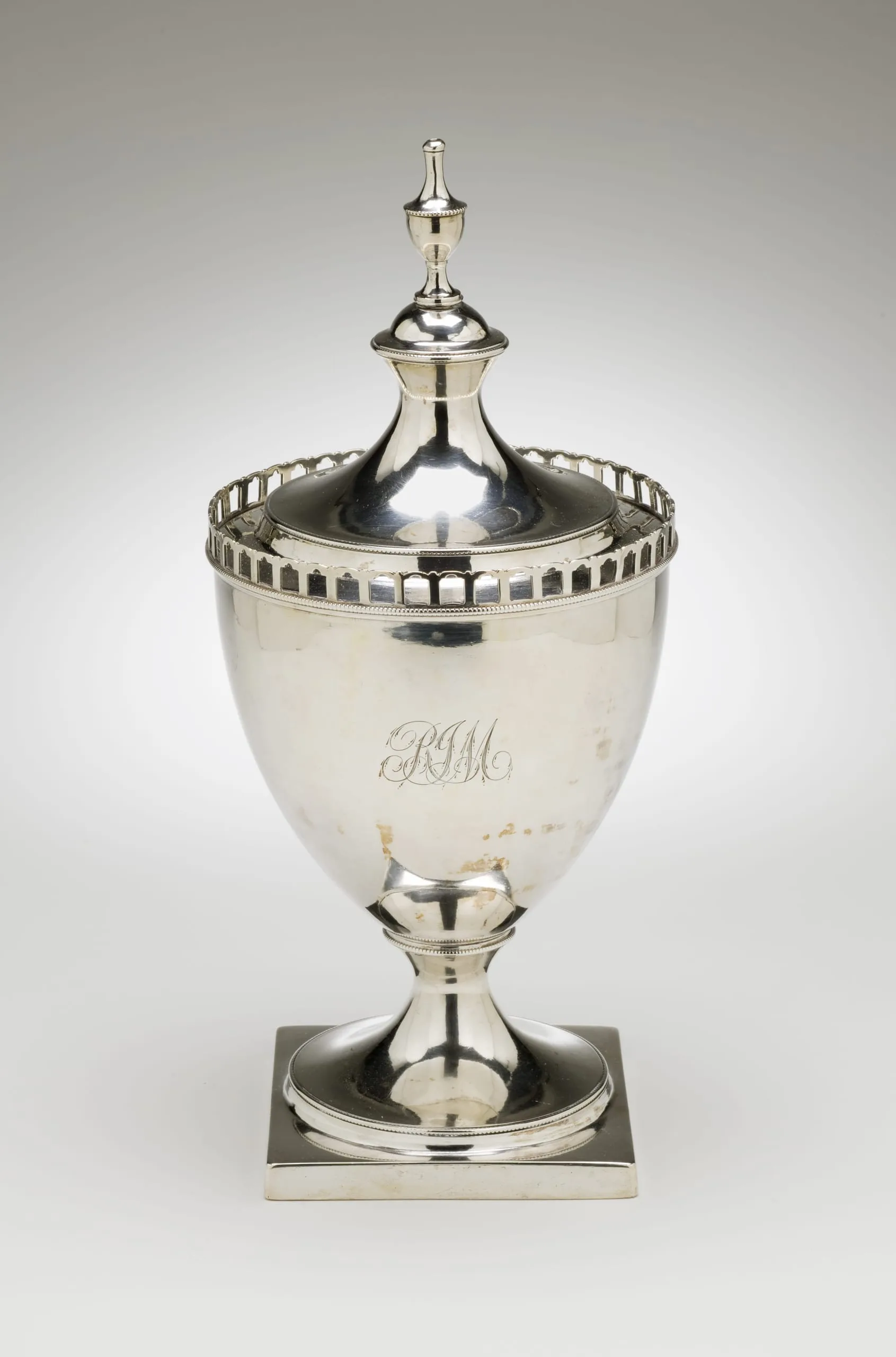
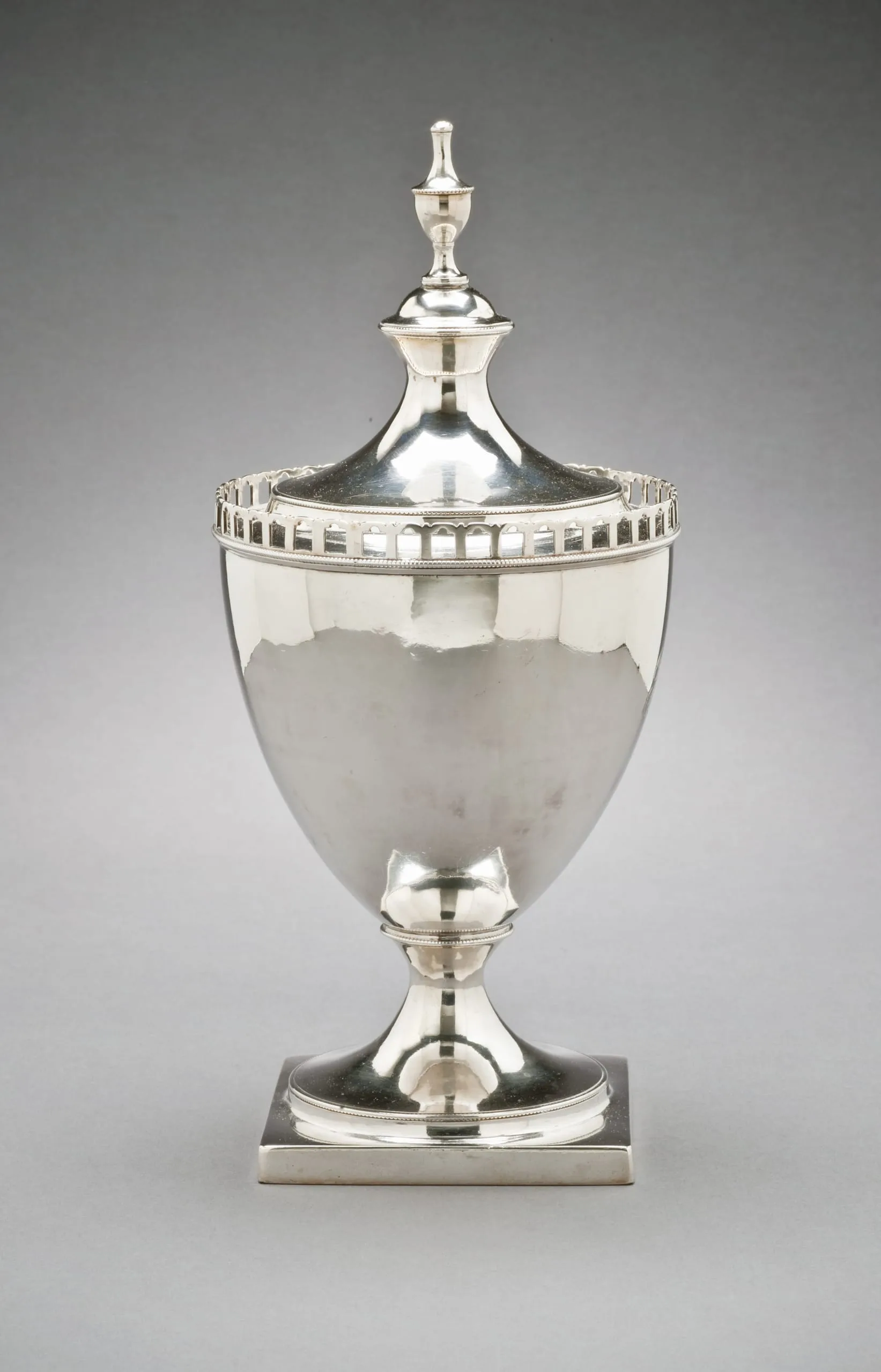
American silversmiths in the early national period were quick to adopt a variety of Neoclassical forms and decoration. In keeping with a newly established government inspired by the ideals of ancient Greece and Rome, classical shapes and ornament soon dominated every branch of architecture and design. Simple geometry, clean lines, and plain surfaces replaced the earlier Rococo style that favored asymmetrical, naturalistic ornament. The body of this sugar bowl resembles a classical urn, a shape repeated in the finial. The only ornament present are bands of minuscule beading applied to the foot, waist, and cover, and the trim around the upper rim of the body. The elegant urn shape and beaded decoration are distinctive of silver produced by the leading silversmiths in Philadelphia during this period.
Robert Swan may be the same person by that name who immigrated to Philadelphia in 1774 from Kilmalalee, Scotland. We know little about his life and career, except that he worked in Philadelphia as a silversmith between 1799 and 1817 and later advertised as both a silversmith and an umbrella manufacturer until 1831.