LACMA

ShopMembershipMyLACMATickets
LACMA
Los Angeles County Museum of Art
5905 Wilshire Blvd.
Los Angeles, CA 90036
info@lacma.org
(323) 857-6000
Sign up to receive emails
Subscribe
© Museum Associates 2026
  • About LACMA
  • Jobs
  • Building LACMA
  • Host An Event
  • Unframed
  • Press
  • FAQs
  • Log in to MyLACMA
  • Privacy Policy
© Museum Associates 2026
Collections

Franz Marc
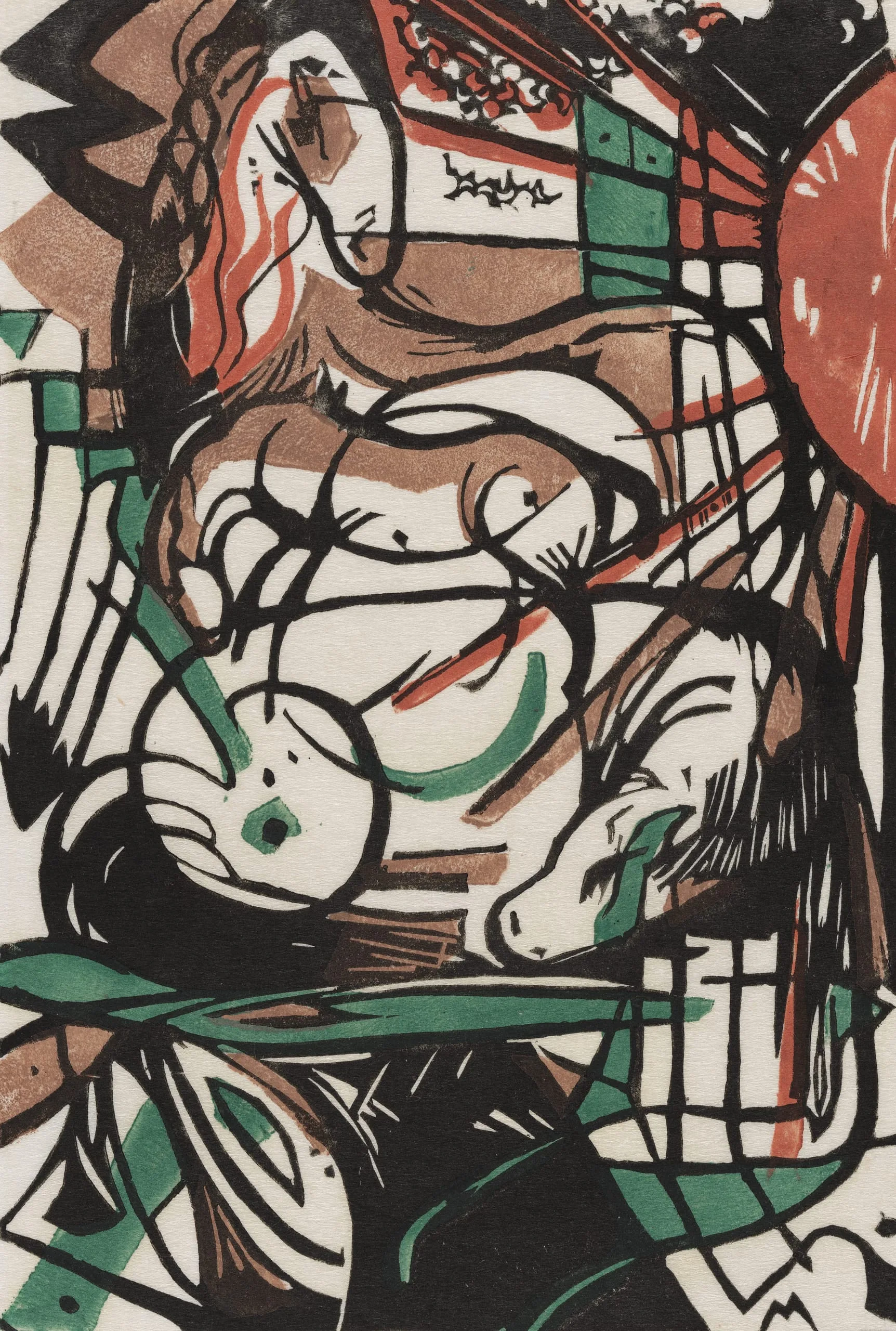
The Birth of Horses (Geburt der Pferde)1913

Not on view
Vertical woodcut or linocut print with bold black outlines and flat areas of brick red, forest green, brown, and coral-orange forming semi-abstract overlapping organic shapes on cream paper

Franz Marc, The Birth of Horses (Geburt der Pferde), 1913, Los Angeles County Museum of Art, The Robert Gore Rifkind Center for German Expressionist Studies, photo © Museum Associates/LACMA

Artist or Maker
Franz Marc
Germany, 1880-1916
Title
The Birth of Horses (Geburt der Pferde)
Place Made
Germany
Date Made
1913
Medium
Woodcut
Dimensions
Image: 8 1/2 x 5 3/4 in. (21.5 x 14.6 cm); Sheet: 13 1/2 x 9 7/8 in. (34.3 x 25.1 cm)
Credit Line
The Robert Gore Rifkind Center for German Expressionist Studies
Accession Number
M.82.288.204
Classification
Prints
Collecting Area
Robert Gore Rifkind Center for German Expressionist Studies
Curatorial Notes

Franz Marc’s pantheistic color woodcut The Birth of Horses (Geburt der Pferde) is one of the most important prints produced by the Blaue Reiter (Blue Rider), an Expressionist group that Marc cofounded with Wassily Kandinsky and others in Munich in 1911. Marc’s dynamic composition conveys his view of nature as a communion of spiritual forces most strongly sensed, and embodied, by animals. Although the work includes the discernible outline of a horse, as a whole it delights in the abstract, with strong lines cutting across the composition, breaking it into segments filled with a vibrant palette of oranges, reds, and greens. Marc died tragically in World War I, cutting short what might have been a brilliant career, though his efforts lived on through Kandinsky, who was beginning to develop his own language of pure abstraction inspired by the synesthetic experience of music.

The Birth of Horses also speaks to the mutually influential relationship between German Expressionism and Italian Futurism. Critic Adolf Behne, writing in the avant-garde magazine Der Sturm (The Storm), observed that the Futurists were “not so much interested in depicting the unfolding of external movement as in the inner vitality of the motion inherent in . . . objects.” This reading implicitly linked the Futurists and Expressionists, who were similarly invested in capturing the dynamism of people, places, and things “by means of a compression and a concentration on the essential and an elimination of everything unimportant!” While the Futurists were obsessed with the speed and motion of modern technology, Marc and other Expressionists stripped compositions down to their bare elements of line, form, and color in order to convey the sheer, unadulterated energy of nature.

Andrea Gyorody

2017
Selected Bibliography
  • Reed, Orrel P., German expressionist art: the Robert Gore Rifkind Collection: prints, drawings, illustrated books, periodicals, posters. Exhibition Catalogue. Los Angeles: Frederick S. Wight Art Gallery, University of California, Los Angeles, 1977.
  • Davis, Bruce. German Expressionist Prints and Drawings: The Robert Gore Rifkind Center for German Expressionist Studies. Los Angeles, CA: Los Angeles County Museum of Art, 1989; Munich, Germany: Prestel, 1989.

  • Benson, Timothy O., et al. Expressionist Utopias: Paradise, Metropolis, Architectural Fantasy. Los Angeles: Los Angeles County Museum of Art, 1993.

  • Benson, Timothy O. and Andrea Gyorody. A New Generation of Creators: Selections from The Robert Gore Rifkind Center for German Expressionist Studies. Los Angeles: Los Angeles County Museum of Art, 2017.