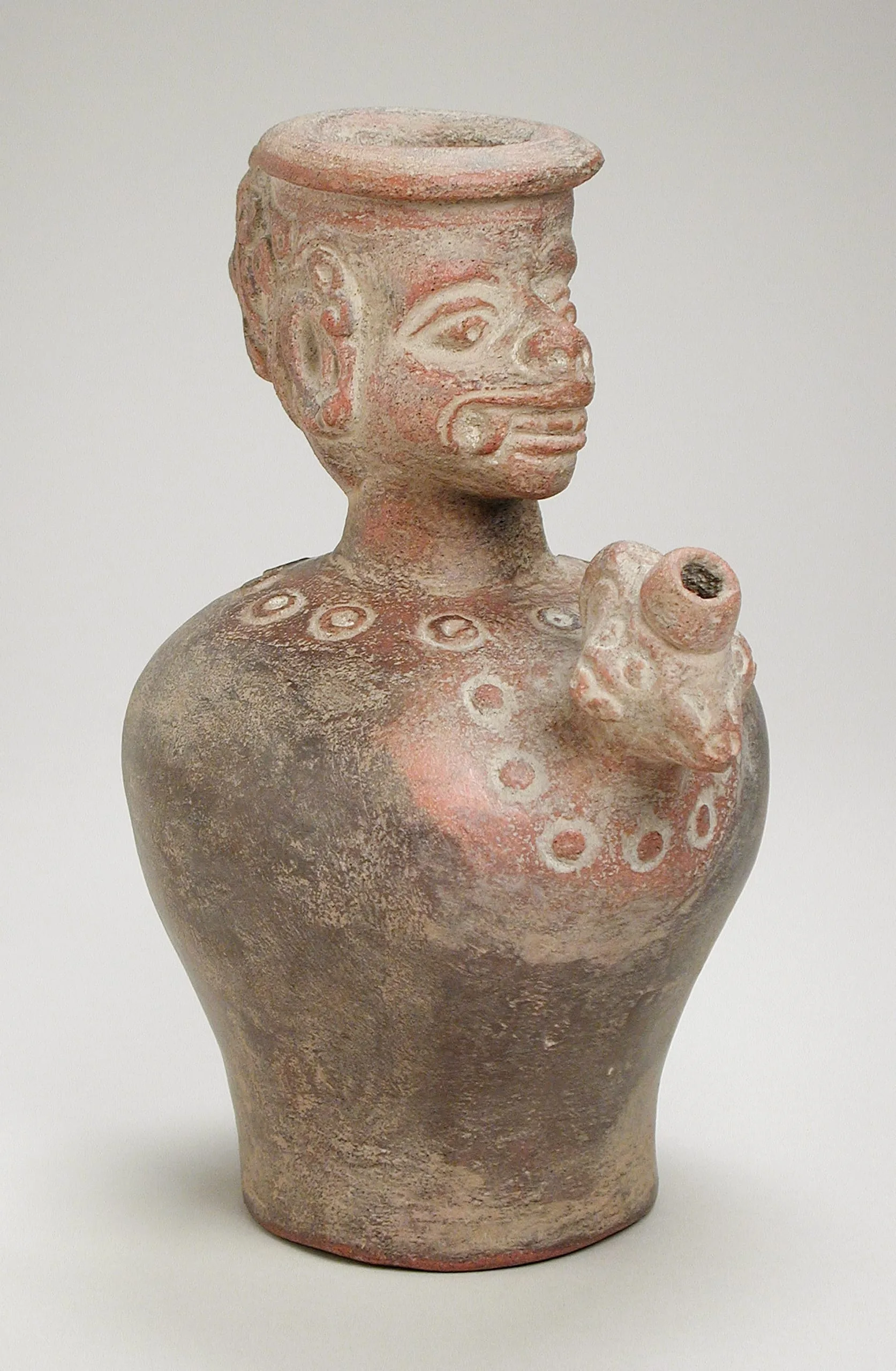
Kendis (derived from Sanskrit: kundika) are the ubiquitous water vessels of Southeast Asia. They are pouring vessels with a spout of various shapes on the side of the vessel body. The bodies are globular with or without a low foot. The spouts the spouts can be straight, curved, bulbous (or mammary), or in the form of an animal head. They typically have no handles, so the pot is held by its neck while pouring. The shape of the necks varies but generally has a flared mouth. Kendis are made in a variety of materials, including earthenware, stoneware, glazed ceramic, porcelain, pewter, brass, bronze, and silver alloy. They were produced in Indonesia, Thailand, Vietnam, Malaysia, and in China as export ware. Kendis were made in different sizes, with small vessels typically used for dispensing medicine and magic potions, or as children toys. Besides their everyday usage, they were also used for ceremonial purposes. Representations of kendis are replete in the stone narrative panels of Borobudur and other Southeast Asian monuments. See also M.88.72.
The mouth and upper portion of this kendi is graced with the head of Hanuman, The Divine Monkey (vanara). Hanuman first appears in the great Indian epics, the Mahabharata ([War of the] Great Bharatas) and the Ramayana (Adventures of Rama). He served as the Monkey General who located and helped rescue Prince Rama’s wife, the kidnapped Princess Sita, from Ravana, the arrogant ten-headed demon-king of Lanka (probably modern Sri Lanka). The heroic monkey, who like Rama was also deified in later Indian culture, is honored for his fierce battles and staunch loyalty to Rama.
The flattened cylinder atop Hanuman’s head is the lower rim for a now-missing lid (see also M.86.346.1). The Divine Monkey is wide-eyed, mustachioed, and growling with prominent fangs. He wears a necklace of round ornaments. The vessel spout is in the form of conjoined simian faces.