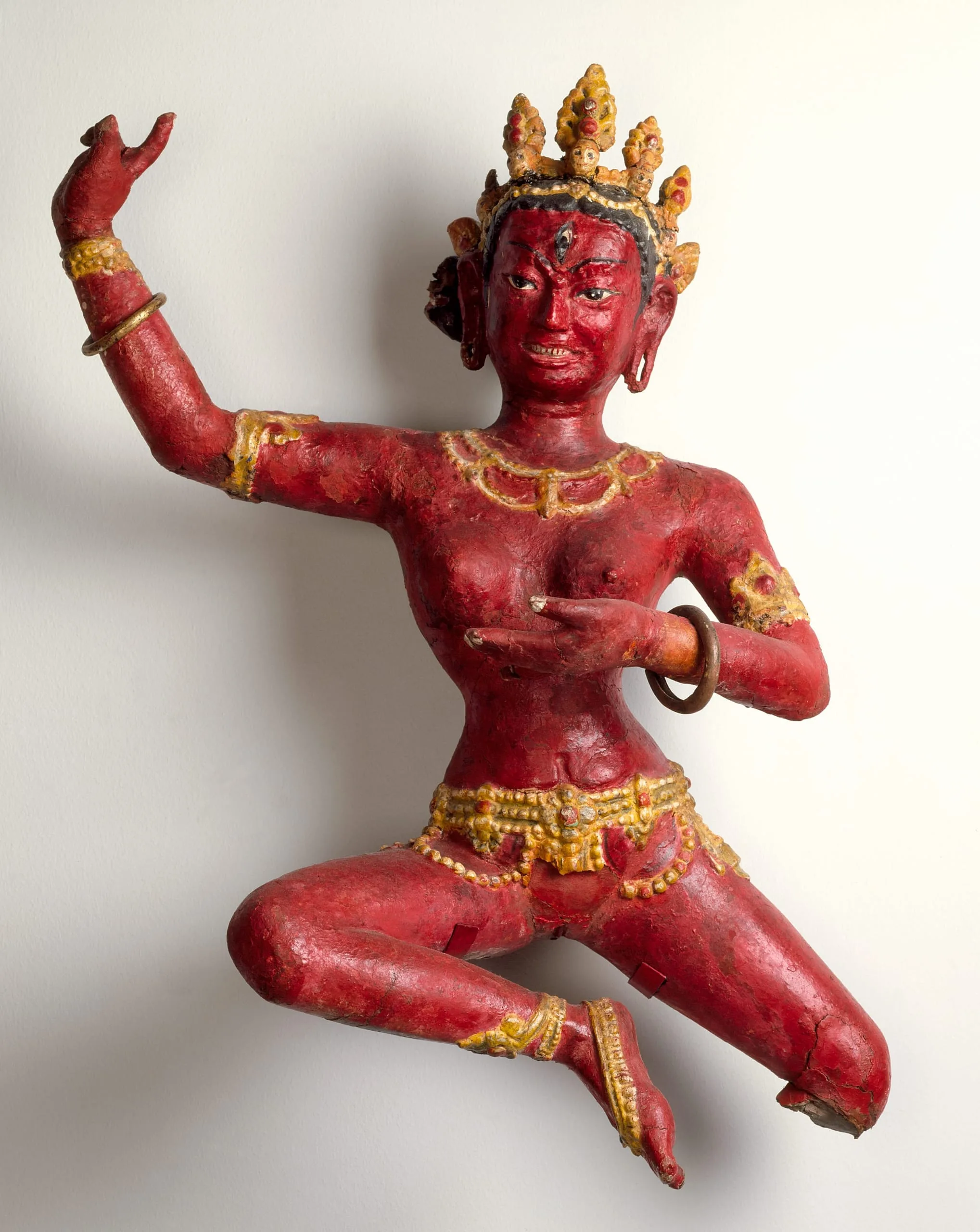
The esoteric Buddhist goddess Vajravarahi (Adamantine Sow) is the embodiment of transcendent wisdom. Highly venerated in her own right, Vajravarahi is also the consort of Chakrasamvara, the personification of transcendent compassion. In her dancing posture depicted here, she is the supreme dakini, a group of wrathful female divinities who represent the generative power and innate presence of the Buddha that is found in all sentient beings. Her ecstatic dance of enlightenment overcomes and dispels delusion, which is symbolized by the small head of a female pig that projects above her right ear (visible from the rear). Vajravarahi is naked and has red skin indicative of her spiritual transformation. Her third eye symbolizes her mystical insight. She wears a tiara of golden ornaments and skulls, a golden necklace, armlets, bracelets, waistbelt, anklets, and ankle bracelets (the jewelry is here painted yellow), and copper bracelets. She once held a chopper in her raised right hand and a skull cup in her left, which she uses respectively to cut through the fog of ignorance and to hold the blood symbolic of wisdom's triumph over ignorance. Her left leg is now missing below the knee. In metal and painted depictions of Dancing Vajravarahi, her left foot often stands on a human corpse (see M.74.106.1). Originally, she would have been mounted "floating" on a wall by means of two suspension loops embedded in her upper and lower back.
See Susan S. Bean, Clay Works: Earthen Sculpture in South Asia (London: Bloomsbury Visual Art, 2026), p. 69, fig. 2.18.
A comparable clay image of Vajravarahi is in the Walters Art Museum, Baltimore (25.270).