- Title
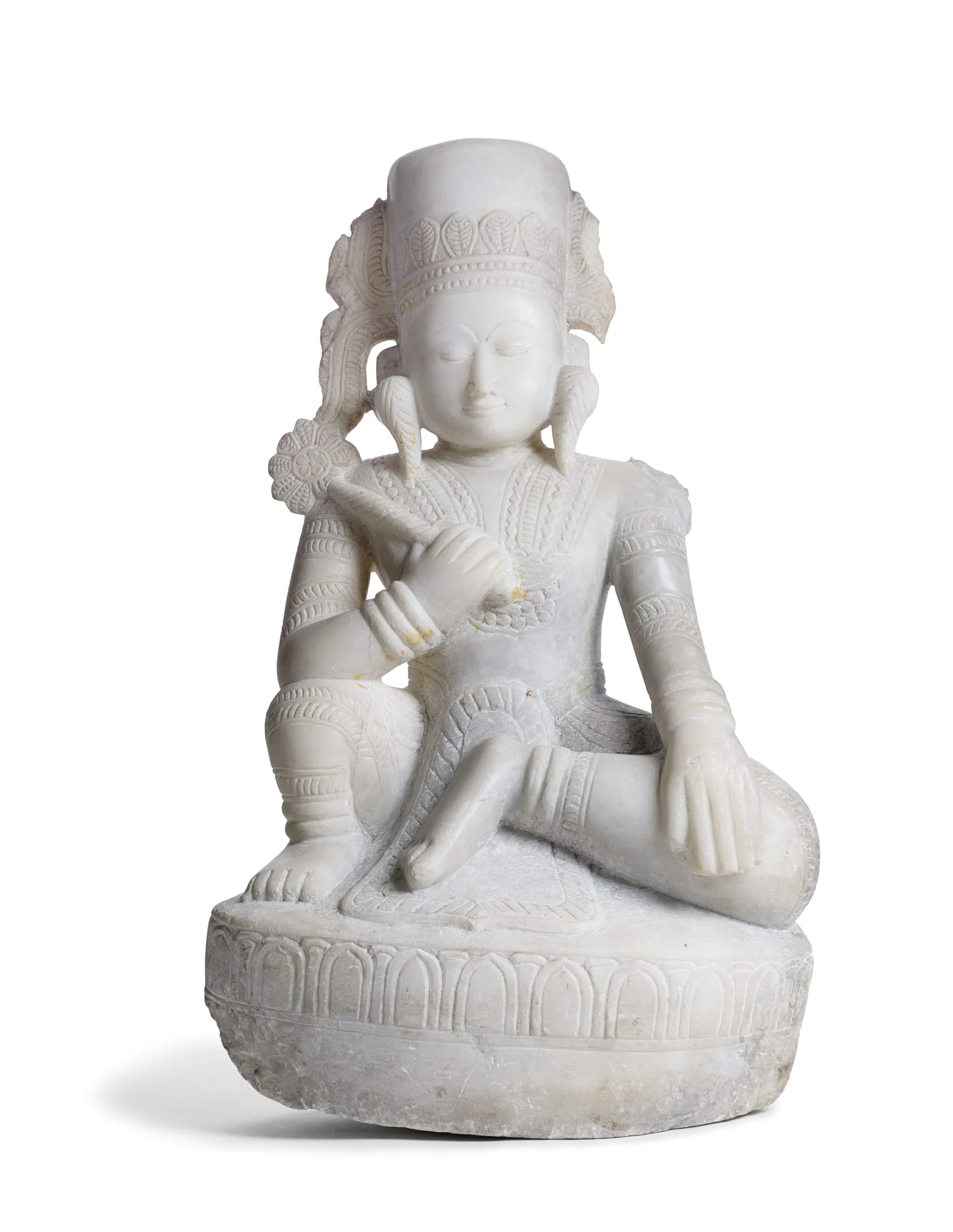
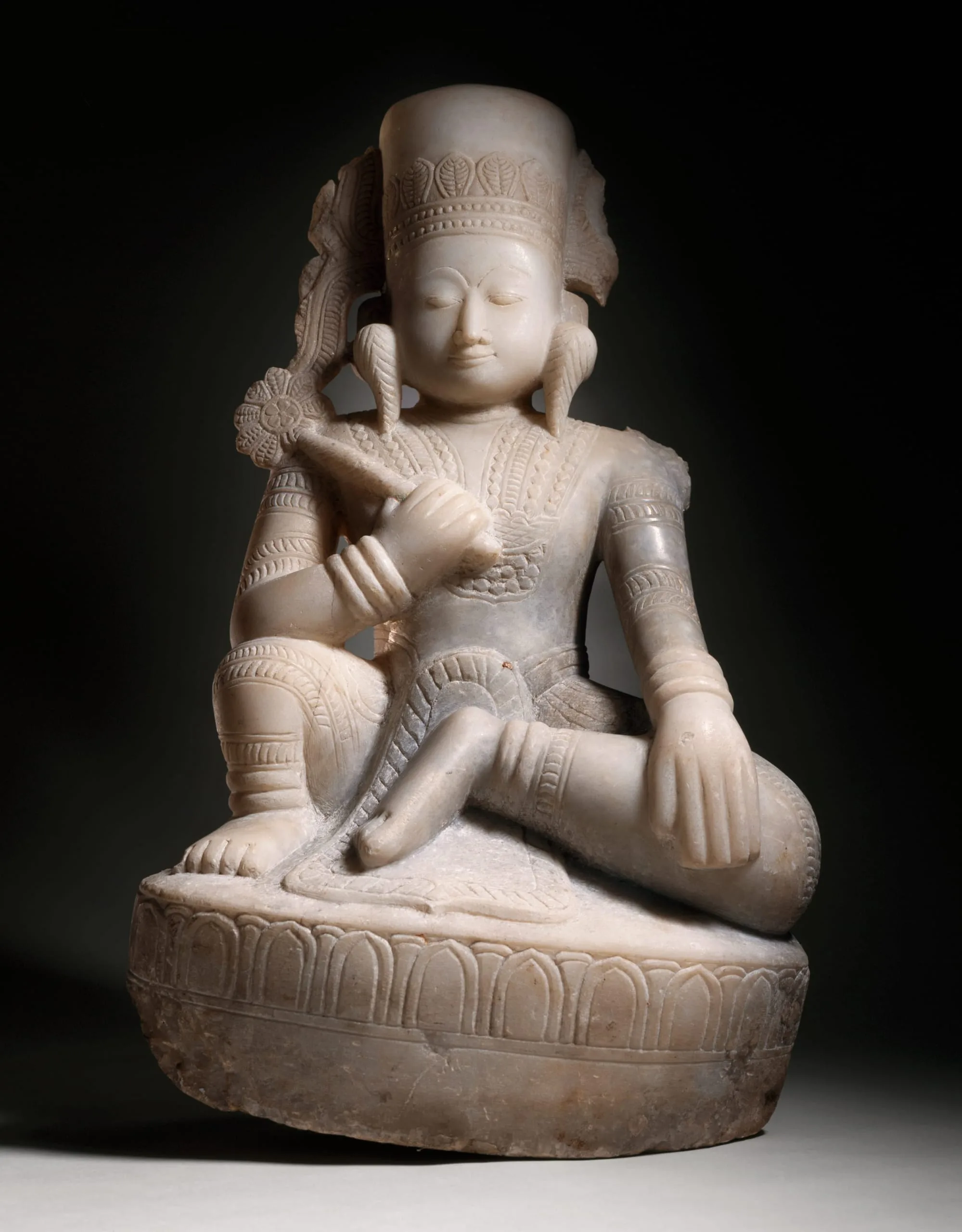
- The Bodhisattva Lokanatha
- Date Made
- circa late 18th century
- Medium
- White marble
- Dimensions
- 12 1/2 × 13 1/2 × 9 in. (31.75 × 34.29 × 22.86 cm)
- Accession Number
- AC1995.103.1
- Curatorial Notes
Lokanatha (Lord of the World) is a form of the Mahayana Bodhisattva Avalokiteshvara. He is venerated as an embodiment of pure compassion for all sentient beings and eternal devotion to their liberation from suffering. In this form that is particularly popular in Burma, one of his functions is guard the faith until the appearance of the future Buddha, Maitreya. This sculpture reflects the stylistic shifts that began to appear in Burmese art around the 14th century, when earlier Indianized traditions gave way to more localized forms. The headdress, for instance, derives from the miter-like hat of the royal minister during the Konbaung period (752-1885) and the lateral ribbons resembling royal garb. He is seated on a lotus base in the kingly posture of royal ease (maharajalila asana) and carries a lotus in his left hand.
- Selected Bibliography
- Fraser-Lu, Sylvia, and Donald M. Stadtner, eds. Buddhist Art in Myanmar. New York: Asia Society Museum, 2015.
- Proser, Adriana. "Buddhist Art of Myanmar: an Exhibition at Asia Society, New York." Arts of Asia 45, no. 2 (2015): 65-78.
- Little, Stephen, Tushara Bindu Gude, Karina Romero Blanco, Silvia Seligson, Marco Antonio Karam. Las Huellas de Buda. Ciudad de México : Instituto Nacional de Antropología e Historia, 2018.
- Little, Stephen, and Tushara Bindu Gude. Realms of the Dharma: Buddhist Art across Asia. Los Angeles: Los Angeles County Museum of Art, 2025.