- Title
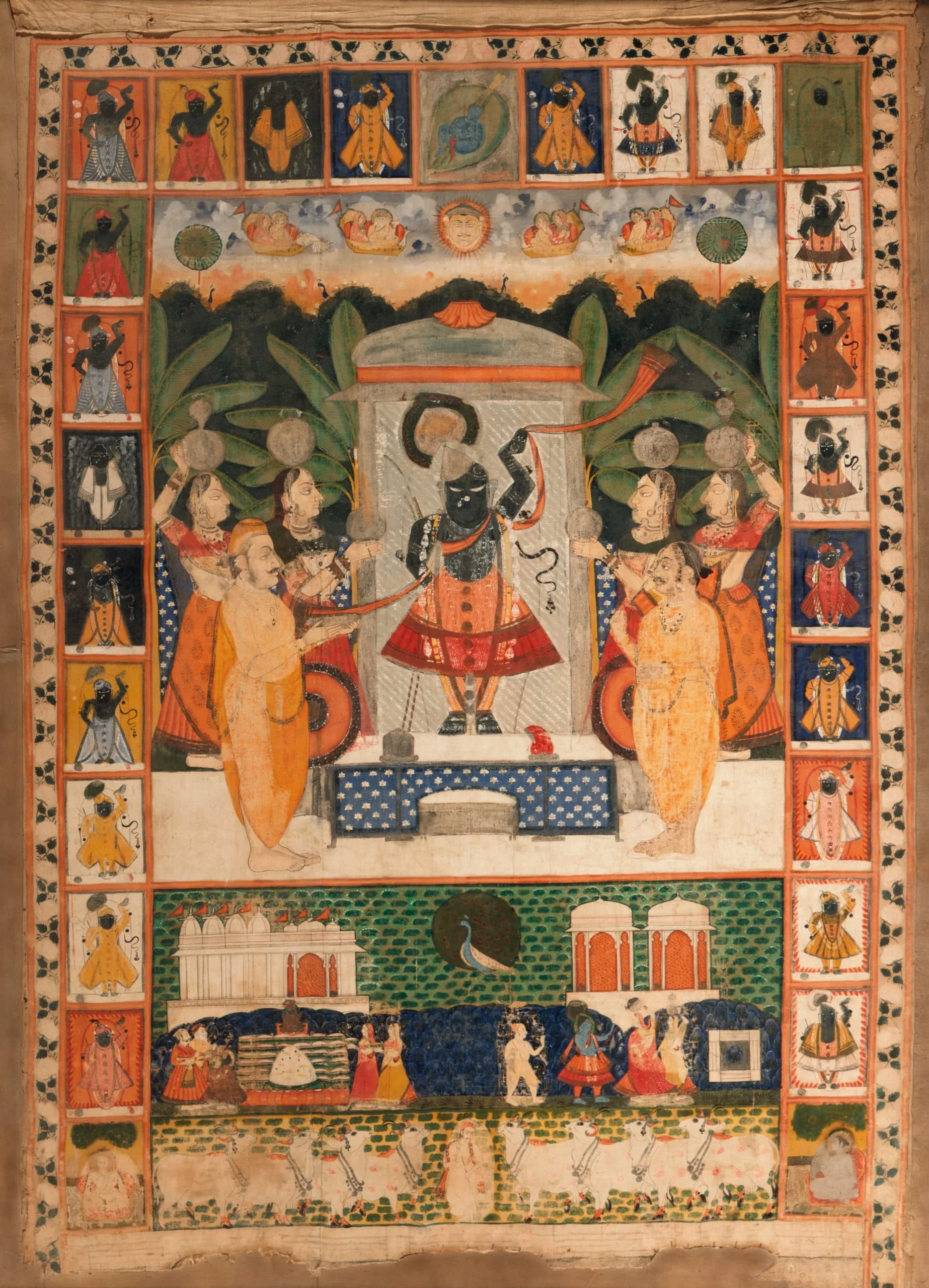
- Govardhanlal (officiated 1877-1934) Worshipping Shri Nathji During Danalila
- Date Made
- 1900-1925
- Medium
- Opaque watercolor on cloth
- Dimensions
- Sheet and image: 80 x 57 1/4 in. (203.2 x 145.41 cm)
- Accession Number
- AC1995.102.1
- Curatorial Notes
Shri Nathji is the preeminent form of the Hindu god Krishna who is worshipped by the Vallabha Sampradaya religious community founded in the 16th century. Shri Nathji is typically shown with his left hand upraised to symbolize his holding Mt. Govardhan aloft to protect the people of Vrindavan from a torrential thunderstorm unleashed by Indra, the king of the gods. Images of Shri Nathji at the pilgrimage town of Nathadwara are dressed by Vallabha priests in twenty-four modes of adornment (shringaras) according to the annual major festivals reenacting episodes from Krishna’s life. During the festivals painted textiles (pichhwai) decorated with iconographic compositions relating to the specific celebrations are displayed.
This pichhwai depicts the chief priest (tilakayat) Govardhanlal (officiated 1877-1934) worshipping Shri Nathji during the festival of Danalila. It commemorates the occasion when Krishna encountered the milkmaids (gopis) returning from milking the cows on the slopes of Mt. Govardhan. Krishna had waiting for them at a mountain pass and requested some of their milk as a toll (dana). When they refused, he caused one of them to spill her pot of milk. The gopis then relented and shared their milk with Krishna. In this painting the gopis are shown balancing pots of milk on their heads and offering them as a toll to the image of Shri Nathji. The yearly cycle of the principal festivals is depicted along the top and sides. See also M.73.22, AC1999.127.41, and M.2010.187.