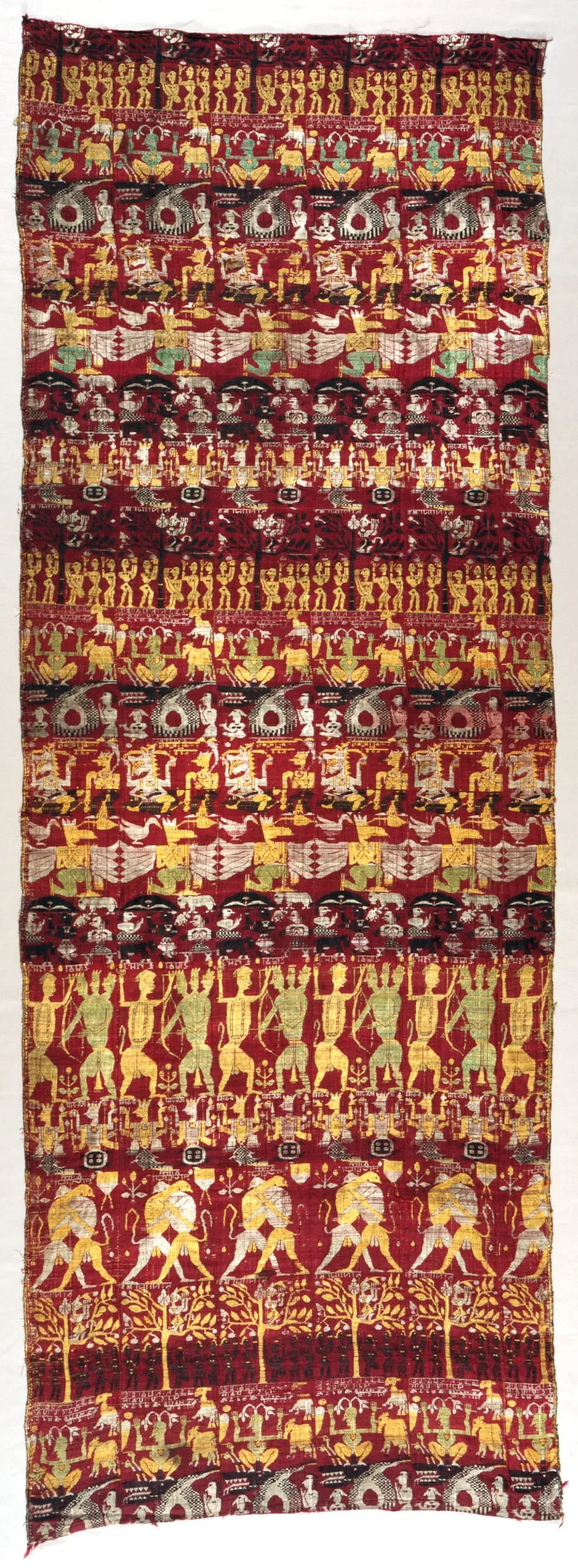
This vibrant, silk textile can be read vertically in horizontal registers, much like a scroll. The principal imagery is based on scenes from the epic Ramayana, the story of the life of Rama, Vishnu’s seventh avatar (incarnation), and on the Bhagavata Purana, which relates the adventures of Krishna, the eighth avatar. Text, in undeciphered Assamese script, probably identifies scenes or provides blocks of scripture. The half-register at the top shows the teasing Krishna playing his flute in a tree as naked milkmaids (gopis) beg him to return their clothes, taken by him while they were bathing. Below, a blue-skinned Krishna dances on the head of the snake king Kaliya. The next register illustrates an incident from the Bhagavata Purana, in which a fierce form of the man-lion Narasimha devours the wicked king Hiranyakashipu. In the following row, with wings outstretched, is the kneeling Garuda, the man-bird mount of Vishnu. Underneath him is a scene of Krishna lifting Mount Govardhan to protect the cows and cowherds from a storm. The two double registers contain scenes from the Ramayana. In the first, the multiheaded demon Ravana (blue) battles the monkey king Hanuman (yellow). In the second, two monkeys are locked in struggle. Alternating figures of Vishnu’s fish and turtle avatars—matsya and kurma—divide the scenes.
The textile is known as a Vrindavani Vastra (Cloth of Vrindavan), after the town in northern India where, according to legend, the Hindu god Krishna spent his youth. It might have been used as an altar cloth or hanging. Its detailed imagery is a result of the complex lampas weaving technique, which employs two sets of warps and wefts. One set provides the textile’s fundamental structure, while a second weft “floats” across several warps creating the slightly raised pattern.