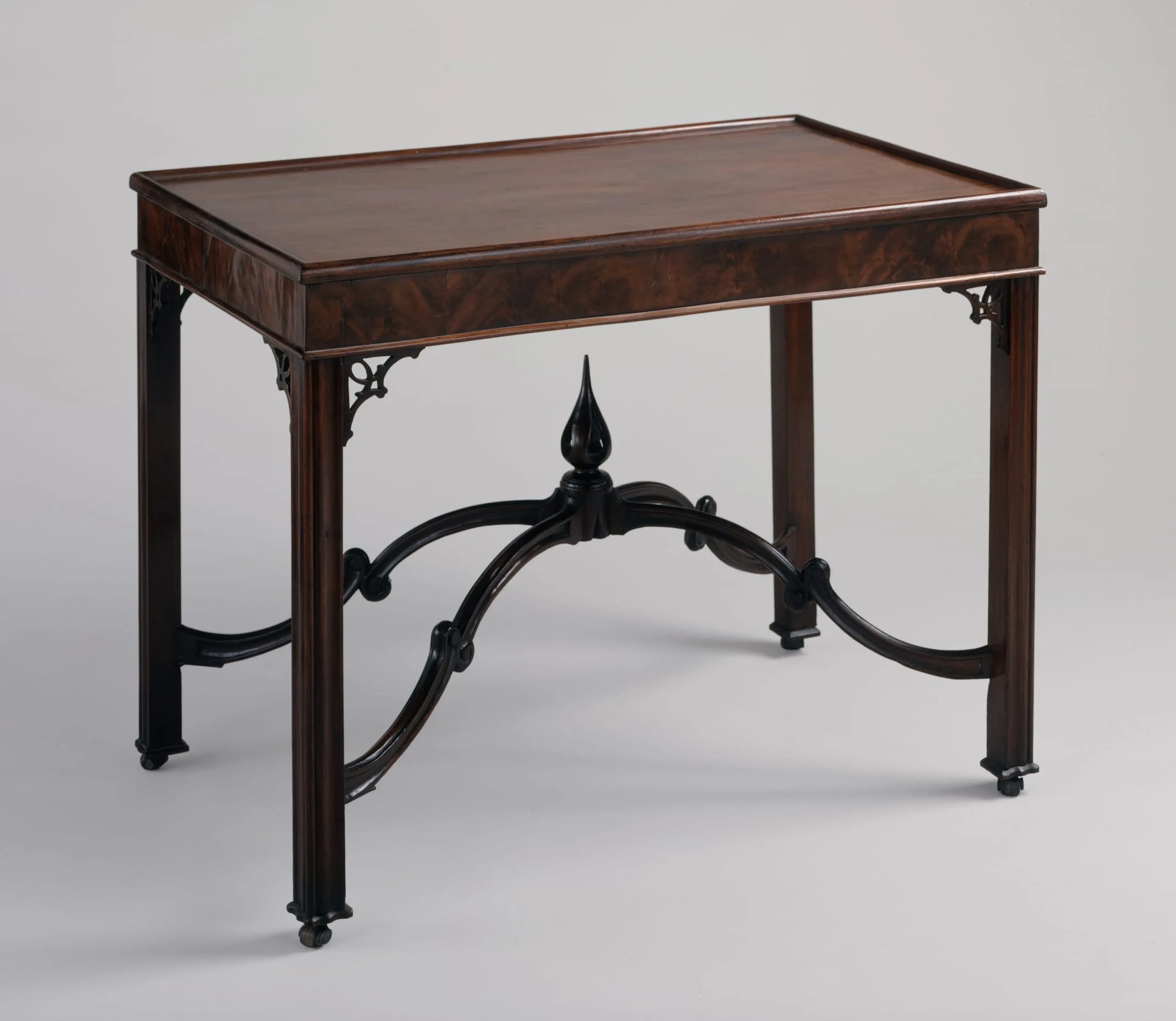
In wealthy households in the eighteenth century, serving and drinking tea was far from a simple, informal affair. It involved rules of etiquette and specific implements for drinking and serving, including a tea table. Tea itself, first imported to Europe from China in the seventeenth century and believed to be good for one’s health, was costly. Tea services made of silver or porcelain were equally precious, and before long, furniture makers created tables designed specifically to hold and display them. This example, known as a tea or “china” table at the time, represented the height of London fashion when it was made, probably around 176575, in Portsmouth, New Hampshire. It resembles designs published a decade earlier by London cabinetmaker Thomas Chippendale in his Gentleman and Cabinet-Maker’s Director, a volume of engraved designs whose influence extended well beyond England to its American colonies.
In Portsmouth, the English-trained cabinetmaker Robert Harrold, possibly the maker of this table, produced some of the most sophisticated expressions of the Rococo style in colonial America. With dramatically figured mahogany veneers, stretchers that sweep upward to a carved finial, pierced brackets, and columnar legs, the table may originally have had a low railing around the top to prevent ceramics from sliding off. Only seven other tables of this design are known today, all with histories of ownership in Portsmouth. Around the same time, Harrold was also creating furniture commissioned by the royal governor. If one imagines this table set with silver and Chinese porcelain, it is easy to picture it as the striking centerpiece of a well-furnished parlor where tea was served.