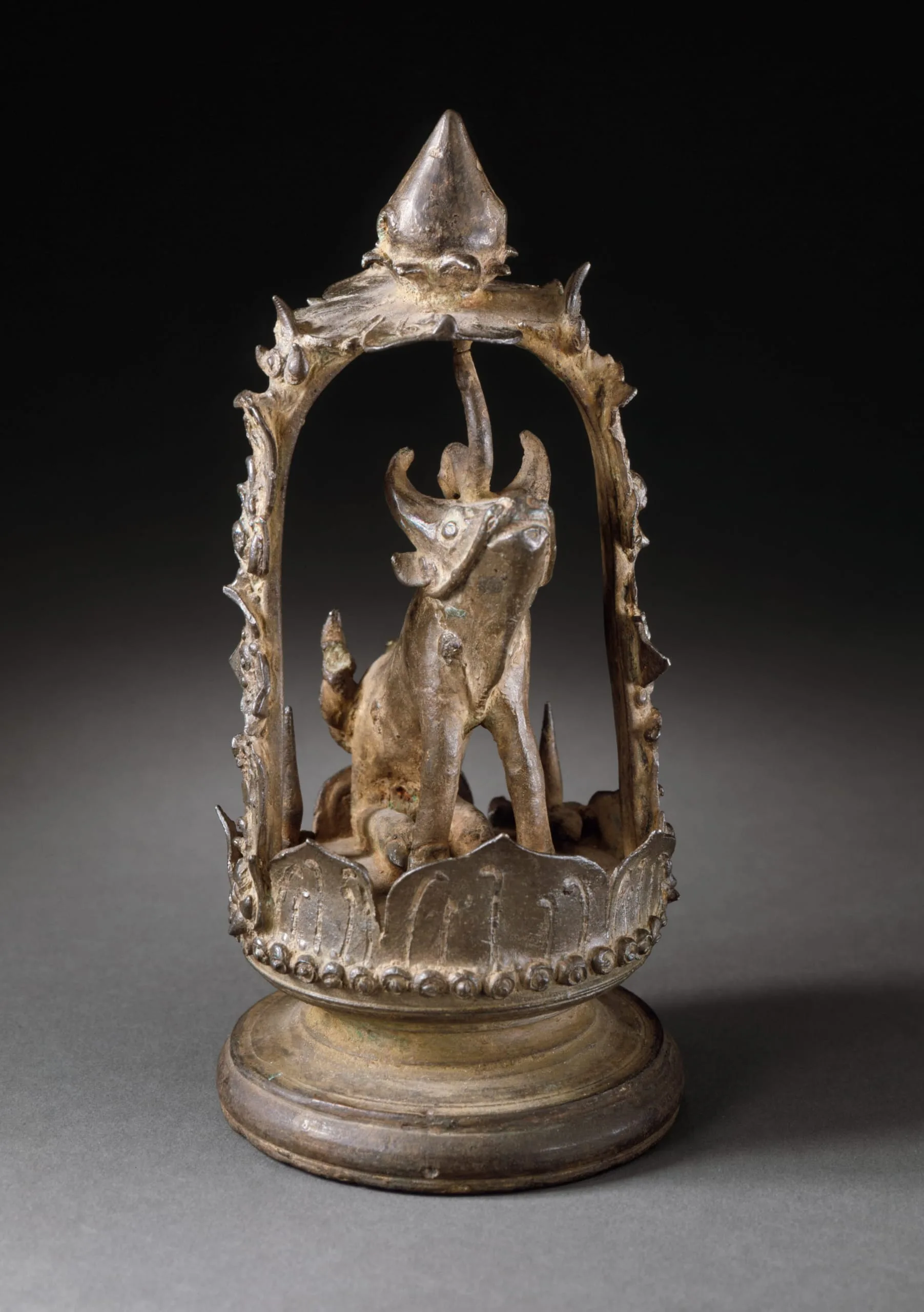
Ornate oil lamps may have entered the artistic traditions of Southern Asia through early trade contact with Roman and Byzantine oil lamps. They have long been used in places of worship and for domestic rituals by adherents of all the major religions throughout the diverse regions of South Asia, Southeast Asia, and the Himalayas. Burning oil lamps help demarcate and purify a sacred space, and they can symbolize a practitioner’s enlightenment. Typically made of brass, bronze, or earthenware (see M.84.213.62), they can be hung from chains such as this example (see also 78.10, M.91.232.3, and AC1992.271.1), mounted on pedestals (see M.79.152.50a-b and M.78.23a and .23b) or stands (see 82.5, M.84.227.8, AC1993.152.1, and AC1995.152.1), or hand-held (see M.91.204). The fuel can be animal fat, such as clarified butter (ghee), or various plant-based oils that is contained in reservoirs or small burner dishes often ovate in shape with depressed corners. The fuel is ignited with a protruding or floating fiber wick. Figural oil lamps were fashioned in a wide variety of conceptual forms, including anthropomorphic, zoomorphic, phytomorphic, abstract, and combined creations. See Sean Anderson, Flames of Devotion: Oil Lamps from South and Southeast Asia and the Himalayas (Los Angeles: UCLA Fowler Museum of Cultural History, 2006).
This lamp was likely a hanging lamp, as the lotus bud finial on the blossoming lotus arch may have originally been encircled with a trilobed hanging loop. Beneath the arch, a bull crouches on his haunches and rears upward. In Javanese culture, the bull symbolizes immense strength, resilience, agricultural fertility, and community heritage. They are believed to guide souls to the afterlife. Upright lotus petals form an enclosure border at the bull’s foot level. The lamp has a pedestal base.