- Maker
- John Seymour
United States, Massachusetts, Boston, 1738-1818 - Title
- Tambour Desk
- Date Made
- 1794-1804
- Medium
- Mahogany, satinwood inlays, pine, and ivory
- Dimensions
- 62 × 41 × 20 in. (157.48 × 104.14 × 50.8 cm)
- Accession Number
- M.2001.75.3
- Curatorial Notes
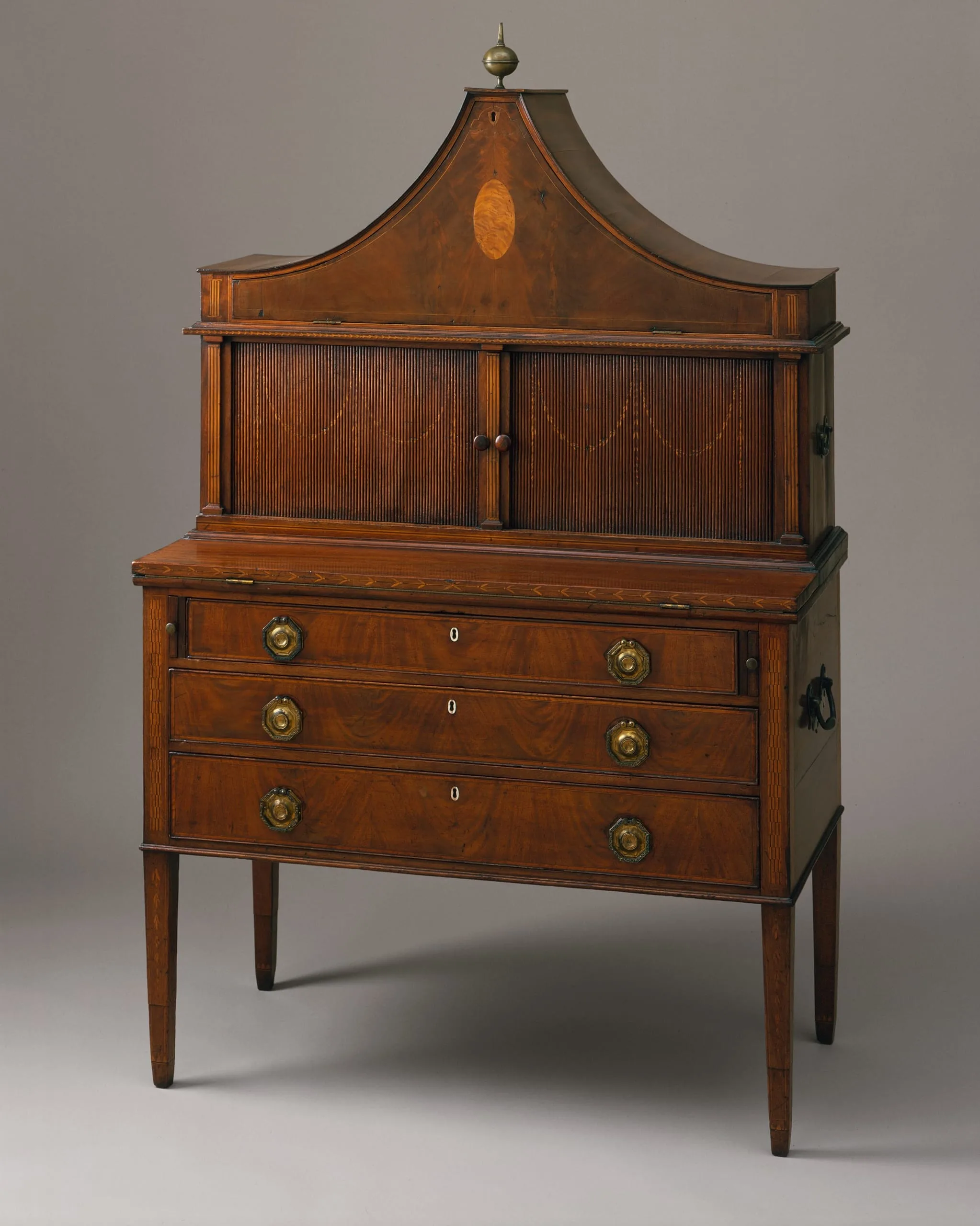
A tambour door is composed of thin strips of wood glued to a canvas backing. The distinctive form of this desk, with its curved pediment and sliding tambour doors, was a signature design developed by John Seymour, an English-trained cabinetmaker who emigrated to Portland, Maine, in 1784 with his son Thomas. A decade later, father and son settled in Boston, where they produced a wide range of furniture in the latest English fashion and soon established themselves among the city’s leading cabinetmakers of the early national period. This desk is one of only four known examples of this design. Although not marked or labeled, its construction details, dramatically figured veneers, and delicate inlaid ornament are consistent with other desks signed and labeled by the Seymours, including one that descended from mother to daughter over several generations. That history supports the theory that these desks were intended for women. Drawers and compartments behind the tambour shutters allowed one to organize letters, papers, and writing implements. The hinged board that separates the upper and lower cases opens to form a writing surface.
- Selected Bibliography
- Los Angeles County Museum of Art. New York: Thames and Hudson, 2003.