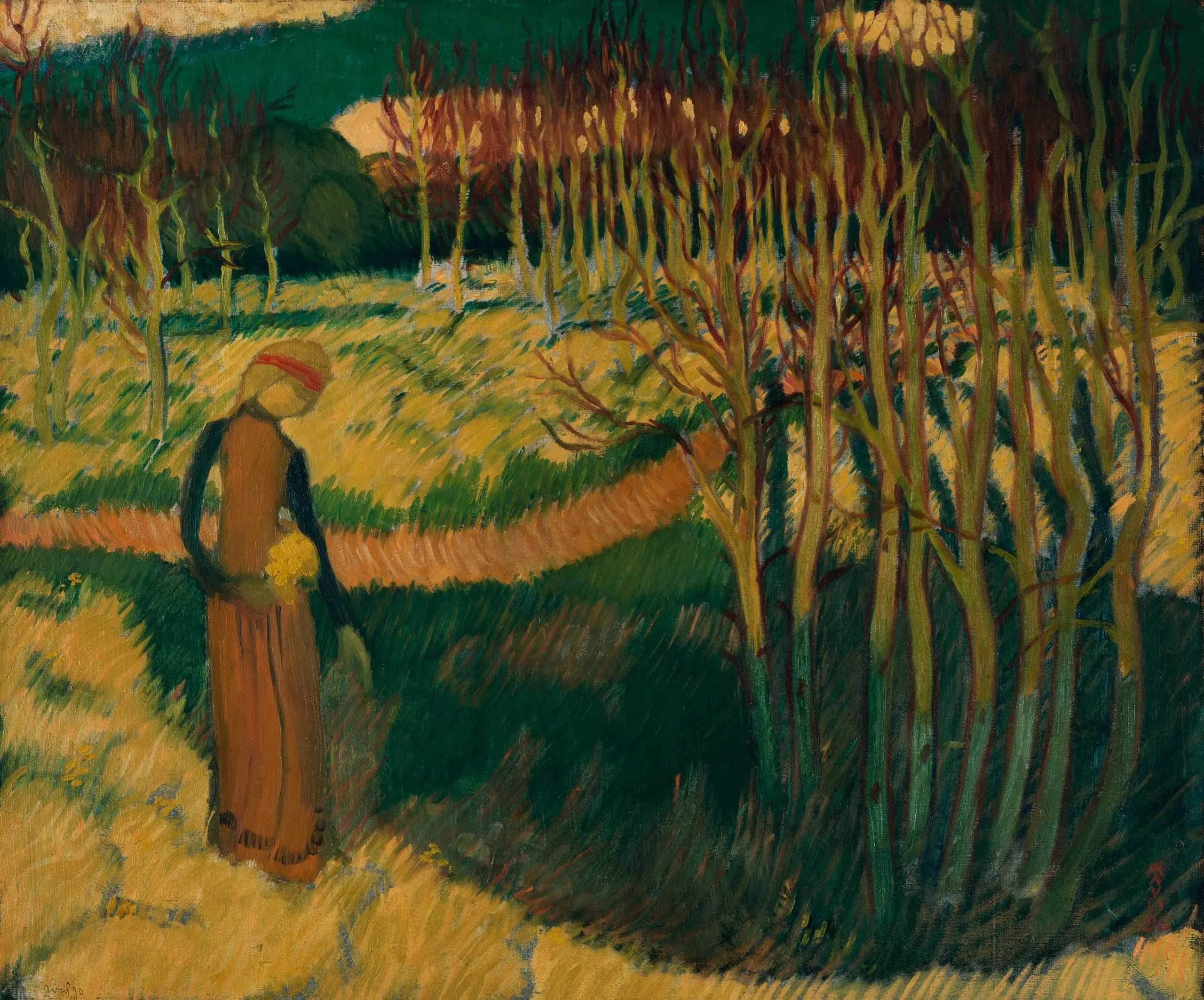
In 1888, along with Paul Sérusier, Pierre Bonnard, Édouard Vuillard, and others, Maurice Denis founded the artist group called the Nabis (Hebrew for “prophets”). These young artists rejected the illusionistic and representational painting learned at the Académie Julian in favor of expressing ideas and emotion through color and form. In addition to turning away from academic forms, they embraced decorative and graphic arts, collaborating with publishers, printmakers, and designers. Denis was not only an artist but a writer and theorist, whose literary contributions like the manifesto “Définition du Néo-traditionnisme” (1890) defined the Nabis movement.
LACMA’s Motif Romanesque displays many of the formal qualities valued by the group, particularly the loose handling of paint and blocks of vibrant colors. Here, a woman gathers yellow flowers on the outskirts of a wooded area. A clump of thin, bare trees, outlined in reddish brown paint, forms a solid mass in a grassy field that vibrates with short, diagonal brushstrokes of yellow and green. A devout Catholic, Denis often created images with religious overtones, but the theme of Motif Romanesque is ambiguous. Does the title reference religious art produced during the eleventh and twelfth centuries, or is it a nod to the perceived innocence and spiritual authenticity of that period expressed in a contemporary subject?
Denis exhibited the painting at the Salon des Indépendants in 1891, along with seven other canvases, a fan design, and illustrations for Paul Verlaine’s poetry collection, Sagesse. This exhibition was an outgrowth of the Salon des Refusés, where artists whose pieces had been rejected from the state-sanctioned Salon could display their work. Begun in 1884 and promoted as an artist-led exhibition free of jury restrictions and prizes, the Salon des Indépendants would showcase some of the most significant modern art of the late nineteenth and early twentieth centuries.
2024