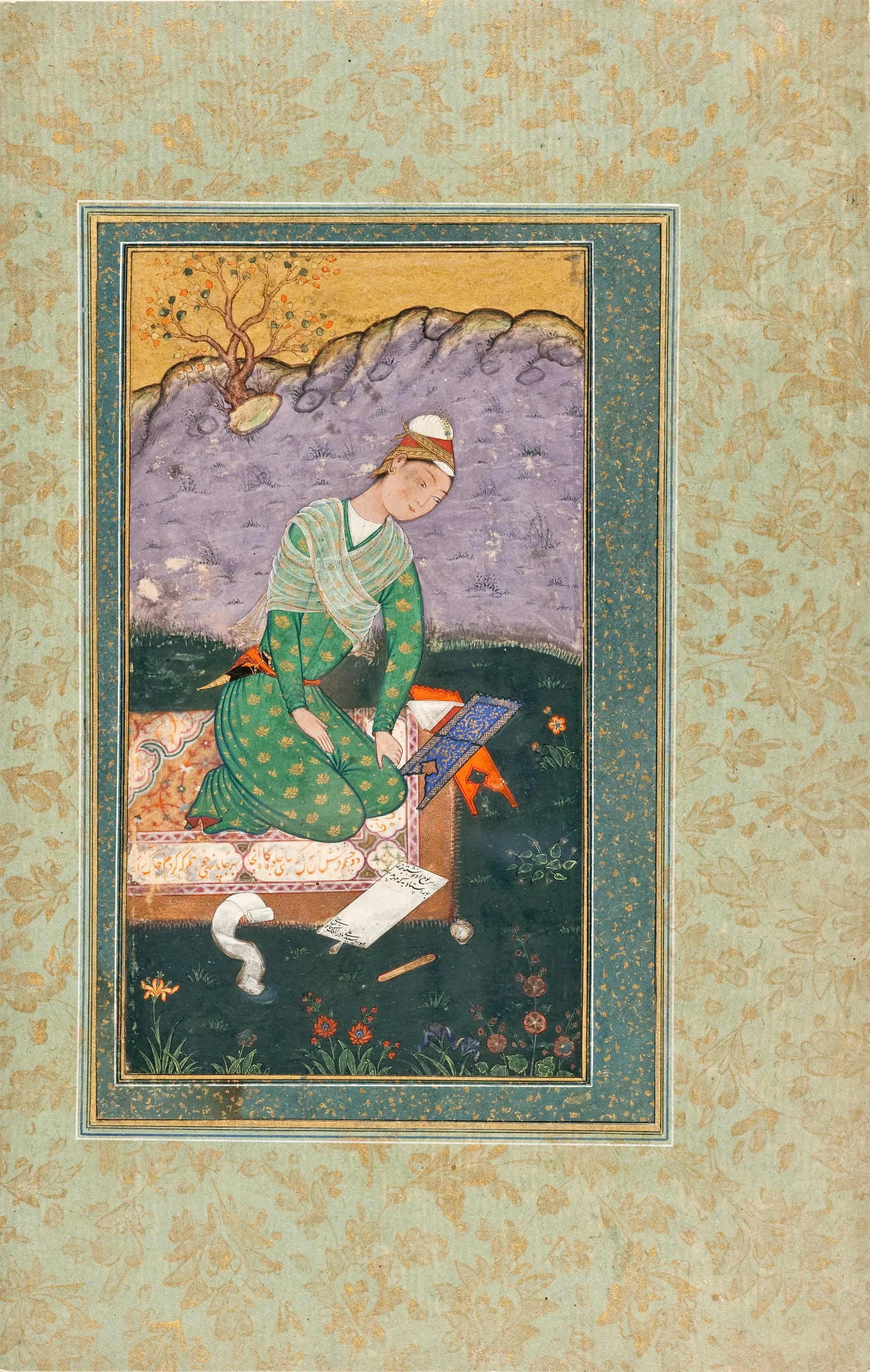
The arts of the book in early modern Iran and India are closely allied, sharing techniques, materials, styles, formatting practices, and a Persianate literary and historical tradition. A key part of this relationship was the circulation of illustrated manuscripts and especially the associated artists, traveling primarily from Iran to India. This charming painting by Mir Sayyid ‘Ali provides important evidence of this artistic route and its impact on the genesis of early Mughal painting.
Mir Sayyid ‘Ali was the son of the painter Mir Musavvir and, like his father, worked at the court of the Safavid ruler Shah Tahmasp (r. 1524−76) in Tabriz. The Mughal emperor Humayun (r. 1530−40 and 1555−56), who briefly took refuge at the Safavid court during his fifteen-year period of exile, became interested in artists of the royal atelier, extending some of them an invitation to join his retinue. Mir Sayyid ‘Ali (along with ‘Abd al-Samad; see M.2010.54.2 and M.78.9.11) was among the first to accept Humayun’s offer. He entered Humayun’s service in either 1549 or 1552, although it was not until 1555 that the emperor was restored to his throne in Delhi.
Just below the seated youth, the signature at the bottom of the writing tablet indicates that the artist was already well established and admired at Humayun’s court. It reads: “Depicted by Sayyid ‘Ali, the rarity of the kingdom of Humayun Shah.” Richly clad in a gold-brocaded robe in an Indian rather than Persian manner, the sitter is surrounded by the accoutrements of a scholar: an open book on a stand, a rolled scroll, a pencase and inkwell, and the writing tablet. Some contemporary scholars have proposed that the painting is a self-portrait or else a portrait. Given that the artist was likely in his forties at the time the image was made, it seems improbable that he would have portrayed himself as a beardless young man, while the figure’s features and demeanor suggest a generic type rather than an exacting likeness.
As compared with Mir Sayyid ‘Ali’s known works from Iran, this painting shows subtle changes in his style, including greater dimensionality and a stronger sense of space, while it retains a typically Persian interest in color and attention to detail, all of which will inform subsequent Mughal painting. The ingenious way in which the inscriptions are integrated into the composition, such as the Persian couplet on the rug, is another carryover from Iran in general and this artist in particular. Like the signature below, the inscription at the top of the writing tablet, which implies that the strictness of the master is better than the kindness of the father, may be personal to the artist, whose father was his teacher.
Mir Sayid ‘Ali retained his high status in the Mughal imperial atelier under Humayun’s son and successor Akbar (r. 1556−1605). From 1562 until his death in 1572, he directed the first extensive manuscript project of Akbar’s reign, the Hamzanama (see M.78.9.1). He also likely taught younger artists, but apart from the present painting, which is signed, and a few attributed works, there is little preserved visual evidence from his time in India.