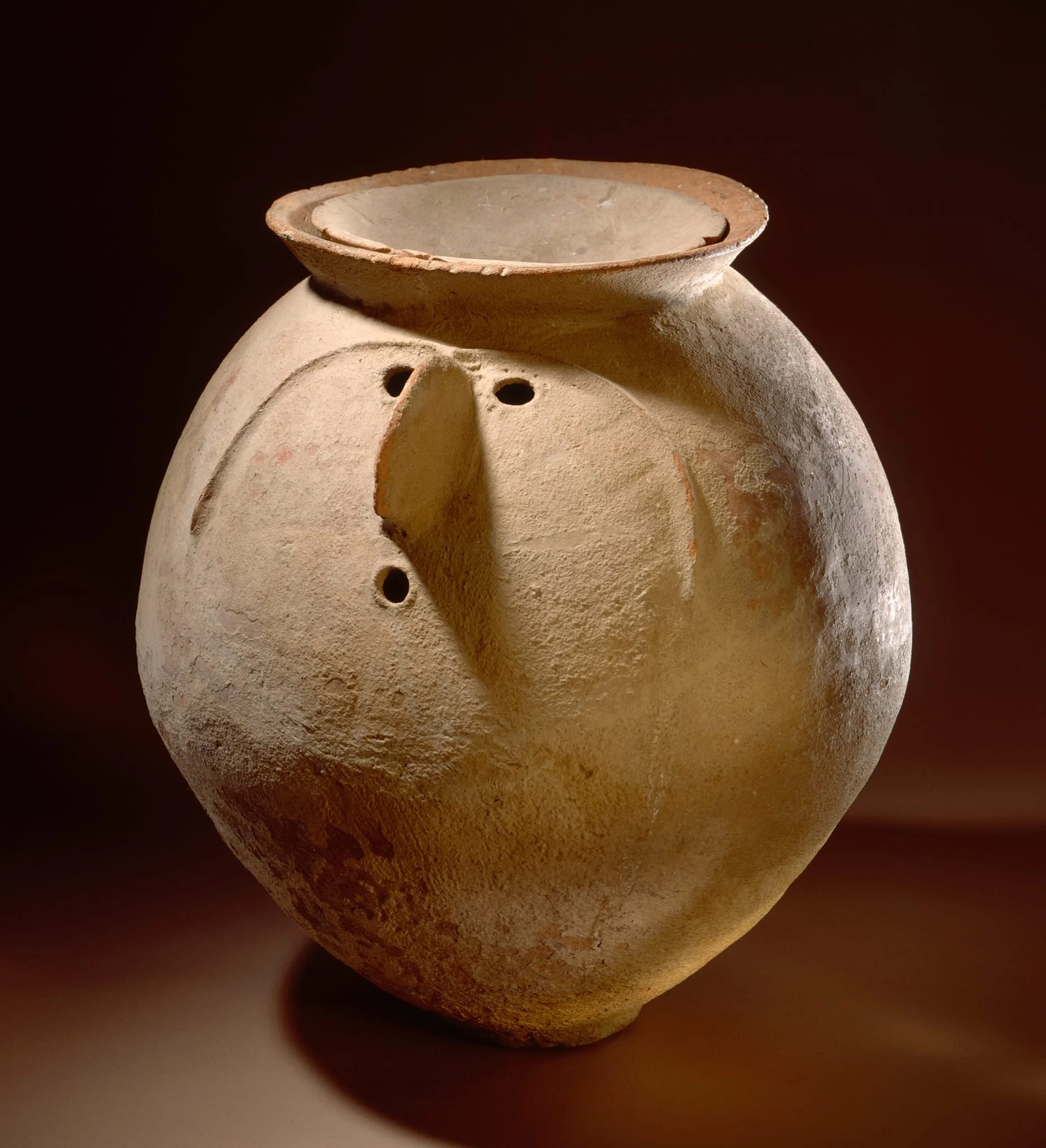
Extraordinary in its aesthetic sensitivity, the hauntingly expressive, stylized face on the burial urn transforms this otherwise functional object into a powerful work of art. It was created in the protohistoric Gandhara Grave Culture (1500-600 BCE) in present-day Pakistan, whose remains primarily consist of pottery and various implements and grave goods. Intriguingly, the distinctive quarter-circle-shaped nose that juts out prominently is curiously reminiscent of the stylized noses found on anthropomorphic ossuaries (personified funerary boxes used for secondary burials) from ancient Israel dating from the Chalcolithic period, 4500–3500 BCE (now mainly in the collection of the Israel Antiquities Authority).
A closely comparable cremation urn from the Gandhara Grave Culture is in the Virginia Museum of Fine Arts, Richmond (87.453a-b). See Joseph M. Dye, The Arts of India: Virginia Museum of Fine Arts (London: Philipp Wilson, 2001), p. 83, no. 1; and Bridget and Raymond Allchin, The Rise of Civilization in India and Pakistan (Cambridge: Cambridge University Press, 1982), p. 241, fig. 9.11.